A nurse holds a syringe of a dose of the AstraZeneca Covid-19 vaccine in Guadalajara, Mexico in April 2022. The drug firm is to cease production of the shots. AFP

AstraZeneca withdraws Covid-19 vaccine due to 'lack of demand'


Gillian Duncan
  • English
  • Arabic

AstraZeneca has begun the worldwide withdrawal of its Covid-19 vaccine due to a “surplus of available updated vaccines” since the pandemic.

The company said it would proceed to withdraw Vaxzevria's marketing authorisations within Europe.

Regulator, the European Medicines Agency, has confirmed the vaccine is no longer authorised for use.

“As multiple, variant Covid-19 vaccines have since been developed there is a surplus of available updated vaccines,” the company said, adding this had led to a decline in demand.

The Anglo-Swedish drugmaker's decision came after a statement to the High Court in London in February confirmed that its vaccine “can, in very rare cases, cause TTS” (Thrombosis with Thrombocytopenia Syndrome), a form of blood clot.

Cases were found in people with a low blood platelet count.

It is estimated that between two and three per 100,000 people who were vaccinated had this adverse effect.

Adam Finn, professor of paediatrics at the University of Bristol and head of the Bristol Children's Vaccine Centre, said the the withdrawal is likely not related to the rare side effect.

He told Radio 4's Today show on Wednesday: "It's turned out that this virus is very agile, and it's evolved away from the original vaccines. So they have in a sense become irrelevant and only the reformulated vaccines are likely to be being used now.

"And of course, we're in a very different place, with almost everyone at the population immune to Sars-CoV-2. So the need for this vaccine I think has evaporated now."

Nevertheless, the relationship between the vaccine and TTS has been known for some time, he said.

AstraZeneca vaccine - in pictures

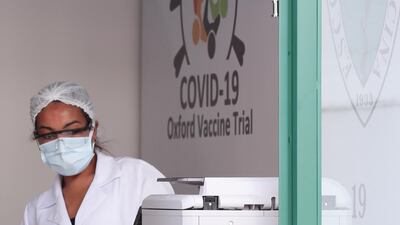
  • An employee is pictured at the Reference Centre for Special Immunobiologicals (CRIE) of the Federal University of Sao Paulo, Brazil, where the trials of the Oxford/AstraZeneca coronavirus vaccine are conducted. Amanda Perobelli / Reuters
    An employee is pictured at the Reference Centre for Special Immunobiologicals (CRIE) of the Federal University of Sao Paulo, Brazil, where the trials of the Oxford/AstraZeneca coronavirus vaccine are conducted. Amanda Perobelli / Reuters
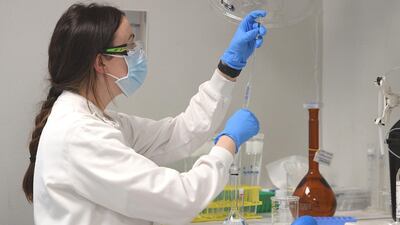
  • A chemist works at AstraZeneca's Sydney labs after Prime Minister Scott Morrison announced Australians will be among the first in the world to receive a coronavirus disease vaccine, if it proves successful. Dan Himbrechts / Australian Associated Press via Reuters
    A chemist works at AstraZeneca's Sydney labs after Prime Minister Scott Morrison announced Australians will be among the first in the world to receive a coronavirus disease vaccine, if it proves successful. Dan Himbrechts / Australian Associated Press via Reuters
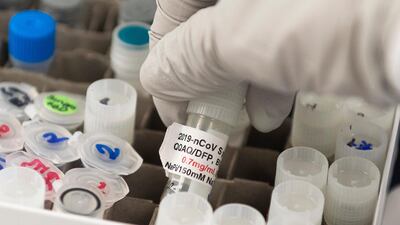
  • AstraZeneca's vaccine was among the furthest along in development. AFP
    AstraZeneca's vaccine was among the furthest along in development. AFP
  • Technicians work at the mAbxience biopharmaceutical company on an experimental coronavirus vaccine developed by Oxford University and the laboratory AstraZeneca in Garin, Argentina. Natacha Pisarenko / AP
    Technicians work at the mAbxience biopharmaceutical company on an experimental coronavirus vaccine developed by Oxford University and the laboratory AstraZeneca in Garin, Argentina. Natacha Pisarenko / AP
  • The single trial volunteer's illness is not seen as a significant setback, despite the publicity surrounding it. Paul Ellis / AFP
    The single trial volunteer's illness is not seen as a significant setback, despite the publicity surrounding it. Paul Ellis / AFP
  • Australian Prime Minister Scott Morrison tours AstraZeneca's Sydney laboratories in September as the government signs a deal with the British-Swedish firm for a supply of a Covid-19 vaccine. EPA
    Australian Prime Minister Scott Morrison tours AstraZeneca's Sydney laboratories in September as the government signs a deal with the British-Swedish firm for a supply of a Covid-19 vaccine. EPA

He added: "It's completely clear that this vaccine and the other one [using] this platform, a viral vector from Johnson & Johnson, was associated with this thrombocytopenic thrombosis syndrome. I think that's been clear for a long time, although perhaps only recently acknowledged.

"But I don't think that's really relevant to this withdrawal. I think the withdrawal of the vaccine is simply reflects the fact that it's no longer useful and so not going to be being used anymore."

The firm's application to withdraw the vaccine was made on March 5 and came into effect on May 7, according to the UK's Daily Telegraph.

Patients who say they were left with permanent health problems and are suing the drug maker, though some cases were recently dropped after being told the presence of a small print warning means their case would probably fail.

Gareth Eve, whose BBC radio presenter wife Lisa Shaw died three weeks after receiving her first dose, is among a number of parties who have pulled out of the High Court legal action.

Award-winning BBC radio presenter Lisa Shaw, who died due to complications from the AstraZeneca Covid-19 vaccine. PA

They were told their claim was unlikely to succeed because a leaflet, handed out at vaccination centres, warned of “extremely rare cases of blood clots with low levels of platelets” after vaccination with the AstraZeneca shot.

It is believed the warning, issued on April 7, 2021, could protect AstraZeneca from cases in which relatives died after receiving vaccines beyond that date.

A dozen families have now dropped out of the legal action as a result.

But more than 50 of relatives of people who received the vaccine before the warning was added are continuing with the lawsuit.

The vaccine, developed with scientists from the University of Oxford, was seen as pivotal given its low cost and the fact it could be stored in a normal fridge rather than super-cold storage.

London-listed AstraZeneca began moving into respiratory syncytial virus vaccines and obesity drugs through several deals last year after a slowdown in growth as Covid-19 medicine sales declined, Reuters reported.

Scientists are still learning much about the effects of Long Covid, which is thought to affect millions of people.

Great hope

The launch of the AstraZeneca vaccine was seen as a milestone in the battle against the Covid-19 pandemic.

The first clinical trial for the vaccine started in January 2020, around the same time when reports of the first cases emerged in China.

It built on previous work to create an adenovirus-based vaccine against the Middle Eastern Respiratory Syndrome (MERS) coronavirus, making it a case of ‘copying and pasting’ the genetic code for the spike protein for the virus that causes Covid into the platform's harmless chimp adenovirus to create the ChAdOx1 nCoV-19 vaccine.

By early February, the lab had tested a lab version of the vaccine in mice, which revealed strong immune responses, suggesting the vaccine would work.

Human volunteers received their first doses in April 2020.

NHS staff administer the Oxford-AstraZeneca Covid-19 coronavirus vaccine in St Helens, United Kingdom. Getty Images

On 23 November 2020, it was announced the vaccine was successful, with 70.4% efficacy in preventing symptomatic Covid more than 14 days after receiving two doses of the vaccine.

"We were involved in Bristol in collaboration with Oxford a number of other centres in doing research on this vaccine and I very clearly remember the day in November 2020, when the results came through. And it turned out that it worked," said Prof Finn.

"And we were able to see very early on that even just one dose of this vaccine was saving many, many lives.

"It was a very remarkable period and we really didn't know what to expect, as it came through. Of course, we've never had the experience of developing a vaccine in such a short period of time. But the truth is, it made an enormous difference. It was what as you said at the beginning was what lifted us out of the catastrophe that was unfolding at the time, combined with the other vaccine from Pfizer."


The six points:

1. Ministers should be in the field, instead of always at conferences

2. Foreign diplomacy must be left to the Ministry of Foreign Affairs and International Co-operation

3. Emiratisation is a top priority that will have a renewed push behind it

4. The UAE's economy must continue to thrive and grow

5. Complaints from the public must be addressed, not avoided

6. Have hope for the future, what is yet to come is bigger and better than before

The biog

Favourite film: Motorcycle Dairies, Monsieur Hulot’s Holiday, Kagemusha

Favourite book: One Hundred Years of Solitude

Holiday destination: Sri Lanka

First car: VW Golf

Proudest achievement: Building Robotics Labs at Khalifa University and King’s College London, Daughters

Driverless cars or drones: Driverless Cars

How Islam's view of posthumous transplant surgery changed

Transplants from the deceased have been carried out in hospitals across the globe for decades, but in some countries in the Middle East, including the UAE, the practise was banned until relatively recently.

Opinion has been divided as to whether organ donations from a deceased person is permissible in Islam.

The body is viewed as sacred, during and after death, thus prohibiting cremation and tattoos.

One school of thought viewed the removal of organs after death as equally impermissible.

That view has largely changed, and among scholars and indeed many in society, to be seen as permissible to save another life.

Mercer, the investment consulting arm of US services company Marsh & McLennan, expects its wealth division to at least double its assets under management (AUM) in the Middle East as wealth in the region continues to grow despite economic headwinds, a company official said.

Mercer Wealth, which globally has $160 billion in AUM, plans to boost its AUM in the region to $2-$3bn in the next 2-3 years from the present $1bn, said Yasir AbuShaban, a Dubai-based principal with Mercer Wealth.

Within the next two to three years, we are looking at reaching $2 to $3 billion as a conservative estimate and we do see an opportunity to do so,” said Mr AbuShaban.

Mercer does not directly make investments, but allocates clients’ money they have discretion to, to professional asset managers. They also provide advice to clients.

“We have buying power. We can negotiate on their (client’s) behalf with asset managers to provide them lower fees than they otherwise would have to get on their own,” he added.

Mercer Wealth’s clients include sovereign wealth funds, family offices, and insurance companies among others.

From its office in Dubai, Mercer also looks after Africa, India and Turkey, where they also see opportunity for growth.

Wealth creation in Middle East and Africa (MEA) grew 8.5 per cent to $8.1 trillion last year from $7.5tn in 2015, higher than last year’s global average of 6 per cent and the second-highest growth in a region after Asia-Pacific which grew 9.9 per cent, according to consultancy Boston Consulting Group (BCG). In the region, where wealth grew just 1.9 per cent in 2015 compared with 2014, a pickup in oil prices has helped in wealth generation.

BCG is forecasting MEA wealth will rise to $12tn by 2021, growing at an annual average of 8 per cent.

Drivers of wealth generation in the region will be split evenly between new wealth creation and growth of performance of existing assets, according to BCG.

Another general trend in the region is clients’ looking for a comprehensive approach to investing, according to Mr AbuShaban.

“Institutional investors or some of the families are seeing a slowdown in the available capital they have to invest and in that sense they are looking at optimizing the way they manage their portfolios and making sure they are not investing haphazardly and different parts of their investment are working together,” said Mr AbuShaban.

Some clients also have a higher appetite for risk, given the low interest-rate environment that does not provide enough yield for some institutional investors. These clients are keen to invest in illiquid assets, such as private equity and infrastructure.

“What we have seen is a desire for higher returns in what has been a low-return environment specifically in various fixed income or bonds,” he said.

“In this environment, we have seen a de facto increase in the risk that clients are taking in things like illiquid investments, private equity investments, infrastructure and private debt, those kind of investments were higher illiquidity results in incrementally higher returns.”

The Abu Dhabi Investment Authority, one of the largest sovereign wealth funds, said in its 2016 report that has gradually increased its exposure in direct private equity and private credit transactions, mainly in Asian markets and especially in China and India. The authority’s private equity department focused on structured equities owing to “their defensive characteristics.”

World record transfers

1. Kylian Mbappe - to Real Madrid in 2017/18 - €180 million (Dh770.4m - if a deal goes through)
2. Paul Pogba - to Manchester United in 2016/17 - €105m
3. Gareth Bale - to Real Madrid in 2013/14 - €101m
4. Cristiano Ronaldo - to Real Madrid in 2009/10 - €94m
5. Gonzalo Higuain - to Juventus in 2016/17 - €90m
6. Neymar - to Barcelona in 2013/14 - €88.2m
7. Romelu Lukaku - to Manchester United in 2017/18 - €84.7m
8. Luis Suarez - to Barcelona in 2014/15 - €81.72m
9. Angel di Maria - to Manchester United in 2014/15 - €75m
10. James Rodriguez - to Real Madrid in 2014/15 - €75m

COMPANY PROFILE
Name: ARDH Collective
Based: Dubai
Founders: Alhaan Ahmed, Alyina Ahmed and Maximo Tettamanzi
Sector: Sustainability
Total funding: Self funded
Number of employees: 4
The%20end%20of%20Summer
%3Cp%3EAuthor%3A%20Salha%20Al%20Busaidy%3C%2Fp%3E%0A%3Cp%3EPages%3A%20316%3C%2Fp%3E%0A%3Cp%3EPublisher%3A%20The%20Dreamwork%20Collective%C2%A0%3C%2Fp%3E%0A

COMPANY PROFILE

Name: N2 Technology

Founded: 2018

Based: Dubai, UAE

Sector: Startups

Size: 14

Funding: $1.7m from HNIs

SPECS
%3Cp%3E%3Cstrong%3EEngine%3A%20%3C%2Fstrong%3E2.4-litre%204-cylinder%20turbo%20hybrid%0D%3Cbr%3E%3Cstrong%3EPower%3A%3C%2Fstrong%3E%20366hp%0D%3Cbr%3E%3Cstrong%3ETorque%3A%20%3C%2Fstrong%3E550Nm%0D%3Cbr%3E%3Cstrong%3ETransmission%3A%20%3C%2Fstrong%3ESix-speed%20auto%0D%3Cbr%3E%3Cstrong%3EPrice%3A%3C%2Fstrong%3E%20From%20Dh360%2C000%0D%3Cbr%3E%3Cstrong%3EAvailable%3A%20%3C%2Fstrong%3ENow%0D%3C%2Fp%3E%0A
Updated: May 08, 2024, 9:24 AM