


'Disease X' is a common enemy that the world must be prepared to fight together, World Health Organisation director general Dr Tedros Adhanom Ghebreyesus warned on Wednesday.
The name, given to the as yet unknown cause of the next potential pandemic, first appeared on the WHO's list of priority diseases in 2018, the year before Covid-19 emerged in the Chinese city of Wuhan.
“You may even call Covid the first 'disease X'. And it may happen again,” Dr Tedros told a session at Davos.
“Of course there are some people who say, oh, this may create panic. No, it's better, actually, to anticipate something that may happen, because it has happened in our history many times, and prepare for it.”
Dr Tedros said Covid had taught the world many lessons on how to deal with the next pandemic.
Michel Demare, Chairman of the Board of AstraZeneca, told the session countries are not spending enough to prepare for the next pandemic.
“In OECD countries, the average spend on prevention is 3 per cent of the budget of health systems,” he said.
“Obviously, if you spend so little on prevention, you end up spending the majority of your budget on hospitalisation and only treatments.
“So there is a lot of change that needs to happen there.”
In 2021, the WHO outlined plans to create a pandemic treaty that would serve as a blueprint for tackling future global outbreaks.

Dr Tedros told Davos the pandemic treaty will be key in protecting the world from future outbreaks.
But countries have since been involved in significant wrangling over the terms of the treaty, which is not yet finalised.
“Member states are negotiating. This is between countries, and I hope they will deliver this pandemic agreement by that time, on the deadline, because if this generation cannot do it, where they have the first-hand experience, I don't think the next generation will do it,” he said.
“For our children and grandchildren's sake, I think we have to convert all the lessons we have learnt into this pandemic and prepare the world for the future.
“This is a common global interest, and very narrow national interests should not get in the way.”
Bill Gates said innovations like AI could help to address the lack of resources in underdeveloped countries, and added that it was “imperative” to increase aid to these countries.
-

French President Emmanuel Macron (centre), flanked by delegation members, walks through an inflatable tunnel connecting venues at Davos. AFP -

Argentina's President Javier Milei. Reuters -
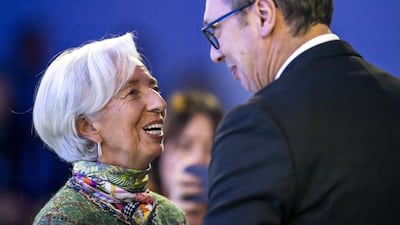
European Central Bank chief Christine Lagarde with Serbia's President Vucic. EPA -

WEF participants gather at Davos Congress Centre. AP Photo -
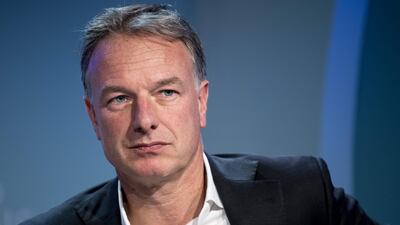
ING Group chief executive Steven van Rijswijk at the World Economic Forum gathering in Davos. AFP -
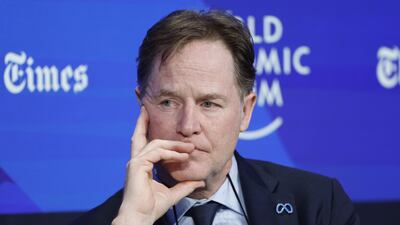
Nick Clegg, president of global affairs and communications with Meta at the WEF. Bloomberg -
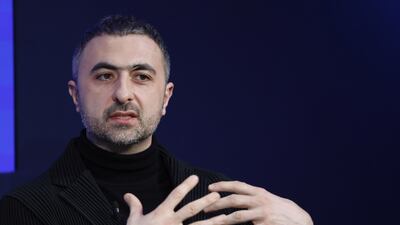
Mustafa Suleyman, co-founder and chief executive officer of Inflection AI, speaking at the event. Bloomberg -
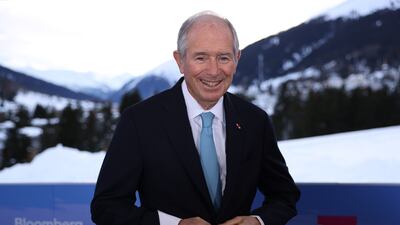
Steve Schwarzman, co-founder and chief executive officer of Blackstone Group, at the Swiss alpine resort. Bloomberg -
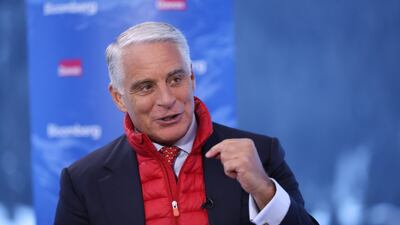
Andrea Orcel, group chief executive of Unicredit, speaking during an interview at the World Economic Forum in Davos, Switzerland. Bloomberg -

Mike Brown, chief executive of Nedbank Group Ltd. Bloomberg -
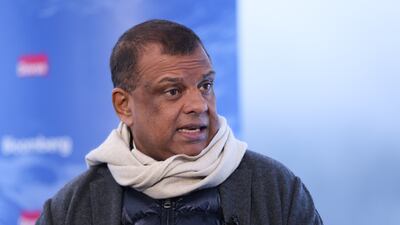
Tony Fernandes, chief executive Capital A Berhad. Bloomberg -
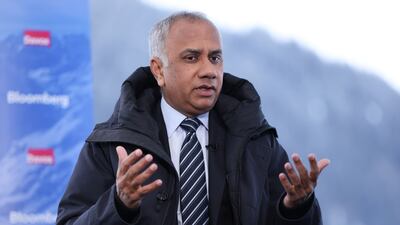
Salil Parekh, chief executive officer of Infosys. Bloomberg -

Julie Sweet, chief executive of Accenture, and Ludovic Subran, chief economist at Allianz SE. Bloomberg -
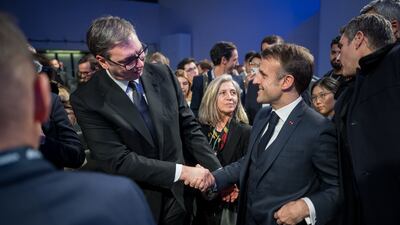
France's President Macron (right) shakes hand with Serbia's President Aleksandar Vucic after his speech. AFP -

Pat Gelsinger, chief executive of Intel. EPA -
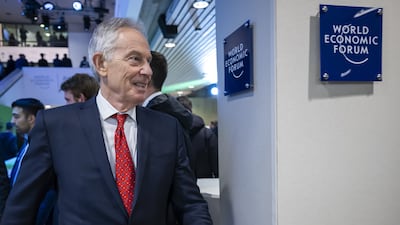
Former British prime minister Tony Blair. EPA -

Jamie Dimon, chief executive of JP Morgan Chase. Bloomberg -
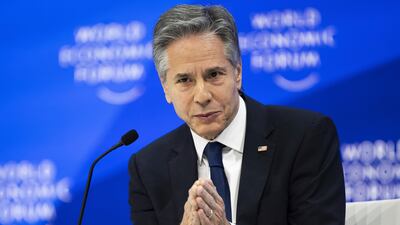
US Secretary of State Antony Blinken. AP -
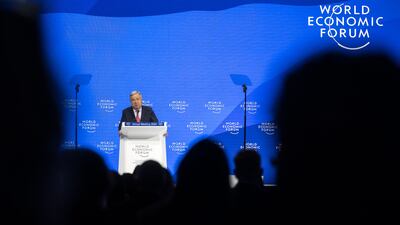
Antonio Guterres, UN Secretary General, addresses the assembly. AFP -

Former US vice president Al Gore speaks. Reuters


Mr Gates highlighted three areas where action could be taken to address shortages in areas including nutrition and health care.
“There’s no doubt we find ourselves in a juncture where demand for resources exceeds the resources available,” he said, during a discussion on the schism between the Global North and South at Davos.
“There are three things we can do to improve the system where we have shortages. One, we should try to be more generous, those who have the most should be pushing to be more generous.
“Two, focus on higher impact areas. We need to go to countries and say, what are your priorities? Health? Nutrition? Education?
“Three, innovation. There has been far too little innovation in the Global South, whether malaria or crops, wheat, rice. The amount put into that agricultural economy is much less than it should be. The system of co-operation sometimes achieves miracles.”

