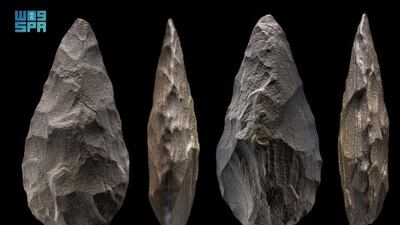
One of the world's oldest Acheulean sites was found in the northern region of Hail in Saudi Arabia.
The discovery of the oldest human habitation in the Arabian Peninsula was revealed in an article in Nature Scientific Report, the Saudi Press Agency reported.
The site, Al Nasim, has paleo-environmental evidence for freshwater lakes and rivers, and geomorphological features associated with Middle Pleistocene materials.
The Saudi Commission for Tourism and National Heritage began paleo-environmental and archaeological surveys of the Green Arabian Project more than 10 years ago in partnership with the German Max Planck Society, the University of Oxford, the Saudi Geological Survey and King Saudi University in Riyadh.
The survey reveals that the Arabian Peninsula had wetter conditions and a rainy climate in the central region.
This led to the formation of lakes, rivers, valleys and vegetation that contributed to a better way of living for human beings and altered the spatial distribution of hominins within and between continents.
Archaeological studies also suggest that the earliest living man inhabited South-West Asia and that the Acheulean civilisation had one of the longest-lasting tool-making traditions.
The artefacts found included hand axes and stone tools, providing an insight about the inhabitants’ way of living.
“Al Nasim represents one of the oldest documented Acheulean sites in Saudi Arabia, revealing regionally diverse stone tool assemblages used by Middle Pleistocene man, which further indicates a pattern of repeated entry of inhabitants into the peninsula during the wet ‘Green Arabia’ phase,” the SPA reported.
The site comprises a deep, narrow basin where several Palaeolithic artefacts were recovered, which are similar to those previously found at the Acheulean sites in the Nefud Desert.
The similarity between the Acheulean discoveries in Al Nasim and those in the Nefud Desert indicate that the paleolakes of this region provided an important corridor for humans to travel and meet others.
____________
Read more: Saudi Arabia’s Al Ula archaeologists unearth Gulf’s first domesticated dogs
-
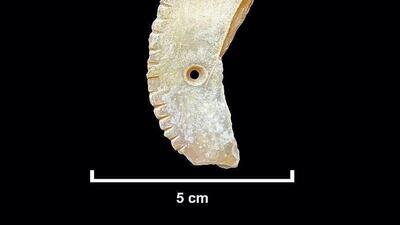
The Royal Commission for Al-Ula revealed that a team of archaeologists in the province of Al-Ula, northwestern Saudi Arabia, has discovered the oldest evidence of dogs that coexisted with humans in the Arabian Peninsula, dating back to 4000-4200 BC. SPA -
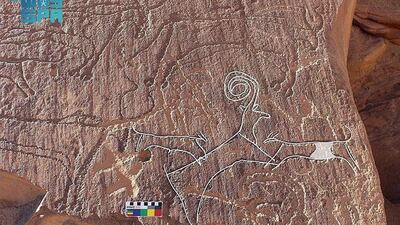
The Royal Commission for Al Ula revealed that a team of archaeologists in the province of Al Ula, northwestern Saudi Arabia, has discovered the oldest evidence of dogs that coexisted with humans in the Arabian Peninsula, dating back to 4000-4200 BC. SPA -

Rebecca Foote, director, archaeology and cultural heritage research at Royal Commission for Al Ula. Courtesy Discovery Channel -

A still from 'The Architects of Ancient Arabia' shows Hegra, Al Ula, Saudi Arabia. Courtesy Discovery Channel -

A still from 'The Architects of Ancient Arabia' shows Hegra, Saudi Arabia’s first Unesco World Heritage Site, at Al Ula, Saudi Arabia. Courtesy Discovery Channel -

A still from 'The Architects of Ancient Arabia' shows Jebel Al Fil (or Elephant Rock), Al Ula. Courtesy Discovery Channel -

Al Ula airport will welcome international flights. Courtesy RCU -
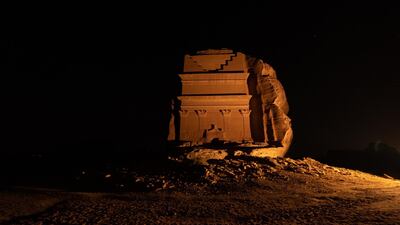
A still from 'The Architects of Ancient Arabia' shows the Tomb of Lihyan, son of Kuza at Hegra, Al Ula. Courtesy Discovery Channel -

The Royal Commission for Al Ula revealed that a team of archaeologists in the province of Al Ula, northwestern Saudi Arabia, has discovered the oldest evidence of dogs that coexisted with humans in the Arabian Peninsula, dating back to 4000-4200 BC. SPA -
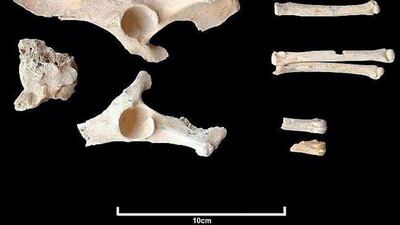
The Royal Commission for Al Ula revealed that a team of archaeologists in the province of Al Ula, northwestern Saudi Arabia, has discovered the oldest evidence of dogs that coexisted with humans in the Arabian Peninsula, dating back to 4000-4200 BC. SPA -
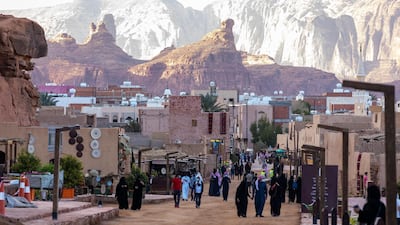
Al Ula's Old Town in Saudi Arabia has reopened to visitors. Courtesy RCU -
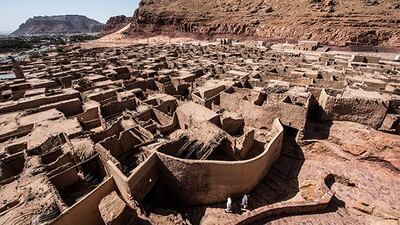
Al Ula Old Town is know for its anicent mud-brick houses. Courtesy RCU -

RIYADH, KINGDOM OF SAUDI ARABIA. 29 SEPTEMBER 2019. Sulaiman Al Juwayhil, tour guide in Al Ula, giving a tour in Madaen Saleh. (Photo: Reem Mohammed/The National) Reporter: Section:


Last year, the Heritage Commission discovered traces of humans, elephants and camels among other animals at a dry paleolake dating from more than 120,000 years ago in Tabuk.
It was the first discovery with scientific evidence of the oldest footprints of man and animals in the Arabian Peninsula.
Saudi experts at the Heritage Commission continue to work on the Green Arabian Project with those from the Max Planck Institute to study climate changes in the Arabian Peninsula over time, and the history of ancient immigrations from other continents.
More on ancient artefacts
Inside an Emirati general's fascinating private museum
Germany to return looted bronzes to Nigeria next year
Egyptian museum where a van Gogh painting was stolen reopens after a decade

