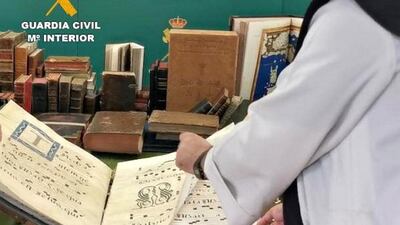

More than 60 people have been arrested in raids that recovered stolen cultural artefacts worth more than €10 millions ($12m).
Europe's crime agency, Europol, recovered 56,400 stolen items during the four-month Operation Pandora, which involved seizures in 31 countries.
Recovered objects included archaeological finds, furniture, coins, paintings, musical instruments and sculptures.
Thousands of checks were carried out in various airports, ports, border crossing points, as well as in auction houses, museums and houses across Europe.
As a result, more than 300 investigations were opened and 67 people arrested in 31 countries.
"Despite constraints imposed by Covid-19, Operation Pandora targeting the illicit trafficking of cultural goods has been the most successful to date," Europol said.

In France, a total of 27,300 archaeological artefacts were seized as a result of a single investigation carried out by French Customs.
"A suspect was arrested, who now faces a prison sentence and a fine of several hundred thousands of euros," Europol said.
The Spanish authorities seized more than 7,700 cultural goods, including archaeological artefacts, coins, sculptures and statues, weapons, paintings and archives of sound, film and photography with a value in excess of €9m.

In one case, a man was arrested after more than 90 objects stolen from religious institutions were discovered.
"The Spanish Civil Guard also finalised a complex investigation and as a result, one individual was arrested and 94 objects stolen in various places of worship were recovered, Europol said.
"A total of €165,000 in cash was seized at his home. The arrestee is suspected of trying to sell these stolen goods online, such as a 16th century silver chalice and an illuminated manuscript of the Apocalypse by Beatus of Liebana."
In Sweden, police trawled online auctions sites and discovered a pair of 17th century candlesticks that had been taken from a church eight years ago and a folk art item that had been stolen in 2019.
The Italian Carabinieri seized more than 2,700 cultural goods, including ceramics, archaeological finds, art and books valued at €1,155,000.
Two Greek nationals were arrested by the Hellenic Police for trying to sell six marble and clay antiquities for €150,000.
In total, Greek police carried out 34 arrests and recovered6,757 antiquities, including ceramic and marble objects and 6,452 coins – 5,533 of which were recovered in a single investigation.

Europol said officers seized 50 metal detectors and warns that archaeological sites are at risk from treasure hunters.
"Six of the metal detectors were seized directly from archaeological sites, clearly demonstrating that such sites are under threat," Europol said.
Several hundred Second World War grenades seized by Slovakian police.
"This is a worrisome development as some of these old explosive devices are still functional and may lead to numerous casualties," said Europol.
The operation was led by Europol and was supported by Interpol, who provided an expert to crosscheck its Stolen Works of Art database to locate and identify stolen and missing items.

