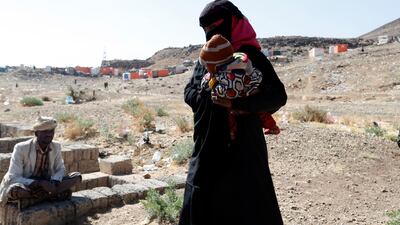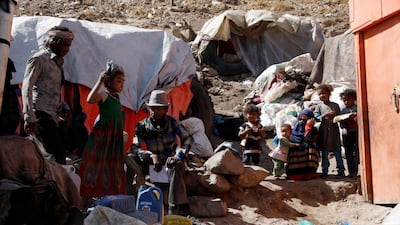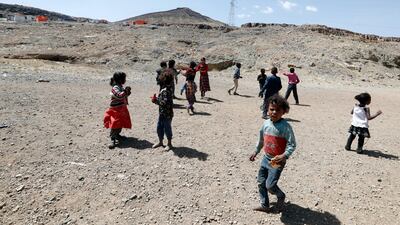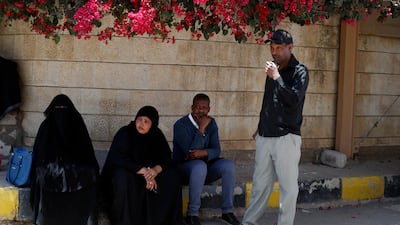
Members of African communities in Yemen gather outside the headquarters of the UN migration agency in Sanaa Yemen, 13 March 2021. EPA

UN: Conditions in Houthi migrant detention centre where fire killed 44 were ‘inhuman’


  • English
  • Arabic

A branch of the UN has blamed the Iran-backed Houthi rebels in Yemen for a fire at a migrant detention centre in Sanaa that killed at least 44.

The International Organisation for Migration said that the rebels presided over “inhuman” and “unsafe” conditions at the facility holding upwards of 900 detainees – including 350 people in a warehouse.

Survivors of the March 8 fire told The National said that Houthi guards started the fire following a protest over appalling living conditions. Survivors and local rights campaigners say the deadly blaze erupted when guards fired tear gas into the crowded warehouse.

We stand with the victims of the fire. Migrants urgently need more protection and support in Yemen

The people, mostly from Ethiopia, were trying to cross Yemen for work in Gulf states but were stopped by the rebels and were being held at the detention facility.

“Conditions in the holding facility, which was three times overcapacity, were inhumane and unsafe,” said Antonio Vitorino, IOM’s director general.

At least 43 of the dead were buried in a Sanaa cemetery on Friday amid tight security. Women from the migrant community were seen screaming and crying while ambulances, carrying the bodies, arrived from a funeral service at a major mosque.

Abdallah Al Leithi, head of the Sudanese community in Sanaa, said many of the dead lacked paperwork that could identify them. Most “had not given their real names” on documentation before the fire, he said.

There were no immediate comments from the Houthis.

The UN migration agency has called for those responsible for the tragedy to be held accountable, said Olivia Headon, the agency’s spokeswoman in Yemen.

“We stand with the victims of the fire. Migrants urgently need more protection and support in Yemen, or we will continue to see them suffer and lives lost. A step in this direction is to ensure that the victims of the fire and their families have the accountability they deserve following the horrific incident,” she said.

Houthis prevent access

The Iran-backed Houthi rebels did not state the cause of the fire, mention a protest or give a final casualty toll.

They had said an investigation was opened but no conclusions have been announced. The Houthis also prevented the UN migration agency from accessing injured migrants at hospitals, the agency said.

The rebels also attempted to turn the blame on the IOM, accusing it of not providing shelter for migrants and transfer them to their home countries.

Mr Vitorino said, however, his agency “does not establish, manage or supervise detention centres in Yemen or anywhere else in the world.”

He said the IOM has been working to restart a voluntary return of migrants from Sanaa to Ethiopia, which he described as a “lifeline for many stranded migrants in dangerous situations.”

Yemen’s six-year-old civil war has not prevented migrants from entering the country, desperate to make their way to neighbouring Saudi Arabia to find jobs as housekeepers, servants and construction workers.

At least 138,000 migrants embarked on the arduous journey from the Horn of Africa to Yemen in 2019, but the figure plummeted to 37,000 last year because of the coronavirus pandemic.

Over 2,500 migrants reached Yemen from Djibouti in January, according to the IOM.

Gallery: Displaced civilians flee fighting in Yemen 

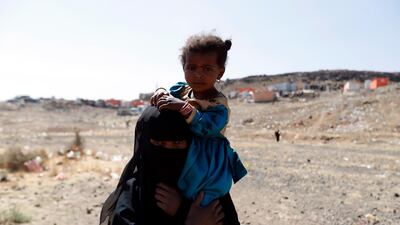
  • A displaced Yemeni woman carries her child at a camp for Internally Displaced Persons (IDPs) on the outskirts of Sana'a, Yemen. EPA
    A displaced Yemeni woman carries her child at a camp for Internally Displaced Persons (IDPs) on the outskirts of Sana'a, Yemen. EPA
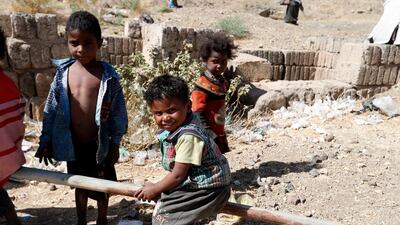
  • Displaced Yemeni children play at a camp for Internally Displaced Persons (IDPs) on the outskirts of Sana'a, Yemen. EPA
    Displaced Yemeni children play at a camp for Internally Displaced Persons (IDPs) on the outskirts of Sana'a, Yemen. EPA
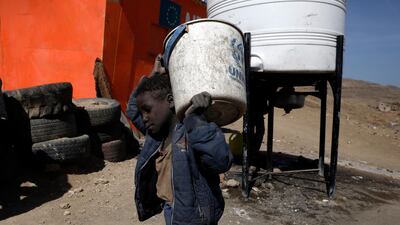
  • A displaced Yemeni boy carries a UNHCR bucket at a camp for Internally Displaced Persons (IDPs) on the outskirts of Sana'a, Yemen. EPA
    A displaced Yemeni boy carries a UNHCR bucket at a camp for Internally Displaced Persons (IDPs) on the outskirts of Sana'a, Yemen. EPA
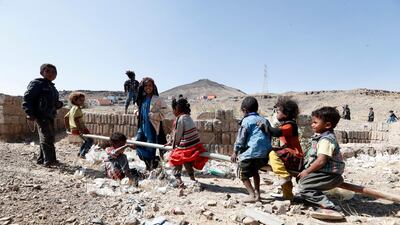
  • Displaced Yemeni children play at a camp for Internally Displaced Persons (IDPs) on the outskirts of Sana'a, Yemen. EPA
    Displaced Yemeni children play at a camp for Internally Displaced Persons (IDPs) on the outskirts of Sana'a, Yemen. EPA
  • A displaced Yemeni woman holds her baby at a camp for Internally Displaced Persons (IDPs) on the outskirts of Sana'a, Yemen. EPA
    A displaced Yemeni woman holds her baby at a camp for Internally Displaced Persons (IDPs) on the outskirts of Sana'a, Yemen. EPA
  • Displaced Yemenis sit near their huts at a camp for Internally Displaced Persons (IDPs) on the outskirts of Sana'a, Yemen. EPA
    Displaced Yemenis sit near their huts at a camp for Internally Displaced Persons (IDPs) on the outskirts of Sana'a, Yemen. EPA
  • Displaced Yemeni children play at a camp for Internally Displaced Persons (IDPs) on the outskirts of Sana'a, Yemen. EPA
    Displaced Yemeni children play at a camp for Internally Displaced Persons (IDPs) on the outskirts of Sana'a, Yemen. EPA
Game Changer

Director: Shankar 

Stars: Ram Charan, Kiara Advani, Anjali, S J Suryah, Jayaram

Rating: 2/5

Profile

Company: Libra Project

Based: Masdar City, ADGM, London and Delaware

Launch year: 2017

Size: A team of 12 with six employed full-time

Sector: Renewable energy

Funding: $500,000 in Series A funding from family and friends in 2018. A Series B round looking to raise $1.5m is now live.

Who's who in Yemen conflict

Houthis: Iran-backed rebels who occupy Sanaa and run unrecognised government

Yemeni government: Exiled government in Aden led by eight-member Presidential Leadership Council

Southern Transitional Council: Faction in Yemeni government that seeks autonomy for the south

Habrish 'rebels': Tribal-backed forces feuding with STC over control of oil in government territory

Keep it fun and engaging

Stuart Ritchie, director of wealth advice at AES International, says children cannot learn something overnight, so it helps to have a fun routine that keeps them engaged and interested.

“I explain to my daughter that the money I draw from an ATM or the money on my bank card doesn’t just magically appear – it’s money I have earned from my job. I show her how this works by giving her little chores around the house so she can earn pocket money,” says Mr Ritchie.

His daughter is allowed to spend half of her pocket money, while the other half goes into a bank account. When this money hits a certain milestone, Mr Ritchie rewards his daughter with a small lump sum.

He also recommends books that teach the importance of money management for children, such as The Squirrel Manifesto by Ric Edelman and Jean Edelman.

The Sand Castle

Director: Matty Brown

Stars: Nadine Labaki, Ziad Bakri, Zain Al Rafeea, Riman Al Rafeea

Rating: 2.5/5

White hydrogen: Naturally occurring hydrogenChromite: Hard, metallic mineral containing iron oxide and chromium oxideUltramafic rocks: Dark-coloured rocks rich in magnesium or iron with very low silica contentOphiolite: A section of the earth’s crust, which is oceanic in nature that has since been uplifted and exposed on landOlivine: A commonly occurring magnesium iron silicate mineral that derives its name for its olive-green yellow-green colour

Fight card

1. Bantamweight: Victor Nunes (BRA) v Siyovush Gulmamadov (TJK)

2. Featherweight: Hussein Salim (IRQ) v Shakhriyor Juraev (UZB)

3. Catchweight 80kg: Rashed Dawood (UAE) v Khamza Yamadaev (RUS)

4. Lightweight: Ho Taek-oh (KOR) v Ronald Girones (CUB)

5. Lightweight: Arthur Zaynukov (RUS) v Damien Lapilus (FRA)

6. Bantamweight: Vinicius de Oliveira (BRA) v Furkatbek Yokubov (RUS)

7. Featherweight: Movlid Khaybulaev (RUS) v Zaka Fatullazade (AZE)

8. Flyweight: Shannon Ross (TUR) v Donovon Freelow (USA)

9. Lightweight: Mohammad Yahya (UAE) v Dan Collins (GBR)

10. Catchweight 73kg: Islam Mamedov (RUS) v Martun Mezhulmyan (ARM)

11. Bantamweight World title: Jaures Dea (CAM) v Xavier Alaoui (MAR)

12. Flyweight World title: Manon Fiorot (FRA) v Gabriela Campo (ARG)

COMPANY PROFILE
Name: Akeed

Based: Muscat

Launch year: 2018

Number of employees: 40

Sector: Online food delivery

Funding: Raised $3.2m since inception 

Name: Colm McLoughlin

Country: Galway, Ireland

Job: Executive vice chairman and chief executive of Dubai Duty Free

Favourite golf course: Dubai Creek Golf and Yacht Club

Favourite part of Dubai: Palm Jumeirah


Living in...

This article is part of a guide on where to live in the UAE. Our reporters will profile some of the country’s most desirable districts, provide an estimate of rental prices and introduce you to some of the residents who call each area home.

Pearls on a Branch: Oral Tales
​​​​​​​Najlaa Khoury, Archipelago Books

UAE currency: the story behind the money in your pockets
The burning issue

The internal combustion engine is facing a watershed moment – major manufacturer Volvo is to stop producing petroleum-powered vehicles by 2021 and countries in Europe, including the UK, have vowed to ban their sale before 2040. The National takes a look at the story of one of the most successful technologies of the last 100 years and how it has impacted life in the UAE. 

Read part four: an affection for classic cars lives on

Read part three: the age of the electric vehicle begins

Read part one: how cars came to the UAE


Ten tax points to be aware of in 2026

1. Domestic VAT refund amendments: request your refund within five years

If a business does not apply for the refund on time, they lose their credit.

2. E-invoicing in the UAE

Businesses should continue preparing for the implementation of e-invoicing in the UAE, with 2026 a preparation and transition period ahead of phased mandatory adoption. 

3. More tax audits

Tax authorities are increasingly using data already available across multiple filings to identify audit risks. 

4. More beneficial VAT and excise tax penalty regime

Tax disputes are expected to become more frequent and more structured, with clearer administrative objection and appeal processes. The UAE has adopted a new penalty regime for VAT and excise disputes, which now mirrors the penalty regime for corporate tax.

5. Greater emphasis on statutory audit

There is a greater need for the accuracy of financial statements. The International Financial Reporting Standards standards need to be strictly adhered to and, as a result, the quality of the audits will need to increase.

6. Further transfer pricing enforcement

Transfer pricing enforcement, which refers to the practice of establishing prices for internal transactions between related entities, is expected to broaden in scope. The UAE will shortly open the possibility to negotiate advance pricing agreements, or essentially rulings for transfer pricing purposes. 

7. Limited time periods for audits

Recent amendments also introduce a default five-year limitation period for tax audits and assessments, subject to specific statutory exceptions. While the standard audit and assessment period is five years, this may be extended to up to 15 years in cases involving fraud or tax evasion. 

8. Pillar 2 implementation 

Many multinational groups will begin to feel the practical effect of the Domestic Minimum Top-Up Tax (DMTT), the UAE's implementation of the OECD’s global minimum tax under Pillar 2. While the rules apply for financial years starting on or after January 1, 2025, it is 2026 that marks the transition to an operational phase.

9. Reduced compliance obligations for imported goods and services

Businesses that apply the reverse-charge mechanism for VAT purposes in the UAE may benefit from reduced compliance obligations. 

10. Substance and CbC reporting focus

Tax authorities are expected to continue strengthening the enforcement of economic substance and Country-by-Country (CbC) reporting frameworks. In the UAE, these regimes are increasingly being used as risk-assessment tools, providing tax authorities with a comprehensive view of multinational groups’ global footprints and enabling them to assess whether profits are aligned with real economic activity. 

Contributed by Thomas Vanhee and Hend Rashwan, Aurifer

COMPANY PROFILE

Name: Lamsa

Founder: Badr Ward

Launched: 2014

Employees: 60

Based: Abu Dhabi

Sector: EdTech

Funding to date: $15 million