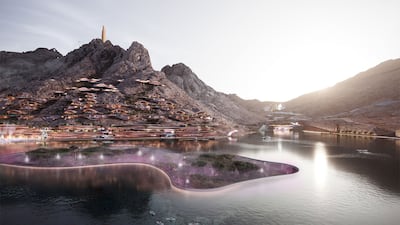
• Saudi Crown Prince Mohammed bin Salman has announced The Line, a 170km belt of hyper-connected future communities, without cars and roads. Images courtesy Neom
    Saudi Crown Prince Mohammed bin Salman has announced The Line, a 170km belt of hyper-connected future communities, without cars and roads. Images courtesy Neom
  • Plans for the city include "zero carbon emissions", Prince Mohammed said. Construction will begin before the end of March.
    Plans for the city include "zero carbon emissions", Prince Mohammed said. Construction will begin before the end of March.
  • Prince Mohammed, who is chairman of the board of the Neom Company, said that The Line has been designed to allow residents to "fulfil all of their daily requirements within a five-minute walk".
    Prince Mohammed, who is chairman of the board of the Neom Company, said that The Line has been designed to allow residents to "fulfil all of their daily requirements within a five-minute walk".
  • Neom is the flagship project of Saudi Arabia's post-oil diversification plan, known as Vision 2030, that seeks to reduce the country's reliance on hydrocarbons.
    Neom is the flagship project of Saudi Arabia's post-oil diversification plan, known as Vision 2030, that seeks to reduce the country's reliance on hydrocarbons.
  • The city will be 100 per cent powered by renewable energy and the cost of infrastructure will be 30 per cent cheaper than more traditional cities.
    The city will be 100 per cent powered by renewable energy and the cost of infrastructure will be 30 per cent cheaper than more traditional cities.
  • It is being overseen by the Public Investment Fund and is set to create hundreds of thousands of jobs and contribute tens of billions of dollars to the kingdom's GDP.
    It is being overseen by the Public Investment Fund and is set to create hundreds of thousands of jobs and contribute tens of billions of dollars to the kingdom's GDP.
  • Neom spans 26,500 square kilometres.
    Neom spans 26,500 square kilometres.
  • It will contain towns and cities, ports and enterprise zones, research centres, sports venues, entertainment sites and tourist destinations.
    It will contain towns and cities, ports and enterprise zones, research centres, sports venues, entertainment sites and tourist destinations.
  • The bulk of construction will take place over the next decade, with a target of hosting one million residents by 2030.
    The bulk of construction will take place over the next decade, with a target of hosting one million residents by 2030.
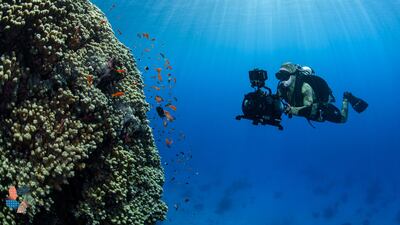
  • A coral reef with anthias fish at Yub'a island dive site, off the northwest of the island, in Neom.
    A coral reef with anthias fish at Yub'a island dive site, off the northwest of the island, in Neom.

What is Neom? Home to The Line at Saudi Arabia's megacity


  • English
  • Arabic

With plans under way to build Saudi Arabia's smart city Neom, it is set to be a place in the desert unlike anything else on Earth.

New satellite images have revealed a birds-eye view of the rise of Saudi Arabia's $500 billion Neom mega project.

The striking aerial views captured progress on The Line, including the set up of offices and campsite for the engineering team and workers.

The Line's executive director, Giles Pendleton, said construction was progressing rapidly on one of the most important new urban developments in Neom and the rest of the world.

“Work is already quite advanced on the infrastructure to support The Line, with world-renowned architects designing the initial sections, vertical spaces, and layers for the first residents,” he told The National.

Unveiling the project, Crown Prince Mohammed bin Salman said the 170-kilometre coastal strip in the north-west of the country would be free of cars and streets and have zero carbon emissions.

The smart city will be powered entirely by clean energy, a major step in Saudi Arabia's shift away from an oil-based economy.

The Line is to be built in Neom and will be home to nine million people, who will live in interconnected societies run by artificial intelligence designed to coexist with nature, with excavation on this massive project having now started.

Confronting the traffic, pollution and infrastructure challenges that overshadow urban life in conventional cities, this futuristic development will prioritise walkability, clean energy and technology to create a new way of living.

Speaking at Tuesday's Global AI Summit in Riyadh, Neom chief executive Nadhmi Al Nasr said the city would make use of artificial intelligence technology to the fullest. He also confirmed that the planning phase of Neom had been successful and that work was progressing steadily.

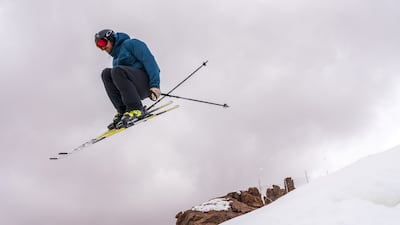
  • Trojena will open in 2026 as part of Saudi Arabia's megacity of the future. Photo: Neom
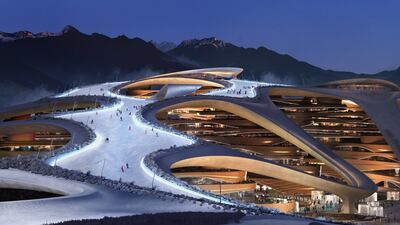
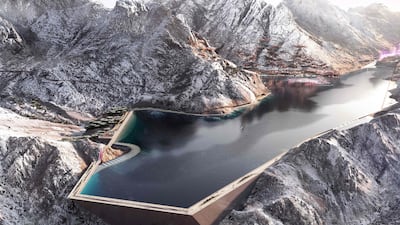
    Trojena will open in 2026 as part of Saudi Arabia's megacity of the future. Photo: Neom
  • Trojena is designed to attract visitors, holidaymakers and winter sports enthusiasts from around the world. PA
    Trojena is designed to attract visitors, holidaymakers and winter sports enthusiasts from around the world. PA
  • The design plan for Trojena, an area in Saudi Arabia's planned megacity of Neom chosen to host the 2029 Asian Winter Games. AFP
    The design plan for Trojena, an area in Saudi Arabia's planned megacity of Neom chosen to host the 2029 Asian Winter Games. AFP
  • The Line is also being built at Neom. It will be free of cars and streets and have zero carbon emissions. Photo: Neom
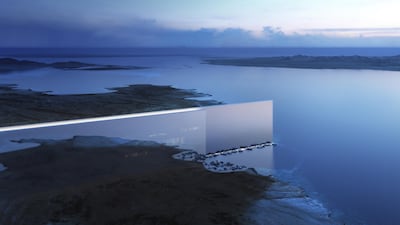
    The Line is also being built at Neom. It will be free of cars and streets and have zero carbon emissions. Photo: Neom
  • Neom chief executive Nadhmi Al Nasr said The Line would make use of artificial intelligence technology to the fullest. Photo: Neom
    Neom chief executive Nadhmi Al Nasr said The Line would make use of artificial intelligence technology to the fullest. Photo: Neom
  • Neom city will be powered by clean energy, officials say. Photo: Neom
    Neom city will be powered by clean energy, officials say. Photo: Neom
  • Trojena in Neom will host the first outdoor snow skiing destination in the GCC region. Photo: Neom
    Trojena in Neom will host the first outdoor snow skiing destination in the GCC region. Photo: Neom
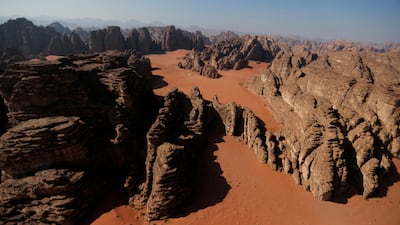
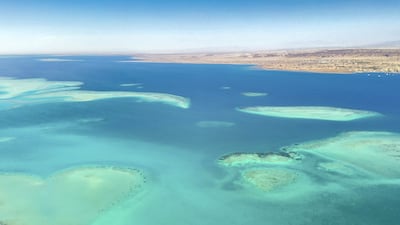
  • Neom lies in a desert bordering the Red Sea in Saudi Arabia. Reuters
    Neom lies in a desert bordering the Red Sea in Saudi Arabia. Reuters
  • Architects say Neom will be designed to make the most of its environmental surroundings. Photo: Neom
    Architects say Neom will be designed to make the most of its environmental surroundings. Photo: Neom
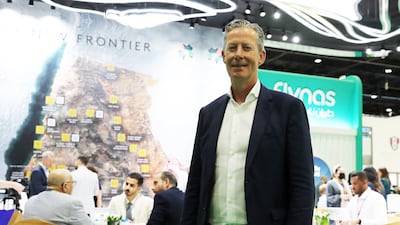
  • Andrew McEvoy, sector head for tourism at Neom, at Arabian Travel Market held at Dubai World Trade Centre. Pawan Singh / The National
    Andrew McEvoy, sector head for tourism at Neom, at Arabian Travel Market held at Dubai World Trade Centre. Pawan Singh / The National
  • The $500bn Neom project in the Tabuk Province of north-western Saudi Arabia is supported by the kingdom's Public Investment Fund. Photo: Saudi Commission for Tourism and Natural Heritage
    The $500bn Neom project in the Tabuk Province of north-western Saudi Arabia is supported by the kingdom's Public Investment Fund. Photo: Saudi Commission for Tourism and Natural Heritage

What is Neom?

First unveiled by Prince Mohammed in 2017, Neom is Saudi Arabia's flagship business and tourism development on the Red Sea coast. It is a central project in the 2030 Vision outlining the kingdom's plans to diversify the economy.

The $500 billion development will include smart towns and cities, ports and enterprise areas, research centres, sports and entertainment venues and tourist centres.

The development will be spread across 26,500 square kilometres and will comprise several zones, including industrial and logistics areas. It is planned for completion in 2025.

The plans include a network of airports, including an international one. The first, called Neom Bay Airport in the northern region of Sharma, opened last year and operates regular flights for Neom investors and employees.

Chief urban development officer at Neom, Antoni Vives, said one of the largest international airports in the world would be ready before 2030.

A business and tech centre is expected to contribute $48bn to the kingdom's gross domestic product and create 380,000 jobs. Construction of this is set to begin in the first quarter of this year.

What is so special about it?

Neom is designed to respond to some of the most pressing global challenges facing urban areas and inspire an alternative way of living.

The city will preserve 95 per cent of the natural environment around the site, highlighting mankind's relationship with the natural world.

All energy in Neom will be 100 per cent renewable — from solar, wind and hydrogen-based power generation — ensuring a zero-emission, carbon-positive ecosystem.

Those behind the project say Neom will be a regional powerhouse in water production and storage, anchored on water desalination. High-tech interoperable, modular systems will attract water-related research companies and start-ups to drive innovation and lead in all sectors of the water industry.

Neom's water distribution network will be completely connected through advanced infrastructure. This will ensure minimal water loss, putting Neom at the forefront of water technology.

“Our game-changing desalination technology is 100 per cent carbon neutral and entirely sustainable," said David Reavley, chief executive of Solar Water. "In Neom, we have found a partner who has a strong vision of what a new future looks like in harmony with nature."

The Line project is the first time in 150 years that a major urban development has been designed around people, not roads. Walkability will define life in the city, with all essential daily services, such as schools, medical clinics, leisure centres and green spaces, within a five-minute walk.

High-speed transit will be among the ways residents will be able to travel longer distances, making all areas of Neom accessible within 20 minutes. An urban environment that prioritises walking, cycling and personal electric mobility devices will be enhanced by access to high-speed public transit services connecting all neighbourhoods.

Who is building it?

Development is already under way. Neom chief executive Nazmi Al Nasr said this week that there were plans for “five to six projects for resort development within the city, in parallel with The Line, with some resorts estimated to open after three years”.

The effect of the Covid-19 pandemic on the progress of the project has been minimal, he said. However, the biggest challenge is to acquire more global and national partnerships.

The urban planning and development of all projects was under way, he added, and more details will be announced after the completion of each of the site plans.

Construction of The Line began in the first quarter of this year. Agreements have been signed with construction companies Aecom and Bechtel to develop an advanced transport infrastructure, making The Line one of the largest and most complex infrastructure projects in the world.

A contract with Saudi Telecom Company was signed last year to provide a 5G network infrastructure that will accelerate Neom's digital ambitions.

Neom also signed a $5bn partnership with Acwa Power and Air Products in the US to develop the world's largest green hydrogen and green ammonia plant, to be operational in 2026.

Solar Water's technology will help Neom to work towards one of its aims of revolutionising the process of water desalination. This will help to solve the problem of access to fresh water in Saudi Arabia.

What is The Line in Neom?

The Line will have a mirror facade, which will allow even its footprint to “blend with nature”.

Speaking at the launch of The Line in July, Prince Mohammed emphasised the need to address mounting pressure on urban spaces and find solutions for a rapidly expanding global population.

The Line will be the first city in the world to be powered by renewable energy including wind, solar and hydrogen.

“By 2050, commute durations will double. By 2050, one billion people will have to relocate due to rising carbon dioxide emissions and sea levels,” he said.

He said that 90 per cent of people breathed polluted air.

“Why should we sacrifice nature for the sake of development? Why should seven million people die every year because of pollution? Why should we lose one million people every year to traffic accidents? And why should we accept wasting years of our lives commuting?” he said.

The Line will also be the world's first zero-gravity vertical city.

“The idea of layering city functions vertically, giving people the possibility of moving seamlessly in three dimensions to access them, is a concept referred to as zero-gravity urbanism,” Prince Mohammed said.

There will be a hyper rail line running through the city to boost travel. This rail line will be powered through a renewable-powered electric system.

Recent drone footage of The Line, released by OT Sky Drone company, has revealed that construction on the mega project has started, with excavators seen digging a wide trench in the desert.

How do Saudis feel about Neom?

“When I first heard about Neom in 2017, I thought it was the most incredible thing," said Hamid Al Kazim, a Saudi IT expert living in Riyadh. "I couldn't believe Saudi Arabia was going to do this, let alone be the first."

Layan Baker, a Saudi wellness expert in Jeddah, said she found the scope of the project inspiring.

“It is the boldest, most ambitious idea to come out of not just the kingdom, but this decade," she said. "Crown Prince Mohammed bin Salman has been the torchbearer of his ideas and is leading the country, especially its youth and future generations, into a modern era where man and nature can coexist and flourish in harmony."

Rawan Ahmed, a Saudi entrepreneur from the south-west port city of Jazan, told The National it was perhaps a surprise to the rest of the world that the kingdom was at the centre of such innovation.

“For us, it is a great moment in history — we have never felt this excitement before," she said. "It further instils the feeling of national pride, all thanks to the vision of Crown Prince Mohammed bin Salman under the leadership of King Salman.”

When will Neom be completed?

The Crown Prince had said in July that Neom would be partly financed through a flotation expected in 2024.

The city's first phase is set to cost 1.2 trillion riyals ($319bn), half of which will come from the kingdom's sovereign wealth fund, the Public Investment Fund.

The economic zone that is eventually set to house nine million people is expected to have capacity for 450,000 by 2026 and 1.5-2 million by 2030, he said. It will eventually house nine million people by 2045.


THE BIO

Age: 33

Favourite quote: “If you’re going through hell, keep going” Winston Churchill

Favourite breed of dog: All of them. I can’t possibly pick a favourite.

Favourite place in the UAE: The Stray Dogs Centre in Umm Al Quwain. It sounds predictable, but it honestly is my favourite place to spend time. Surrounded by hundreds of dogs that love you - what could possibly be better than that?

Favourite colour: All the colours that dogs come in

Attacks on Egypt’s long rooted Copts

Egypt’s Copts belong to one of the world’s oldest Christian communities, with Mark the Evangelist credited with founding their church around 300 AD. Orthodox Christians account for the overwhelming majority of Christians in Egypt, with the rest mainly made up of Greek Orthodox, Catholics and Anglicans.

The community accounts for some 10 per cent of Egypt’s 100 million people, with the largest concentrations of Christians found in Cairo, Alexandria and the provinces of Minya and Assiut south of Cairo.

Egypt’s Christians have had a somewhat turbulent history in the Muslim majority Arab nation, with the community occasionally suffering outright persecution but generally living in peace with their Muslim compatriots. But radical Muslims who have first emerged in the 1970s have whipped up anti-Christian sentiments, something that has, in turn, led to an upsurge in attacks against their places of worship, church-linked facilities as well as their businesses and homes.

More recently, ISIS has vowed to go after the Christians, claiming responsibility for a series of attacks against churches packed with worshippers starting December 2016.

The discrimination many Christians complain about and the shift towards religious conservatism by many Egyptian Muslims over the last 50 years have forced hundreds of thousands of Christians to migrate, starting new lives in growing communities in places as far afield as Australia, Canada and the United States.

Here is a look at major attacks against Egypt's Coptic Christians in recent years:

November 2: Masked gunmen riding pickup trucks opened fire on three buses carrying pilgrims to the remote desert monastery of St. Samuel the Confessor south of Cairo, killing 7 and wounding about 20. IS claimed responsibility for the attack.

May 26, 2017: Masked militants riding in three all-terrain cars open fire on a bus carrying pilgrims on their way to the Monastery of St. Samuel the Confessor, killing 29 and wounding 22. ISIS claimed responsibility for the attack.

April 2017Twin attacks by suicide bombers hit churches in the coastal city of Alexandria and the Nile Delta city of Tanta. At least 43 people are killed and scores of worshippers injured in the Palm Sunday attack, which narrowly missed a ceremony presided over by Pope Tawadros II, spiritual leader of Egypt Orthodox Copts, in Alexandria's St. Mark's Cathedral. ISIS claimed responsibility for the attacks.

February 2017: Hundreds of Egyptian Christians flee their homes in the northern part of the Sinai Peninsula, fearing attacks by ISIS. The group's North Sinai affiliate had killed at least seven Coptic Christians in the restive peninsula in less than a month.

December 2016A bombing at a chapel adjacent to Egypt's main Coptic Christian cathedral in Cairo kills 30 people and wounds dozens during Sunday Mass in one of the deadliest attacks carried out against the religious minority in recent memory. ISIS claimed responsibility.

July 2016Pope Tawadros II says that since 2013 there were 37 sectarian attacks on Christians in Egypt, nearly one incident a month. A Muslim mob stabs to death a 27-year-old Coptic Christian man, Fam Khalaf, in the central city of Minya over a personal feud.

May 2016: A Muslim mob ransacks and torches seven Christian homes in Minya after rumours spread that a Christian man had an affair with a Muslim woman. The elderly mother of the Christian man was stripped naked and dragged through a street by the mob.

New Year's Eve 2011A bomb explodes in a Coptic Christian church in Alexandria as worshippers leave after a midnight mass, killing more than 20 people.

Skoda Superb Specs

Engine: 2-litre TSI petrol

Power: 190hp

Torque: 320Nm

Price: From Dh147,000

Available: Now

The President's Cake

Director: Hasan Hadi

Starring: Baneen Ahmad Nayyef, Waheed Thabet Khreibat, Sajad Mohamad Qasem 

Rating: 4/5

Lexus LX700h specs

Engine: 3.4-litre twin-turbo V6 plus supplementary electric motor

Power: 464hp at 5,200rpm

Torque: 790Nm from 2,000-3,600rpm

Transmission: 10-speed auto

Fuel consumption: 11.7L/100km

On sale: Now

Price: From Dh590,000

From Europe to the Middle East, economic success brings wealth - and lifestyle diseases

A rise in obesity figures and the need for more public spending is a familiar trend in the developing world as western lifestyles are adopted.

One in five deaths around the world is now caused by bad diet, with obesity the fastest growing global risk. A high body mass index is also the top cause of metabolic diseases relating to death and disability in Kuwait,  Qatar and Oman – and second on the list in Bahrain.

In Britain, heart disease, lung cancer and Alzheimer’s remain among the leading causes of death, and people there are spending more time suffering from health problems.

The UK is expected to spend $421.4 billion on healthcare by 2040, up from $239.3 billion in 2014.

And development assistance for health is talking about the financial aid given to governments to support social, environmental development of developing countries.


Living in...

This article is part of a guide on where to live in the UAE. Our reporters will profile some of the country’s most desirable districts, provide an estimate of rental prices and introduce you to some of the residents who call each area home.

Five famous companies founded by teens

There are numerous success stories of teen businesses that were created in college dorm rooms and other modest circumstances. Below are some of the most recognisable names in the industry:

  1. Facebook: Mark Zuckerberg and his friends started Facebook when he was a 19-year-old Harvard undergraduate. 
  2. Dell: When Michael Dell was an undergraduate student at Texas University in 1984, he started upgrading computers for profit. He starting working full-time on his business when he was 19. Eventually, his company became the Dell Computer Corporation and then Dell Inc. 
  3. Subway: Fred DeLuca opened the first Subway restaurant when he was 17. In 1965, Mr DeLuca needed extra money for college, so he decided to open his own business. Peter Buck, a family friend, lent him $1,000 and together, they opened Pete’s Super Submarines. A few years later, the company was rebranded and called Subway. 
  4. Mashable: In 2005, Pete Cashmore created Mashable in Scotland when he was a teenager. The site was then a technology blog. Over the next few decades, Mr Cashmore has turned Mashable into a global media company.
  5. Oculus VR: Palmer Luckey founded Oculus VR in June 2012, when he was 19. In August that year, Oculus launched its Kickstarter campaign and raised more than $1 million in three days. Facebook bought Oculus for $2 billion two years later.
RACE CARD

4.30pm: Maiden Dh80,000 1,400m
5pm: Conditions Dh80,000 1,400m
5.30pm: Liwa Oasis Group 3 Dh300,000 1,400m
6pm: The President’s Cup Listed Dh380,000 1,400m
6.30pm: Arabian Triple Crown Group 2 Dh300,000 2,200m
7pm: Wathba Stallions Cup Handicap (30-60) Dh80,000 1,600m
7.30pm: Handicap (40-70) Dh80,000 1,600m.