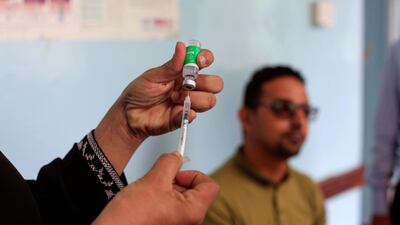
Yemen’s Houthi rebels are refusing to take the Covid-19 vaccine and distribute it in areas under their control, the country’s internationally recognised government said on Thursday.
A vaccination campaign began last month in government-held areas after authorities received their first shipment from the global Covax vaccine-sharing scheme. The country has received 360,000 doses of AstraZeneca's vaccine and expects to get 1.9 million doses this year.
"The Houthis' refusal to receive the Covid-19 vaccine is threatening the lives of citizens in areas under their control," said Ali Al Walidi, the undersecretary of Yemen's Health Ministry, during an online meeting hosted by the World Health Organisation.
Mr Al Walidi said the war waged by the rebels since 2014 has led to the economic, health, and political collapse of the country as well as outbreaks of diseases.
Yemen's vaccine campaign began in the southern port city of Aden in late April, the government's interim capital in a six-year war.
WHO representative in Yemen, Dr Adham Abdel-Moneim, said the rebels had rejected a plan to implement a joint campaign to vaccinate medics in areas under their control.
“Initially they agreed, under insistence, to accept 10,000 vaccine doses, but those could not be delivered after they stipulated that they must be distributed separately from our supervision,” he said.
Dr Abdel-Moneim said the Houthis accepted only 1,000 doses that were intended to be given to 500 doctors, on the basis that they would be vaccinated under the rebels' supervision.
The Iran-backed rebels control most of northern Yemen, having ousted the government from the capital Sanaa in 2015.
The internationally recognised government's health ministry previously said the vaccines would be free and distributed across the country, where the Houthis control most big urban centres.
Covax is co-led by the Gavi Vaccine Alliance and the WHO to provide Covid-19 vaccines to low-income countries.
Yemen has recorded 6,593 coronavirus infections and 1,298 deaths, although the true figure is thought to be much higher. The war is restricting Covid-19 testing and reporting.
The authorities' aim is to vaccinate 70 per cent of the population. The health ministry said it had appealed to Saudi Arabia's King Salman Humanitarian Aid and Relief Centre to finance 50 per cent of the vaccines.
Mr Al Walidi praised Saudi Arabia’s efforts in supporting the country’s battered health system.

The specs: 2018 Nissan Patrol Nismo
Price: base / as tested: Dh382,000
Engine: 5.6-litre V8
Gearbox: Seven-speed automatic
Power: 428hp @ 5,800rpm
Torque: 560Nm @ 3,600rpm
Fuel economy, combined: 12.7L / 100km
MATCH INFO
Manchester United 2 (Heaton (og) 42', Lindelof 64')
Aston Villa 2 (Grealish 11', Mings 66')
Ten tax points to be aware of in 2026
1. Domestic VAT refund amendments: request your refund within five years
If a business does not apply for the refund on time, they lose their credit.
2. E-invoicing in the UAE
Businesses should continue preparing for the implementation of e-invoicing in the UAE, with 2026 a preparation and transition period ahead of phased mandatory adoption.
3. More tax audits
Tax authorities are increasingly using data already available across multiple filings to identify audit risks.
4. More beneficial VAT and excise tax penalty regime
Tax disputes are expected to become more frequent and more structured, with clearer administrative objection and appeal processes. The UAE has adopted a new penalty regime for VAT and excise disputes, which now mirrors the penalty regime for corporate tax.
5. Greater emphasis on statutory audit
There is a greater need for the accuracy of financial statements. The International Financial Reporting Standards standards need to be strictly adhered to and, as a result, the quality of the audits will need to increase.
6. Further transfer pricing enforcement
Transfer pricing enforcement, which refers to the practice of establishing prices for internal transactions between related entities, is expected to broaden in scope. The UAE will shortly open the possibility to negotiate advance pricing agreements, or essentially rulings for transfer pricing purposes.
7. Limited time periods for audits
Recent amendments also introduce a default five-year limitation period for tax audits and assessments, subject to specific statutory exceptions. While the standard audit and assessment period is five years, this may be extended to up to 15 years in cases involving fraud or tax evasion.
8. Pillar 2 implementation
Many multinational groups will begin to feel the practical effect of the Domestic Minimum Top-Up Tax (DMTT), the UAE's implementation of the OECD’s global minimum tax under Pillar 2. While the rules apply for financial years starting on or after January 1, 2025, it is 2026 that marks the transition to an operational phase.
9. Reduced compliance obligations for imported goods and services
Businesses that apply the reverse-charge mechanism for VAT purposes in the UAE may benefit from reduced compliance obligations.
10. Substance and CbC reporting focus
Tax authorities are expected to continue strengthening the enforcement of economic substance and Country-by-Country (CbC) reporting frameworks. In the UAE, these regimes are increasingly being used as risk-assessment tools, providing tax authorities with a comprehensive view of multinational groups’ global footprints and enabling them to assess whether profits are aligned with real economic activity.
Contributed by Thomas Vanhee and Hend Rashwan, Aurifer
Water waste
In the UAE’s arid climate, small shrubs, bushes and flower beds usually require about six litres of water per square metre, daily. That increases to 12 litres per square metre a day for small trees, and 300 litres for palm trees.
Horticulturists suggest the best time for watering is before 8am or after 6pm, when water won't be dried up by the sun.
A global report published by the Water Resources Institute in August, ranked the UAE 10th out of 164 nations where water supplies are most stretched.
The Emirates is the world’s third largest per capita water consumer after the US and Canada.
