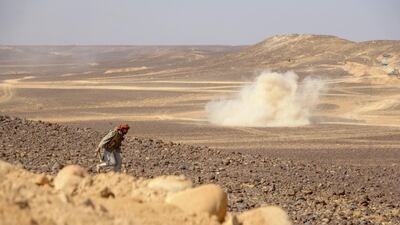
Yemen is in the grip of a new humanitarian disaster as fierce fighting rages in the rugged, mountainous region near the city of Marib.
Iran-backed Houthi rebels are continuing their offensive against the Yemeni government and local tribal forces, and huge camps for Internally Displaced People (IDPs) are increasingly being engulfed by the violence.
"I fled our IDP camp in Sirwah as the Houthis tightened the noose around it, attempting to entrench themselves and fortify it,” said Mariam Ahmed, a refugee fleeing the violence.
"I took my four children and, embracing my nine month-old baby, headed towards Al Rawdha camp in central Marib city on a hot, tough day," she told The National.
"We walked nearly 25km from Sirwah to the IDP camp in Al Rawdha, under heavy shelling. We were forced to take a mountainous, rough road because the Houthis kept shelling the main road that links Sirwah with the city of Marib, to prevent people from fleeing so they can use them as human shields," Mrs Mariam said.
"A new suffering began as we arrived in the IDP camp in the Al Rawdha area in Marib city. We found ourselves homeless. No tent, no food, no clean water but in fact, the IDPs in the camp didn't spare any effort to help. They shared with us their meagre resources to collect us from the open," she added.
Thousands of IDPs were displaced from more than five camps located in Sirwah and Raghwan, districts of western Marib, to new camps in and around Marib city.
Most of these families, like Ms Fatima and her children, recounted the same stories of suffering, fleeing the Houthi offensive in western and southern Marib, which ramped up on February 11, 2020.
The Houthis are attempting to take full control over the last northern foothold for Yemen’s internationally recognised government.
The crisis comes as the government’s IDP Executive Unit appeals for an urgent humanitarian response to save the lives of thousands of IDPs fleeing the Houthi escalation.
"We send this appeal to all the humanitarian work partners to urgently respond to the needs of thousands of IDPs who fled their former camps due to the recent Houthi offensive " Dr Khaled Musaed, the manager of the government's IDP Executive Unit in Marib told The National.
"Since the recent Houthi offensive began earlier this month, 1,517 families and 12,005 individuals fled their IDP camps in districts in western Marib to new camps in Marib city, and to safe havens in the districts of Al Jubah", Dr Khaled Musaed said.
"The situation in the new IDP camps is very bad. Families are still hosted in shared tents. In some camps more than six families -women and children only- live in one tent. Men sleep out in the open," Dr Khaled said.
-

A Yemeni boy poses with a Kalashnikov assault rifle during a gathering of newly-recruited Houthi fighters in the capital Sanaa, to mobilise more fighters to battlefronts in the war against pro-government forces in several Yemeni cities, on July 16, 2017. AFP -

Yemeni children carrying weapons take part in a gathering organised by Houthi rebels to mobilise more fighters to battlefronts to fight pro-government forces, on June 18, 2017, in the capital Sanaa. AFP -
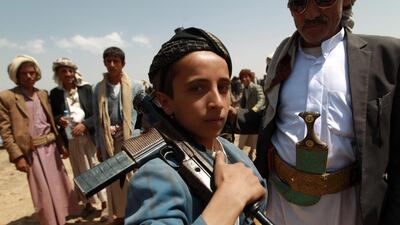
An armed Yemeni boy poses for a picture during a tribal gathering loyal to the Houthi rebels in the Bani Al Harith area, north of Sanaa, on August 17, 2014. AFP -
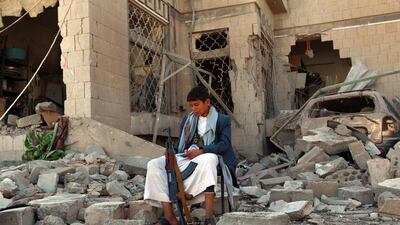
An armed Yemeni youth in the Houthi movement that controls Sanaa, sits amid the rubble of the Iranian ambassador's home in the Yemeni capital on December 5, 2014. AFP -
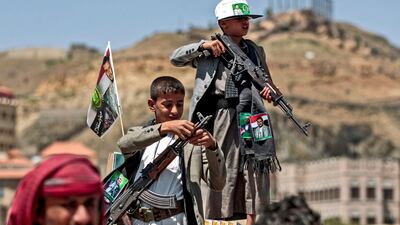
A Yemeni boy lines up a round of ammunition atop the barrel of a Kalashnikov assault rifle, while another stands with Kalashnikov over a crate of juice boxes during a tribal meeting in the Houthi rebel-held capital Sanaa on September 21, 2019, as tribesmen donate rations and funds to rebel fighters. AFP


"The new IDPs need food aid, shelter, toilets, clean water and medications" he added.
Dr Musaed said that a humanitarian response by international organisations is overdue because the majority of the UN INGOs don't have warehouses for supplies to Marib and they need to move aid supplies from Aden or from Hadramawt. Doing so would take time, he said.
International humanitarian organisations in Marib expressed concern over the recent escalation, saying it poses a threat to the lives of 2,231,000 IDPs.
"We are extremely concerned by the intensification of the violence around Marib city. The International Committee of the Red Cross (ICRC) urges all parties to the conflict to take every possible measure to protect civilians and their properties, and to allow safe passage for those who want to escape the fighting, said Basheer Omar, the spokesperson of the ICRC-Yemen to The National.
"The ICRC calls on all parties to the conflict to allow for the Yemeni Red Cross Society (YRCS) and ICRC teams and humanitarian workers to provide emergency aid to people trapped in and around fighting areas . Waves of displacement from those areas have been registered since the beginning of the year, and with the current fighting, there are reports of a new wave of displacement."
On February 19, the office of the UN high commissioner of Human Rights (OHCHR) warned that the lives of thousands of people in IDPs camps in Sirwah district, would be severely affected by water and food shortages as the clashes surrounded their camps.
"Given the potentially disastrous humanitarian consequences, we call on all parties to the conflict to de-escalate the situation and remind them of their obligations under international law to protect civilians from the adverse effects of the armed conflict” Liz Throssell the spokesperson of the OHCHR said in a statement.

