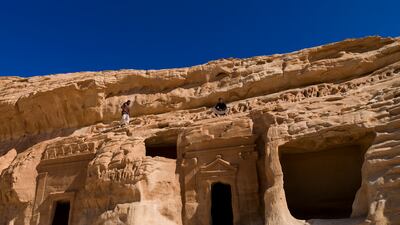
• Ancient Nabataean carved tombs at the archaeological site of Al Hijr, near the north-western Saudi city of AlUla. All photos by AFP
    Ancient Nabataean carved tombs at the archaeological site of Al Hijr, near the north-western Saudi city of AlUla. All photos by AFP
  • Al Hijr, or Hegra, includes 111 tombs built about 2,000 years ago, most with decorated facades.
    Al Hijr, or Hegra, includes 111 tombs built about 2,000 years ago, most with decorated facades.
  • An ornately carved entrance at the site, which also has cave drawings and some pre-Nabataean inscriptions.
    An ornately carved entrance at the site, which also has cave drawings and some pre-Nabataean inscriptions.
  • The Unesco World Heritage-listed archaeological site is now open to tourists.
    The Unesco World Heritage-listed archaeological site is now open to tourists.
  • Giant boulders guard the entrance to the site, whose tombs are carved from the natural rock.
    Giant boulders guard the entrance to the site, whose tombs are carved from the natural rock.
  • Al Hijr is the largest conserved Nabataean site south of Petra in Jordan.
    Al Hijr is the largest conserved Nabataean site south of Petra in Jordan.
  • The scale of the monuments is awe-inspiring.
    The scale of the monuments is awe-inspiring.
  • A tour group at the site.
    A tour group at the site.
  • The builders of the tombs drew on decorative and architectural influences from the Assyrian, Egyptian, Phoenician and Hellenistic cultures.
    The builders of the tombs drew on decorative and architectural influences from the Assyrian, Egyptian, Phoenician and Hellenistic cultures.
  • The local climate has kept the carved facades in a remarkable state of preservation.
    The local climate has kept the carved facades in a remarkable state of preservation.
  • The site bears testimony to a culture able to master a forbidding environment.
    The site bears testimony to a culture able to master a forbidding environment.

Saudi Arabia registers 101 archaeological and historical sites


Mona Farag
  • English
  • Arabic

Saudi Arabia's Heritage Commission announced on Wednesday the registration of 101 new archaeological and historical sites.

The new sites have been added to the kingdom's National Antiquities Register, bringing the total number of registered archaeological sites to 8,528.

Eighty-one of the newly added sites are in Hail, with nine in Tabuk, six in Madinah, three in Qasim, and one site each in the Asir and Jouf regions.

The commission aims to officially register the kingdom’s archaeological and historical sites in the National Antiquities Register and put them on digital maps to facilitate their administration, protection and preservation.

The commission registered 253 new archaeological and historical sites in April, part of efforts to explore and document those sites.

It also aims to build a special database for registered archaeological sites, as well as archive documents and photographs of heritage sites.

The commission is calling on the public to report the discovery of archaeological sites through the Balagh platform, commending the efforts of citizens in preserving the kingdom’s heritage.

Last year, Saudi Arabia’s Heritage Commission revealed that 14 archaeological sites of significant historical heritage were registered in the second quarter alone.

Guillaume Charloux, of the French National Centre for Scientific Research, had told The National the findings in the kingdom were “unparalleled in Arabia”.

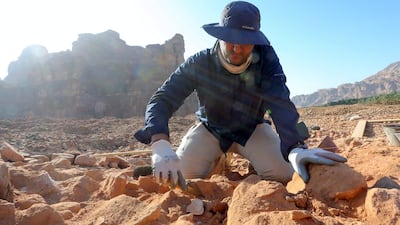
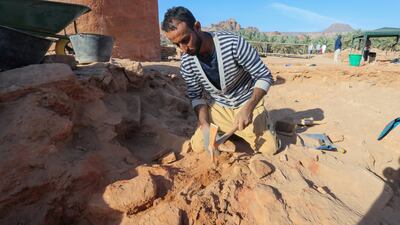
  • French archaeologists in AlUla, Saudi Arabia, clean pottery to examine findings from the Dadan and Lihyan civilisation dating back to the second half of the first millennium BC. Reuters
    French archaeologists in AlUla, Saudi Arabia, clean pottery to examine findings from the Dadan and Lihyan civilisation dating back to the second half of the first millennium BC. Reuters
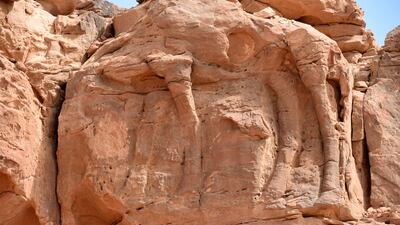
  • This carved camel's body can be seen eight kilometres north of the city of Sakaka in Saudi Arabia's northwestern Al Jouf province. AFP
    This carved camel's body can be seen eight kilometres north of the city of Sakaka in Saudi Arabia's northwestern Al Jouf province. AFP
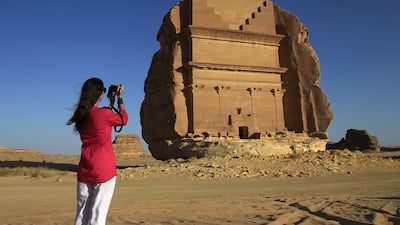
  • A foreign tourist visits Abu Lawha, the largest Nabataean tomb at the desert archaeological site of Madain Saleh, north-west of Riyadh, Saudi Arabia. AP Photo
    A foreign tourist visits Abu Lawha, the largest Nabataean tomb at the desert archaeological site of Madain Saleh, north-west of Riyadh, Saudi Arabia. AP Photo
  • Carvings of camels and horses hewn into rock faces in Saudi Arabia could be around 7,000 years old. AFP
    Carvings of camels and horses hewn into rock faces in Saudi Arabia could be around 7,000 years old. AFP
  • A Saudi archaeologist carefully cleans pottery. Reuters
    A Saudi archaeologist carefully cleans pottery. Reuters
  • Much care must be taken when examining the findings. Reuters
    Much care must be taken when examining the findings. Reuters
  • A Nabataean tomb in Madain Saleh archaeological site, Al Madinah Province, AlUla, Saudi Arabia. Getty Images
    A Nabataean tomb in Madain Saleh archaeological site, Al Madinah Province, AlUla, Saudi Arabia. Getty Images
Updated: October 13, 2022, 8:16 AM