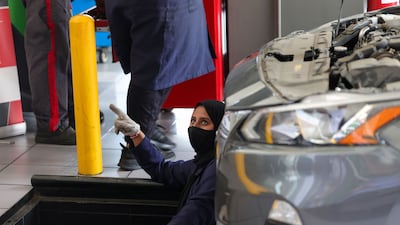
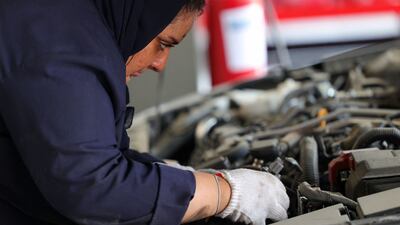
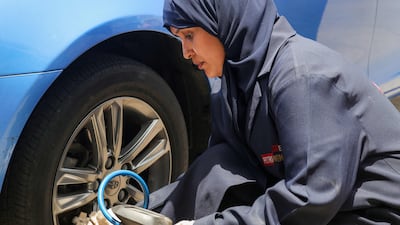
Saudi women will soon drive Haramain trains between the two holy cities of Islam, Makkah and Madinah, and take on other jobs in the transport sector.
Saleh Al Jasser, Minister of Transport and Logistics, said the country is working towards localising jobs, which includes women, in every sector, including transport.
Thirty-one Saudi women completed their first phase of training last month, which began in March this year. The trainees completed a total of 483 hours of training in theory, general knowledge, work hazards, fire outbreak, traffic and safety regulations, and other technical aspects pertaining to train and railway infrastructure.
The women will drive the bullet trains between the cities of Makkah and Madinah after a year of paid training.
A job advert that went up in February to recruit female train drivers in Saudi Arabia attracted 28,000 applicants, showing the scale of pent-up demand as the kingdom opens up more opportunities to women.
Mr Al Jasser said women in the workforce is integral to the country and that in the coming months, highly trained and qualified Saudi women will be leading trains of the two holy mosques.
The contribution of the female workforce is developing significantly, and women will be seen working in many jobs in the near future, the minister said.
The development of the transport sector also helps to empower other sectors by increasing efficiency to serve the industry, including tourism, Hajj and Umrah, and other partner companies.
Eighteen other jobs in the transport sector will be localised during the next year.
The transport sector is working to increase the proportion of Saudis in the labour market, including localising all pilot positions, the minister said, and that jobs such as air controller, and co-pilot have been localised.
Renfe, the Spanish company managing the high-speed rail, and the Saudi Railway Politechnic are training Saudi women and have so far trained more than 130 Saudi citizens over the past nine years.

Scores
Rajasthan Royals 160-8 (20 ov)
Kolkata Knight Riders 163-3 (18.5 ov)
UNSC Elections 2022-23
Seats open:
- Two for Africa Group
- One for Asia-Pacific Group (traditionally Arab state or Tunisia)
- One for Latin America and Caribbean Group
- One for Eastern Europe Group
Countries so far running:
ARGENTINA SQUAD
Goalkeepers: Franco Armani, Agustin Marchesin, Esteban Andrada
Defenders: Juan Foyth, Nicolas Otamendi, German Pezzella, Nicolas Tagliafico, Ramiro Funes Mori, Renzo Saravia, Marcos Acuna, Milton Casco
Midfielders: Leandro Paredes, Guido Rodriguez, Giovani Lo Celso, Exequiel Palacios, Roberto Pereyra, Rodrigo De Paul, Angel Di Maria
Forwards: Lionel Messi, Sergio Aguero, Lautaro Martinez, Paulo Dybala, Matias Suarez
Ten tax points to be aware of in 2026
1. Domestic VAT refund amendments: request your refund within five years
If a business does not apply for the refund on time, they lose their credit.
2. E-invoicing in the UAE
Businesses should continue preparing for the implementation of e-invoicing in the UAE, with 2026 a preparation and transition period ahead of phased mandatory adoption.
3. More tax audits
Tax authorities are increasingly using data already available across multiple filings to identify audit risks.
4. More beneficial VAT and excise tax penalty regime
Tax disputes are expected to become more frequent and more structured, with clearer administrative objection and appeal processes. The UAE has adopted a new penalty regime for VAT and excise disputes, which now mirrors the penalty regime for corporate tax.
5. Greater emphasis on statutory audit
There is a greater need for the accuracy of financial statements. The International Financial Reporting Standards standards need to be strictly adhered to and, as a result, the quality of the audits will need to increase.
6. Further transfer pricing enforcement
Transfer pricing enforcement, which refers to the practice of establishing prices for internal transactions between related entities, is expected to broaden in scope. The UAE will shortly open the possibility to negotiate advance pricing agreements, or essentially rulings for transfer pricing purposes.
7. Limited time periods for audits
Recent amendments also introduce a default five-year limitation period for tax audits and assessments, subject to specific statutory exceptions. While the standard audit and assessment period is five years, this may be extended to up to 15 years in cases involving fraud or tax evasion.
8. Pillar 2 implementation
Many multinational groups will begin to feel the practical effect of the Domestic Minimum Top-Up Tax (DMTT), the UAE's implementation of the OECD’s global minimum tax under Pillar 2. While the rules apply for financial years starting on or after January 1, 2025, it is 2026 that marks the transition to an operational phase.
9. Reduced compliance obligations for imported goods and services
Businesses that apply the reverse-charge mechanism for VAT purposes in the UAE may benefit from reduced compliance obligations.
10. Substance and CbC reporting focus
Tax authorities are expected to continue strengthening the enforcement of economic substance and Country-by-Country (CbC) reporting frameworks. In the UAE, these regimes are increasingly being used as risk-assessment tools, providing tax authorities with a comprehensive view of multinational groups’ global footprints and enabling them to assess whether profits are aligned with real economic activity.
Contributed by Thomas Vanhee and Hend Rashwan, Aurifer
The%20pillars%20of%20the%20Dubai%20Metaverse%20Strategy
%3Cp%3EEncourage%20innovation%20in%20the%20metaverse%20field%20and%20boost%20economic%20contribution%3C%2Fp%3E%0A%3Cp%3EDevelop%20outstanding%20talents%20through%20education%20and%20training%3C%2Fp%3E%0A%3Cp%3EDevelop%20applications%20and%20the%20way%20they%20are%20used%20in%20Dubai's%20government%20institutions%3C%2Fp%3E%0A%3Cp%3EAdopt%2C%20expand%20and%20promote%20secure%20platforms%20globally%3C%2Fp%3E%0A%3Cp%3EDevelop%20the%20infrastructure%20and%20regulations%3C%2Fp%3E%0A