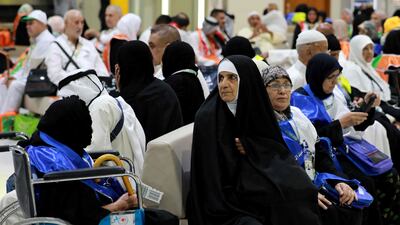
Muslim pilgrims perform prayers around the Kaaba at the Grand Mosque in Makkah. AFP

When is Dhu Al Hijjah 2023 and why is it a holy month?


  • English
  • Arabic

When we speak of Hajj, one imagines huge crowds circling the Kaaba at Makkah, a sea of people in white ihrams and the stoning of the devil in Mina.

Spectacular images of the faithful captured from Mount Arafat are beamed across the world.

But the entire month of Dhu Al Hijjah is holy, with a series of days important to the Muslim faith.

This year, the first day of this revered month fell on June 19 of the Gregorian calendar.

Even before the Hajj journey itself, Muslims observe other holy days. Here is our guide:

Why is the entire month of Dhu Al Hijjah holy?

The 12th and final month of the Islamic calendar is considered one of the four sacred months for Muslims, called Al Ash-hur Al Hurom.

These months are Rajab, (the seventh month), Dhu Al Qaeda (11th), Dhu Al Hijjah (12th) and Muharram (first).

During these months, war is prohibited unless out of necessity and only in self-defence. Performing as many forms of worship as possible is greatly encouraged.

The Quran reads: “Lo! The number of the months with Allah is twelve months by Allah’s ordinance in the day that He created the heavens and the earth. Four of them are sacred.” (Surat At-Tawbah 36).

Dhu Al Hijjah consists of 29 or 30 days and its literal translation means Possessor of the Pilgrimage or the Month of the Pilgrimage.

The month was associated with Hajj before Islam was revealed to the Prophet Mohammed. In pre-Islamic times, Arabs would refrain from raids and wars and go on pilgrimage.

After Islam was established and the people of Makkah accepted the faith, the Prophet Mohammed and his companions performed Hajj.

During that pilgrimage, Muslims witnessed the rituals and, to this day, still follow the Prophet Mohammed’s lead and benefit from his Hadiths, which clarify many Hajj practices.

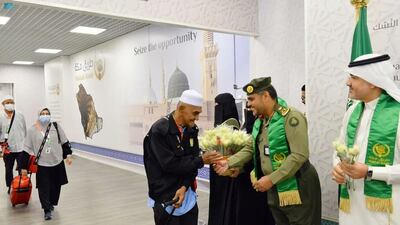
  • Yemeni Muslims prepare to board a flight heading to Makkah. AFP
    Yemeni Muslims prepare to board a flight heading to Makkah. AFP
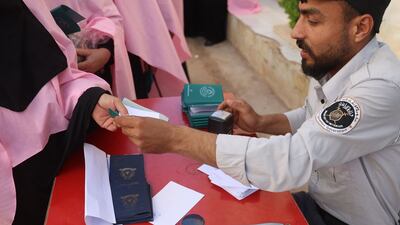
  • A passport control officer checks the travel documents of a Palestinian pilgrim at the Rafah crossing point with Egypt in the southern Gaza Strip. AFP
    A passport control officer checks the travel documents of a Palestinian pilgrim at the Rafah crossing point with Egypt in the southern Gaza Strip. AFP
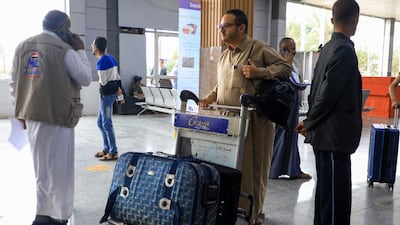
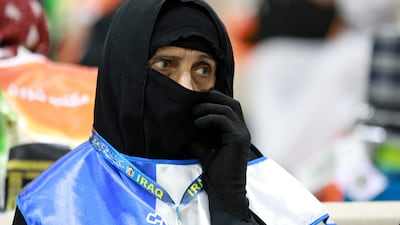
  • Iraqi pilgrims prepare to fly to Makkah for Haj, at Baghdad airport. AP Photo
    Iraqi pilgrims prepare to fly to Makkah for Haj, at Baghdad airport. AP Photo
  • Palestinian pilgrims at the Rafah crossing point with Egypt in the southern Gaza Strip. AFP
    Palestinian pilgrims at the Rafah crossing point with Egypt in the southern Gaza Strip. AFP
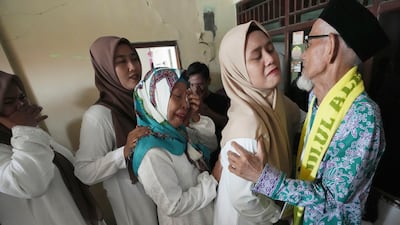
  • Husin bin Nisan, right, bids farewell to relatives before departure for the Hajj pilgrimage at his house in Tangerang, Indonesia. AP Photo
    Husin bin Nisan, right, bids farewell to relatives before departure for the Hajj pilgrimage at his house in Tangerang, Indonesia. AP Photo
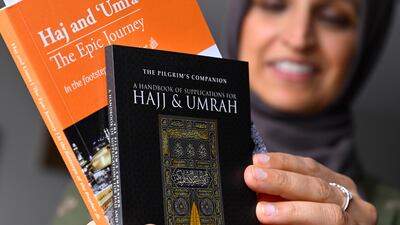
  • Saadiha Khaliq with books she read to prepare for her pilgrimage, in Murfreesboro, Tennessee. The Khaliq family plan to travel together to Makkah in Saudi Arabia for Hajj. AP Photo
    Saadiha Khaliq with books she read to prepare for her pilgrimage, in Murfreesboro, Tennessee. The Khaliq family plan to travel together to Makkah in Saudi Arabia for Hajj. AP Photo
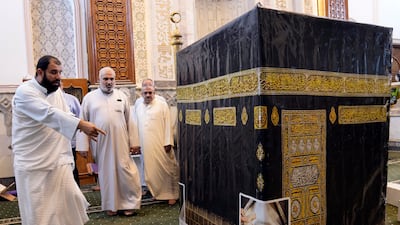
  • Iraqi pilgrims walk around the model of Kaaba during a lecture on performing the Hajj rituals in Tikrit, Iraq. AP Photo
    Iraqi pilgrims walk around the model of Kaaba during a lecture on performing the Hajj rituals in Tikrit, Iraq. AP Photo
  • Syrian pilgrims register for a training session on how to perform Hajj rituals in Hazzanu, Idlib province. AFP
    Syrian pilgrims register for a training session on how to perform Hajj rituals in Hazzanu, Idlib province. AFP
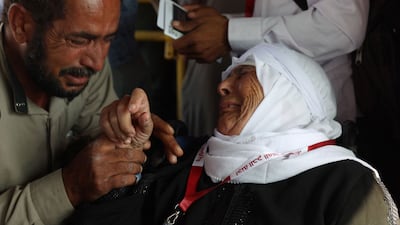
  • A Syrian man bids an elderly woman farewell as Hajj pilgrims board a bus in Sarmada on the first leg of their journey to Saudi Arabia. AFP
    A Syrian man bids an elderly woman farewell as Hajj pilgrims board a bus in Sarmada on the first leg of their journey to Saudi Arabia. AFP
  • A man bids another farewell as pilgrims board a bus in Sarmada town before leaving for the annual Hajj pilgrimage. AFP
    A man bids another farewell as pilgrims board a bus in Sarmada town before leaving for the annual Hajj pilgrimage. AFP
  • People bid relatives farewell as pilgrims board a bus in Sarmada town in Syria's north-western Idlib province. AFP
    People bid relatives farewell as pilgrims board a bus in Sarmada town in Syria's north-western Idlib province. AFP
  • Muslim pilgrims arriving from north-western Syrian areas pass baggage checks at the Bab Al-Hawa border crossing with Turkey. AFP
    Muslim pilgrims arriving from north-western Syrian areas pass baggage checks at the Bab Al-Hawa border crossing with Turkey. AFP
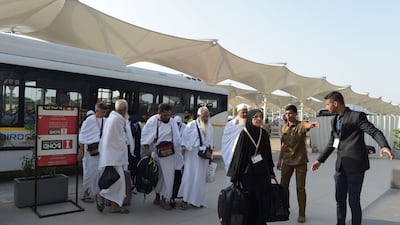
  • Pilgrims arrive at Sardar Vallabhbhai Patel International Airport in Ahmedabad, India, as they prepare to fly to Saudi Arabia. AFP
    Pilgrims arrive at Sardar Vallabhbhai Patel International Airport in Ahmedabad, India, as they prepare to fly to Saudi Arabia. AFP
  • A Kashmiri pilgrim waves goodbye. EPA
    A Kashmiri pilgrim waves goodbye. EPA
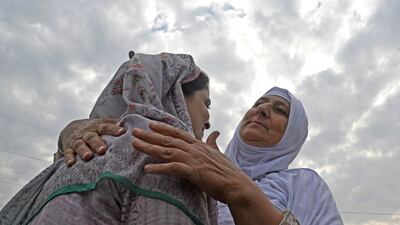
  • A pilgrim is embraced by her relative before leaving for the annual Hajj pilgrimage. AFP
    A pilgrim is embraced by her relative before leaving for the annual Hajj pilgrimage. AFP
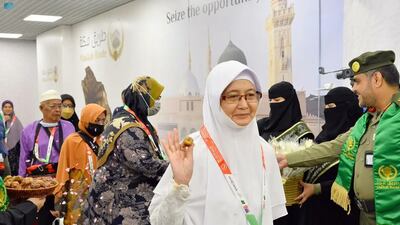
  • The first flights from Malaysia have arrived in Saudi Arabia under the Makkah Route Initiative. SPA
    The first flights from Malaysia have arrived in Saudi Arabia under the Makkah Route Initiative. SPA
  • It has been expanded to Turkey and the Ivory Coast this year, joining Pakistan, Malaysia, Indonesia, Morocco and Bangladesh. SPA
    It has been expanded to Turkey and the Ivory Coast this year, joining Pakistan, Malaysia, Indonesia, Morocco and Bangladesh. SPA
  • All Hajj pilgrims this year must be fully vaccinated against Covid-19 and aged under 65. AFP
    All Hajj pilgrims this year must be fully vaccinated against Covid-19 and aged under 65. AFP
  • They must also present a negative PCR test conducted within 72 hours of their departure flight. AFP
    They must also present a negative PCR test conducted within 72 hours of their departure flight. AFP
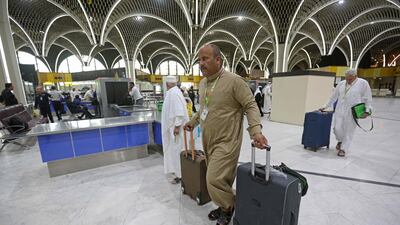
  • A pilgrim takes his luggage after inspection in Baghdad. AFP
    A pilgrim takes his luggage after inspection in Baghdad. AFP
  • Hajj is one of the five pillars of Islam and a once-in-a-lifetime obligation for every Muslim. AFP
    Hajj is one of the five pillars of Islam and a once-in-a-lifetime obligation for every Muslim. AFP

Ashr Dhu Al Hijjah

The first 10 days of Dhu Hijjah, starting on the eve of the month, are of great reverence for Muslims as Allah swears with them: “By the dawn. And 10 nights.” (Surat Al-Fajr).

In their interpretations, Muslim scholars placed tremendous weight on good deeds performed during this period. They even declared it to be of greater importance than jihad. Fasting comes on the top of the list. Unlike Ramadan, this fasting is not mandatory, but it is mustahab, or recommended.

During the first third of Dhu Al Hijjah, Muslims are encouraged to recite the Quran, remember God (dhikr) and give to charity. Residents in Makkah provide supplies for the pilgrims.

The most important day to fast is day nine of Dhu Al Hijjah, which marks the start of the Hajj journey. This day is called Arafat day, when pilgrims set off for Mount Arafat and stay there until sunset.

Prayers are believed to be answered on this day and it is the holiest day in the year for Muslims.

During Hajj, pilgrims are advised not to fast so they can be at full strength to carry out the pilgrimage.

However, Muslims who are not performing Hajj can still enjoy many of its blessings by fasting.

Eid Al Adha

The tenth day of Dhu Al Hijjah marks the first day of Eid Al Adha.

The name Eid Al Adha is derived from the Arabic word Al Udhiya, which means animal sacrifice.

Each year, Muslims who have the financial means sacrifice their best halal domestic animals (usually a cow, but it can also be a camel, goat or sheep depending on the region) as a symbol of Ibrahim's willingness to sacrifice his son, Ismail.

A portion of the meat is kept for the family and their neighbours but most of it is distributed to those in need. Donors can organise for the sacrifice to be held in another region or country, where there are more people in need.

Eid Al Adha is also known in Egypt as Eid Al Lahma, which means the “meat Eid”. Another commonly used name in Arab countries is Al Eid Al Kabeer, meaning the Grand Eid. It is known as the Grand Eid because it is longer than Eid Al Fitr, which is celebrated at the end of Ramadan.

Eid Al Adha is four days. The first day has Eid prayers in the morning, after which the sacrifice is held (Muslims can delay offering the sacrifice by up to the three days).

The next three days, which are also considered Eid, are called Ayyam Al Tashreeq.

What is Ayyam Al Tashreeq?

The Prophet Mohammed described these days as “the days of eating, drinking and praising of God”.

Pilgrims spent Ayyam Al Tashreeq in Mina and perform the ritual of stoning each day, while also praying and enjoying food.

Those not performing Hajj spend these days visiting families and remembering God.

Another social custom that is traditional during both Eids in most Arab countries is Eidiyyah.

Eidiyyah is a small amount of money – and sometimes sweets – distributed to children after Eid prayers and during family gatherings.


Springtime in a Broken Mirror,
Mario Benedetti, Penguin Modern Classics


The biog

Siblings: five brothers and one sister

Education: Bachelors in Political Science at the University of Minnesota

Interests: Swimming, tennis and the gym

Favourite place: UAE

Favourite packet food on the trip: pasta primavera

What he did to pass the time during the trip: listen to audio books

What is Folia?

Prince Khaled bin Alwaleed bin Talal's new plant-based menu will launch at Four Seasons hotels in Dubai this November. A desire to cater to people looking for clean, healthy meals beyond green salad is what inspired Prince Khaled and American celebrity chef Matthew Kenney to create Folia. The word means "from the leaves" in Latin, and the exclusive menu offers fine plant-based cuisine across Four Seasons properties in Los Angeles, Bahrain and, soon, Dubai.

Kenney specialises in vegan cuisine and is the founder of Plant Food Wine and 20 other restaurants worldwide. "I’ve always appreciated Matthew’s work," says the Saudi royal. "He has a singular culinary talent and his approach to plant-based dining is prescient and unrivalled. I was a fan of his long before we established our professional relationship."

Folia first launched at The Four Seasons Hotel Los Angeles at Beverly Hills in July 2018. It is available at the poolside Cabana Restaurant and for in-room dining across the property, as well as in its private event space. The food is vibrant and colourful, full of fresh dishes such as the hearts of palm ceviche with California fruit, vegetables and edible flowers; green hearb tacos filled with roasted squash and king oyster barbacoa; and a savoury coconut cream pie with macadamia crust.

In March 2019, the Folia menu reached Gulf shores, as it was introduced at the Four Seasons Hotel Bahrain Bay, where it is served at the Bay View Lounge. Next, on Tuesday, November 1 – also known as World Vegan Day – it will come to the UAE, to the Four Seasons Resort Dubai at Jumeirah Beach and the Four Seasons DIFC, both properties Prince Khaled has spent "considerable time at and love". 

There are also plans to take Folia to several more locations throughout the Middle East and Europe.

While health-conscious diners will be attracted to the concept, Prince Khaled is careful to stress Folia is "not meant for a specific subset of customers. It is meant for everyone who wants a culinary experience without the negative impact that eating out so often comes with."

Company profile

Date started: December 24, 2018

Founders: Omer Gurel, chief executive and co-founder and Edebali Sener, co-founder and chief technology officer

Based: Dubai Media City

Number of employees: 42 (34 in Dubai and a tech team of eight in Ankara, Turkey)

Sector: ConsumerTech and FinTech

Cashflow: Almost $1 million a year

Funding: Series A funding of $2.5m with Series B plans for May 2020

Mercer, the investment consulting arm of US services company Marsh & McLennan, expects its wealth division to at least double its assets under management (AUM) in the Middle East as wealth in the region continues to grow despite economic headwinds, a company official said.

Mercer Wealth, which globally has $160 billion in AUM, plans to boost its AUM in the region to $2-$3bn in the next 2-3 years from the present $1bn, said Yasir AbuShaban, a Dubai-based principal with Mercer Wealth.

Within the next two to three years, we are looking at reaching $2 to $3 billion as a conservative estimate and we do see an opportunity to do so,” said Mr AbuShaban.

Mercer does not directly make investments, but allocates clients’ money they have discretion to, to professional asset managers. They also provide advice to clients.

“We have buying power. We can negotiate on their (client’s) behalf with asset managers to provide them lower fees than they otherwise would have to get on their own,” he added.

Mercer Wealth’s clients include sovereign wealth funds, family offices, and insurance companies among others.

From its office in Dubai, Mercer also looks after Africa, India and Turkey, where they also see opportunity for growth.

Wealth creation in Middle East and Africa (MEA) grew 8.5 per cent to $8.1 trillion last year from $7.5tn in 2015, higher than last year’s global average of 6 per cent and the second-highest growth in a region after Asia-Pacific which grew 9.9 per cent, according to consultancy Boston Consulting Group (BCG). In the region, where wealth grew just 1.9 per cent in 2015 compared with 2014, a pickup in oil prices has helped in wealth generation.

BCG is forecasting MEA wealth will rise to $12tn by 2021, growing at an annual average of 8 per cent.

Drivers of wealth generation in the region will be split evenly between new wealth creation and growth of performance of existing assets, according to BCG.

Another general trend in the region is clients’ looking for a comprehensive approach to investing, according to Mr AbuShaban.

“Institutional investors or some of the families are seeing a slowdown in the available capital they have to invest and in that sense they are looking at optimizing the way they manage their portfolios and making sure they are not investing haphazardly and different parts of their investment are working together,” said Mr AbuShaban.

Some clients also have a higher appetite for risk, given the low interest-rate environment that does not provide enough yield for some institutional investors. These clients are keen to invest in illiquid assets, such as private equity and infrastructure.

“What we have seen is a desire for higher returns in what has been a low-return environment specifically in various fixed income or bonds,” he said.

“In this environment, we have seen a de facto increase in the risk that clients are taking in things like illiquid investments, private equity investments, infrastructure and private debt, those kind of investments were higher illiquidity results in incrementally higher returns.”

The Abu Dhabi Investment Authority, one of the largest sovereign wealth funds, said in its 2016 report that has gradually increased its exposure in direct private equity and private credit transactions, mainly in Asian markets and especially in China and India. The authority’s private equity department focused on structured equities owing to “their defensive characteristics.”

MATCH INFO

Uefa Champions League semi-final, second leg result:

Ajax 2-3 Tottenham

Tottenham advance on away goals rule after tie ends 3-3 on aggregate

Final: June 1, Madrid

WandaVision

Starring: Elizabeth Olsen, Paul Bettany

Directed by: Matt Shakman

Rating: Four stars

Your Guide to the Home
  • Level 1 has a valet service if you choose not to park in the basement level. This level houses all the kitchenware, including covetable brand French Bull, along with a wide array of outdoor furnishings, lamps and lighting solutions, textiles like curtains, towels, cushions and bedding, and plenty of other home accessories.
  • Level 2 features curated inspiration zones and solutions for bedrooms, living rooms and dining spaces. This is also where you’d go to customise your sofas and beds, and pick and choose from more than a dozen mattress options.
  • Level 3 features The Home’s “man cave” set-up and a display of industrial and rustic furnishings. This level also has a mother’s room, a play area for children with staff to watch over the kids, furniture for nurseries and children’s rooms, and the store’s design studio.
     
Tips to stay safe during hot weather
  • Stay hydrated: Drink plenty of fluids, especially water. Avoid alcohol and caffeine, which can increase dehydration.
  • Seek cool environments: Use air conditioning, fans, or visit community spaces with climate control.
  • Limit outdoor activities: Avoid strenuous activity during peak heat. If outside, seek shade and wear a wide-brimmed hat.
  • Dress appropriately: Wear lightweight, loose and light-coloured clothing to facilitate heat loss.
  • Check on vulnerable people: Regularly check in on elderly neighbours, young children and those with health conditions.
  • Home adaptations: Use blinds or curtains to block sunlight, avoid using ovens or stoves, and ventilate living spaces during cooler hours.
  • Recognise heat illness: Learn the signs of heat exhaustion and heat stroke (dizziness, confusion, rapid pulse, nausea), and seek medical attention if symptoms occur.
Sour%20Grapes
%3Cp%3E%3Cstrong%3EAuthor%3A%20%3C%2Fstrong%3EZakaria%20Tamer%3Cbr%3E%3Cstrong%3EPublisher%3A%20%3C%2Fstrong%3ESyracuse%20University%20Press%3Cbr%3E%3Cstrong%3EPages%3A%20%3C%2Fstrong%3E176%3C%2Fp%3E%0A

THE SPECS

Engine: 3-litre V6

Transmission: eight-speed automatic

Power: 424hp

Torque: 580 Nm

Price: From Dh399,000

On sale: Now

Mina Cup winners

Under 12 – Minerva Academy

Under 14 – Unam Pumas

Under 16 – Fursan Hispania

Under 18 – Madenat

COMPANY PROFILE
Name: Kumulus Water
 
Started: 2021
 
Founders: Iheb Triki and Mohamed Ali Abid
 
Based: Tunisia 
 
Sector: Water technology 
 
Number of staff: 22 
 
Investment raised: $4 million 
Dhadak 2

Director: Shazia Iqbal

Starring: Siddhant Chaturvedi, Triptii Dimri 

Rating: 1/5