



Read the latest updates on the Hajj pilgrimage here
There was an unmistakable face among the hundreds of thousands of pilgrims who made the journey to Makkah for Hajj in 1972.
Wearing the simple white cotton robes worn by all men who carry out the pilgrimage was Muhammad Ali. The self-styled greatest heavyweight boxing champion of the world was instantly recognisable, even to those with little interest in the sport.
A photographer was there to capture the moment when Ali bent down to kiss the Black Stone, or Hajar Al Aswad, in the Kaaba.
That image should have represented the high point of Ali’s spiritual journey, the pilgrimage to Makkah that all able Muslims are required to perform and one of the five pillars of Islam.
"I have had many nice moments in my life, but the feelings I had while standing on Mount Arafat on the day of the Hajj was the most unique,” he told Saudi newspaper Al Madinah in 1989.
“I felt exalted by the indescribable spiritual atmosphere as over one and a half million pilgrims invoked God to forgive them for their sins and bestow on them His choicest blessings."
But the branch of Islam the boxer followed at the time was on the far fringes of the religion and his views were regarded as extreme by many Muslims. Within a few years of the pilgrimage, a crisis of belief would lead him to reassess the direction of his faith.
Born into a devout Christian family, the young Ali, who was baptised as Cassius Marcellus Clay Jr, was heavily influenced by his mother. “Momma Bird” Odessa Clay regularly took her son to worship at the King Solomon Missionary Baptist Church in Louisville, Kentucky.
His religious views began to change as a teenager, the result of the racism and segregation he experienced growing up in the southern US state.
Following his own path

At the age of 16, Ali started down the path to his conversion to Islam. He was influenced by a cartoon in a newspaper published by the Nation of Islam, a religious and political group in the US. The image showed a black Muslim slave being beaten by a white overseer because of his faith.
Ali later wrote to his second wife, Khalilah, that “the thing that attracted me to Islam was a cartoon".
Some months earlier he had taken part in a Golden Gloves tournament in Chicago, buying a record he would play repeatedly. “A White Man’s heaven is a Black Man’s hell” was recorded by a Calypso singer called Louis Farrakhan, a black supremacist who is now the leader of the Nation of Islam.
Ali's anger towards white society in the US came to a head in 1960, when he was 18. He returned in triumph from the Olympic Games in Rome having won the gold medal for boxing in the light heavyweight division.
As a national hero, he believed he would be treated differently. Reality hit him hard when he was turned away from a restaurant in Louisville because of his race. It was reported that he threw his medal into the Ohio River in disgust, saying years later “that was the moment I became a Muslim".
Ali soon left Kentucky, moving to Miami to train for his first title fight and worshipping for the first time at the city’s Al Ansar Mosque, which was run by the Nation of Islam.
His faith was a closely guarded secret at the time owing to fears it could cost him the title fight with Sonny Liston because of prejudice against black Muslims.
Making a name for himself after historic victory

In public, Ali spoke of going to church. On the eve of the fight, in February 1964, it was reported that he prayed. Only a handful of people knew he did so as a Muslim and had been accompanied by American Muslim leader and civil rights figure Malcolm X.
Ali’s defeat of Liston shook the world of boxing, as did his public declaration a day later that he was a Muslim.
He later said Cassius Clay was a slave name. He was named after his father, who ha named after a member of the white Clay family, a committed abolitionist and opponent of slavery in the 19th century.
The boxer's new name honoured Ali, son-in-law of the Prophet Mohammed, with the first name being a tribute to Elijah Muhammad, the leader of the Nation of Islam at the time.
The Nation of Islam was a product of the oppression of black people in the US. It claimed the white race was created to oppress black people by a scientist named Yakub.
It said a space ship would arrive and wipe out life on Earth for a 1,000 years. Ali once claimed he saw the ship during an early morning training run.
Ali expressed the views of the organisation and its charismatic spokesman Malcolm X.
Ali opposed desegregation, going against Christian civil rights activists such as Martin Luther King, and said self-help was the only way forward for black Americans.
He described white people as “blue-eyed, blonde-haired devils".
Ali reigns again before spiritual journey
-

-
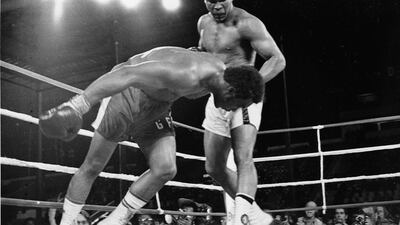
Muhammad Ali watches George Foreman fall to the canvas during their Rumble in the Jungle. AP Photo -
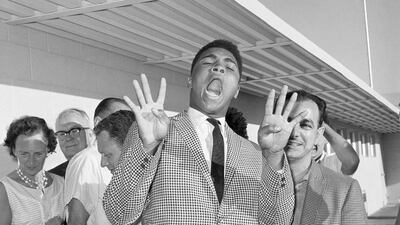
Muhammad Ali pictured at Las Vegas Airport in 1963. Jerry Abbott / EPA -

Muhammad Ali training ahead of his heavyweight fight against British Richard Dunn. Istvan Bajzat / EPA


After refusing to be drafted to fight in the Vietnam War on religious grounds, Ali was stripped of his heavyweight title in 1967 and warned he could be jailed.
In 1971, the Supreme Court upheld his status as a conscientious objector and overturned the ruling that he evaded the draft.
His passport, which was taken away with his title, was returned and in January 1972 Ali flew to Makkah to perform Hajj. He also met members of Saudi Arabia's royal family.
By now an admired figure in the Muslim and Arab world, Ali said the experience of visiting the Prophet Mohammed’s tomb in Madinah gave him faith that he could defeat Joe Frazier, who had beaten him a year earlier.
Ali would narrowly win against Frazier in 1974 and go on to reclaim his world title from George Foreman in the “Rumble in the Jungle” in Zaire.
Ali's religious views were beginning to mature. His former mentor, Malcolm X, had split from the Nation of Islam after renouncing its views and was assassinated in 1965 by three members of the organisation.
Malcolm X had become a Sunni after performing Hajj and Ali followed suit in 1975, helped by the death of Elijah Muhammad the same year and the decision of the Nation of Islam to renounce its more extreme views.
Towards the end of his life, and suffering from Parkinson’s disease, Ali revealed in 2004 that he now was drawn to Sufism and later Sunni-Sufi Islam, as well a becoming increasingly tolerant of all faiths.
"Rivers, ponds, lakes and streams – they all are unique, but they all contain water,” he said.

