


Just two years into her reign, a young Queen Elizabeth II and her husband the Duke of Edinburgh left the UK for her first and longest Commonwealth tour as monarch. It lasted from November 1953 until May 1954, covering 44,000 miles and stopping in the West Indies, Australasia, Asia and Africa.
Towards the end of her epic trip, the royal ship S.S. Gothic docked in Aden for a brief visit.
South Yemen was a British protectorate at the time, with the northern part being an Imamate. By 1968, Yemen was free of colonial shackles and later formed into one republic.
Queen Elizabeth’s April 1954 visit saw the royal couple alight at Prince of Wales Pier where they were greeted by the Governor of Aden, Sir Tom Hickinbotham, and other British dignitaries.
The pair travelled in an open-top car from the pier to an enclosure nearby where they watched a military parade featuring the RAF, Aden Protectorate Levies, Armed Police, Government Guards, Hadhrami Bedouin Legion, and Somaliland Scouts.
Speeches were made in Arabic and English, and the queen knighted Air Marshal Sir Claude Pelly Commander-in-Chief of the RAF in the Middle East, and Abu Bakr bin Sheikh Al Kaff for services to peace in Hadramaut.
Sayyid Abu Bakr reportedly leant on a chair as his Muslim faith ruled out kneeling in front of the monarch.
Thousands turned out to see Queen Elizabeth.

“A vast crowd congregated along the royal route from the harbour to the parade ground, while, despite the intense heat, many others occupied all the vantage points for the witnessing of the ceremony,” London’s Sphere newspaper wrote of the visit.
Sultan Ghalib Al Qu'aiti, 74, remembers the day well. His grandfather, Sir Sultan Saleh bin Ghalib Al Qu’aiti, attended the welcome ceremony,
“She was received by large crowds of Adeni people who greeted her everywhere she went. She listened to a speech of welcome in Arabic made on behalf of the Protectorate chiefs by my grandfather … who presented Her Majesty with 100 tins of the best Hadhrami honey from Wadi Duan,” Mr Al Qu'aiti told The National, reflecting on a key moment in the Queen's 70 years as British head of state, being celebrated this weekend in the UK.
Abdullah Khalil, 82, says he remembers the buzz of the visit as he took up a position among the crowds of spectators.
“She was warmly received by huge crowds of people gathered near the pier and the clock tower in Attawahi city. The area surrounding the hotel was decorated with flags and banners hailing the queen and the prince,” Mr Khalil said.
“It was such a historical day. I still remember how excited I was that day because of the good life we were living at that time.”
A small bronze plaque still marks the spot of the Al Jumhuriyah hospital where the queen laid the foundation stone in 1954. The clinic remains open, albeit with a change of name in 1967, despite a huge bombardment by the Houthi rebel group in 2015.
The hospital was reopened after a UAE-funded restoration project, but has struggled to treat patients amid a six-year civil war.

“The hospital isn’t maintained or air-conditioned,” nurse Zubeida Said told AFP in March. “There are leaks in the bathrooms. The building is old and dilapidated.”
The hospital is a microcosm for Yemen itself.
Despite the clear negatives of colonialism in the country, Yemen’s current destruction and devastation has left some longing for the era of British control.
“The Aden which Queen Elizabeth visited in 1954 doesn't exist today,” Mr Khalil said.
Historian Nagmi Abdulmajid said during British control of Aden, the region was cosmopolitan and contained the second busiest harbour in the world. The queen’s visit even sparked a construction boom.
“This is why people miss the British not just in Aden but in the other countries colonised by them in the East " he said.
As a fragile truce holds between the Houthi rebels and the internationally-recognised government, Yemenis will be hoping to celebrate their future once more.
Queen Elizabeth's visits to the Region: in pictures
-
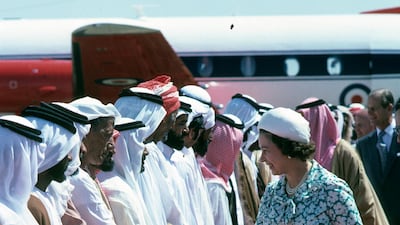
Queen Elizabeth II arrives in Abu Dhabi during a state visit to the Gulf on February 25, 1979. Getty -
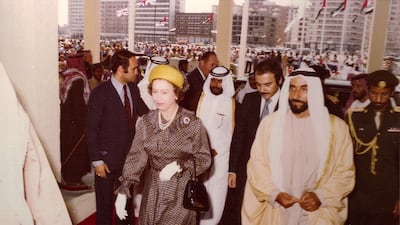
The UAE's Founding Father, Sheikh Zayed bin Sultan Al Nahyan, and the queen arrive for the inauguration of Le Meridien Abu Dhabi in 1979. Photo: Le Meridien Abu Dhabi -
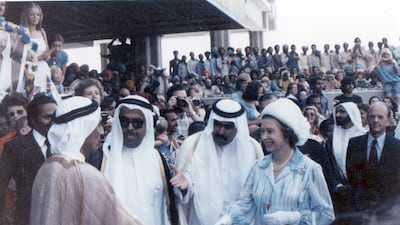
The queen during her visit to the UAE in 1979. Photo: Ramesh Shukla -

The queen appoints Sheikh Rashid, then Ruler of Dubai, a Knight Grand Cross of the Order of St Michael and St George, during her tour of the Gulf states, in Abu Dhabi in February 1979. Getty -
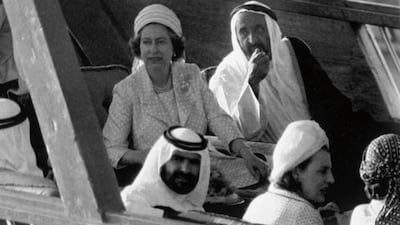
The queen sits with Sheikh Rashid on the Dubai Ruler's new dhow, as they are taken on a sightseeing tour of the emirate on February 26, 1979. AP -
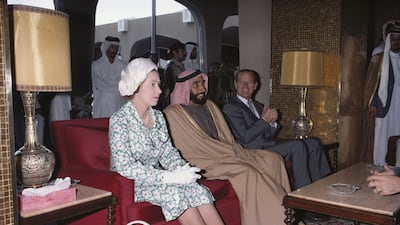
The queen, Sheikh Zayed and Prince Philip sit before lunch at the Hilton Hotel in Abu Dhabi, during the UK royals' tour of the Gulf states in February 1979. Getty -
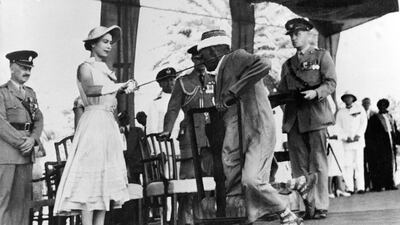
Yemeni councillor Sayyid Abubakr bin Shaikh Alkaff kneels before Queen Elizabeth to be knighted during her visit to Aden on April 29, 1954. AFP -
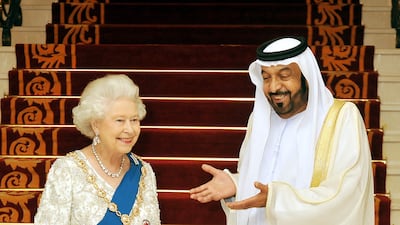
The queen with Sheikh Khalifa, who was then the UAE's President, at Mushrif Palace on November 25, 2010 in Abu Dhabi. Getty -
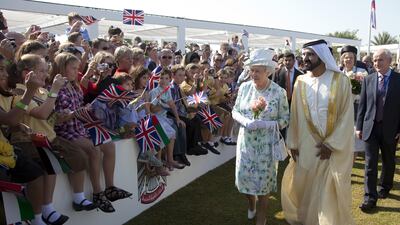
The queen was welcomed by Sheikh Mohammed bin Rashid, Vice President and Ruler of Dubai, during her visit to Abu Dhabi in 2010. Getty -
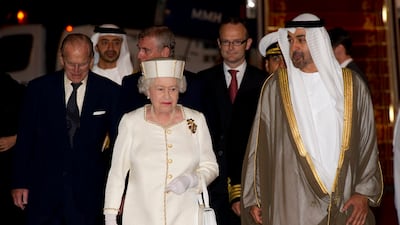
The queen and Prince Philip with President Sheikh Mohamed, then Crown Prince of Abu Dhabi, at Abu Dhabi airport on November 24, 2010. Getty -

The queen with the emir of Bahrain at a horse and camel race meeting in 1979. Getty -

Queen Elizabeth eats with her hands in the desert with King Hassan during her visit to Morocco on October 27, 1980. Getty -
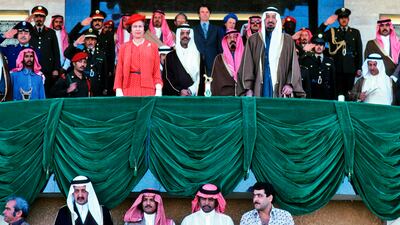
The queen attends the races during her visit to Saudi Arabia in February 1979. Getty -
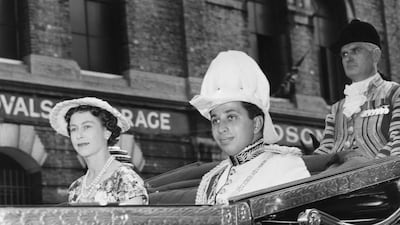
King Faisal II of Iraq and the queen leave Victoria Station in London for Buckingham Palace, in July 1956. Getty -
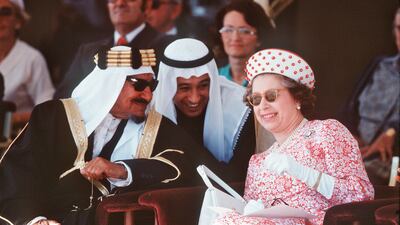
The queen in Kuwait during her tour of the Gulf in 1979. Getty -

The queen drives through Tunis with Tunisian President Habib Bourguiba during a state visit in October 1980. Getty -
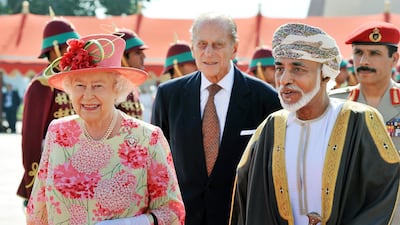
The queen walks towards her plane with Sultan Qaboos of Oman, before she and Prince Philip leave Muscat after a five-day state visit to the Gulf region. Getty -
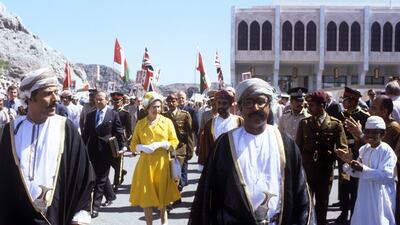
The queen walks in Muscat. Getty -
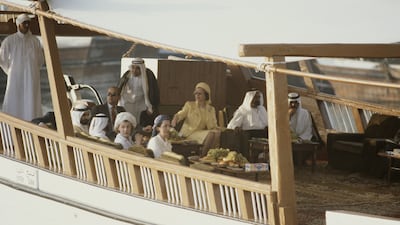
The queen and Prince Philip during a visit to Qatar in February 1979. Getty -
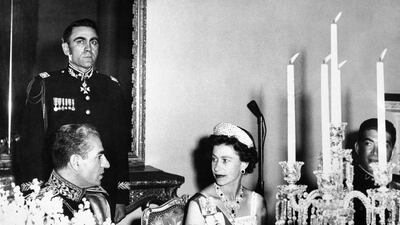
The queen with the Shah Mohammed Reza Pahlevi of Iran during a banquet in Tehran on March 2, 1961. AP -
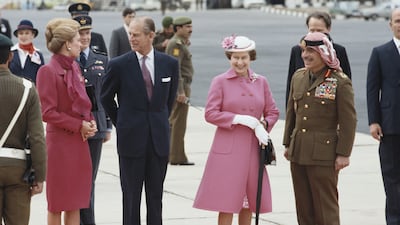
Queen Noor of Jordan, Prince Philip, Queen Elizabeth and King Hussein of Jordan after the British royals' arrival in the country in 1984. Getty -

The queen alongside former Algerian President Chadli Bendjedid, inspect a guard of honour on her arrival in Algiers for a three-day state visit in October 1980. Getty -
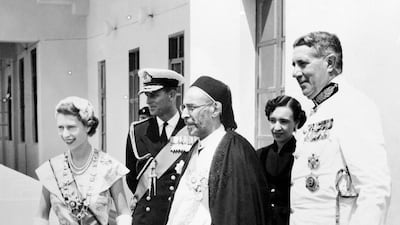
The queen and Prince Philip with King Idris of Libya at the Royal Palace in Tobruk in May 1954. AP



