


Abdullah Al Qarni's family says he dreamt of joining the military since he was a child.
Nearly five years after graduating from a Saudi Arabian military college, Al Qarni had attained the rank of captain and was on a short holiday to see his wife and newborn daughter in his home village of Shaaf, in the south-west province of Asir, when his battalion was called up to take part in Operation Desert Storm to liberate Kuwait.
The ground operation began in late February 1991, after more than a month of air strikes on Saddam Hussein's forces who had invaded Kuwait in August the previous year. Saudi forces went into battle alongside troops from more than 30 other nations as part of one of the biggest military coalitions since the Second World War.
The Iraqi forces in Kuwait were routed within days, but Al Qarni never returned.
In 2008 his older brother, Saleem Al Qarni, got a call from the Saudi Arabian military confirming the family's worst fears: he was dead, having spent nearly two decades in an Iraqi prison. But it took another 13 years to repatriate his remains.
Saudi Arabian authorities said they confirmed that the remains received belong to Al Qarni and decided to bury them at the Al Haram Martyrs' cemetery in the holy city of Makkah.
In Islamic tradition, soldiers who die in the line of duty are considered martyrs and given the greatest honours by their country. Muslims believe that martyrs go to paradise, have their sins forgiven when they breathe their last and shall feel no fear on the Day of Judgment.
“I’m speechless to explain what we felt when his martyrdom was confirmed to us,” Mr Al Qarni, a retired Saudi Arabian navy veteran, told state media at the burial on Thursday.
“His mother kept clinging to the hope that he would return home one day to his three daughters and wife. It was very hard on us all.”
He said the family kept praying that their son was still alive.
Al Qarni's father died in 2000 without learning of his son's fate. His mother died in 2015, while his wife died two years later.
It remains unclear why Al Qarni remained in Iraqi captivity and was not released along with 11 other Saudis taken as prisoners of war.
The reasons for the delay in getting back his remains are also unclear.
“It’s God's will and we are grateful,” his brother said.
“God does things a certain way and he must have chosen my brother to be among the martyrs. This is how we see it.”
In pictures: the 1991 Gulf War
-

American airforce F-15 C fighters flying over a Kuwaiti oilfield which had been torched by retreating Iraqi troops during the Gulf War. Getty Images -
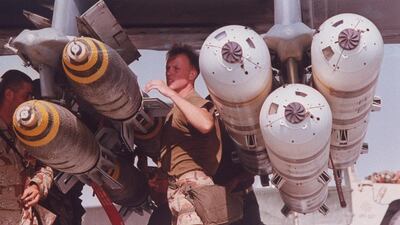
US Air Force ground crew loading 500-pound bombs onto an aircraft during operation Desert Storm - the mission to drive Iraqi forces out of Kuwait, January to February 1991. Mark Peters / Department Of Defence -

Gen Norman Schwarzkopf, commander-in-chief, US Central Command, presents the Legion of Merit to Maj Gen Muhammed Al Badi, chief of staff of the UAE Armed Forces, for his role in liberating Kuwait from occupying Iraqi forces during Operation Desert Storm. April 2, 1991. Corbis via Getty Images -

British engineers from the 7th armoured brigade in action on January 7 1991 in the Saudi Arabian desert. Patrick Baz / AFP -
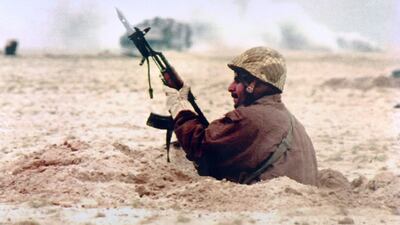
An Egyptian soldier holding a bayonet takes shelter in a hole to protect himself from Iraqi artillery fire on February 25, 1991 while Allied troops launch a ground offensive to free Kuwait from Iraqi invasion. Pascal Guyot / AFP -
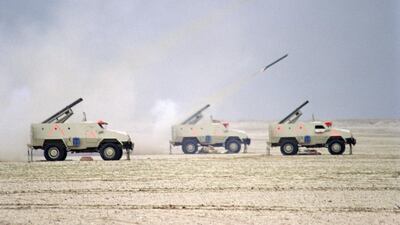
Egyptian army fire missiles on February 25, 1991 on the second day of the massive ground assault of the Allied Forces into Kuwait and Iraq. Pascal Guyot / AFP -
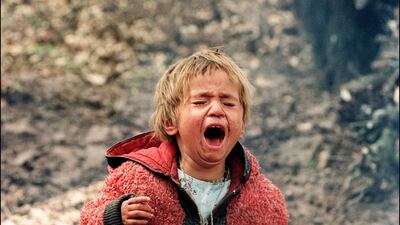
An Iraqi Kurdish refugee child cries on April 11, 1991, in Isikveren refugee camp situated on the Turkish border with Iraq. Nabil Ismail / AFP -
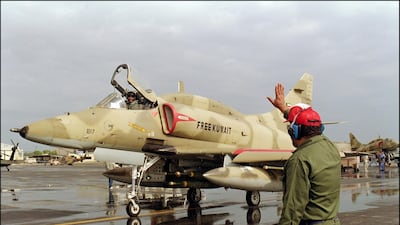
A Kuwaiti airfield worker waves to a departing of a Kuwaiti Air Force A-4 US-made Skyhawk jet fighter pilot 24 January 1991 leaving the Al Hasra air base for a bombing mission over Iraq. Chris Wilkins / AFP -
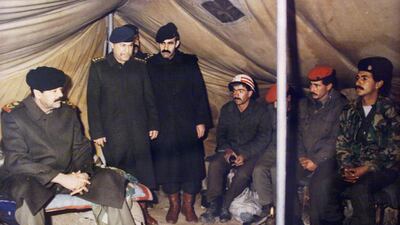
Iraqi President Saddam Hussein (L) is seen sitting in a tent in Najaf (Irak) in 1991 during the Gulf War. AFP -
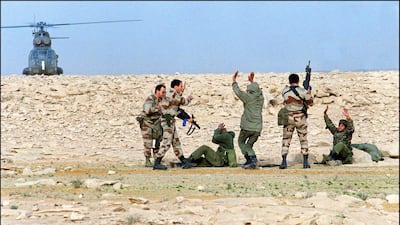
French special forces capture Iraqi soldiers on February 26, 1991 somewhere in Iraqi desert. Mike Nelson /AFP -
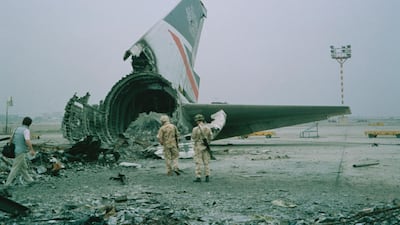
The wreckage of a British Airways Boeing 747-136 at Kuwait City airport, after BA Flight 149 was detained in Kuwait during the Gulf War, 1991. Colin Davey / Getty Images



