• Photo of the holy mosque of Makkah (the year 1968)
    Photo of the holy mosque of Makkah (the year 1968)
  • Fouad Al Darkzli in Arafat during one of the hajjs he did.
    Fouad Al Darkzli in Arafat during one of the hajjs he did.
  • Photo of the holy mosque of Makkah during hajj 1968 taken by Fouad Al Darkzli
    Photo of the holy mosque of Makkah during hajj 1968 taken by Fouad Al Darkzli
  • Page of Fouad Al Darkzli diary dated 1976 after he performed hajj. On this page, he mentions that he was hosted in the house of Mohamed Al Kurdi.
    Page of Fouad Al Darkzli diary dated 1976 after he performed hajj. On this page, he mentions that he was hosted in the house of Mohamed Al Kurdi.
  • Letter from Makkan Mohamed Al Kurdi to Iraqi pilgrim Fouad Al Darkzli, dated April 1968.
    Letter from Makkan Mohamed Al Kurdi to Iraqi pilgrim Fouad Al Darkzli, dated April 1968.
  • Letter from Makkan Mohamed Al Kurdi to Iraqi pilgrim Fouad Al Darkzli, dated April 1965.
    Letter from Makkan Mohamed Al Kurdi to Iraqi pilgrim Fouad Al Darkzli, dated April 1965.
  • Fatimah Mohamed Soror shows a picture of her father, as she narrates how he entrusted her with the money they get from renting their house for pilgrims.
    Fatimah Mohamed Soror shows a picture of her father, as she narrates how he entrusted her with the money they get from renting their house for pilgrims.
  • Noura Al Ahmadi house where they hosted the pilgrim. The house located in Sha'b Al Magharba, around 2 km from the holy mosque.
    Noura Al Ahmadi house where they hosted the pilgrim. The house located in Sha'b Al Magharba, around 2 km from the holy mosque.
  • Fatimah MohamedSoror.
    Fatimah MohamedSoror.
  • Mohamed Al Kurdi (left) and pilgrim Fouad Al Darkzli ( right)
    Mohamed Al Kurdi (left) and pilgrim Fouad Al Darkzli ( right)

Makkah residents reminisce about welcoming pilgrims into their homes and hearts


Balquees Basalom
  • English
  • Arabic

Before hotels sprang up around the Grand Mosque in Makkah, pilgrims performing Hajj would stay in residents' homes, often forming bonds that grew into lasting friendships.

“We opened our hearts before our doors for them,” said Noura Al Ahmadi, 70, who is originally from Madinah.

The Al Ahmadi family had a small house in Sha’b Al Magharba, about two kilometres from the holy mosque, but they always kept one room free so they could have the honour of hosting pilgrims.

Families with multi-storey houses transformed them into mini boutique hotels during the annual pilgrimage.

Fatimah Mohamed Soror, 78, grew up with the tradition of hosting pilgrims. Her family, who are originally from Hadramawt in Yemen, had a four-storey house in Al Falaq, only a 10-minute walk from the mosque.

“The attic had two rooms, a kitchenette and a bathroom," she said. "We used to host the pilgrims on three floors, and the whole family would go up to the attic for the duration of Hajj."

All their belongings would be cleared away and carpets rolled out, leaving the two bedrooms and one living room on each floor clear except for a big cupboard that was hard to move.

“We would move all our stuff to the ground floor and lock it in one room; then the three floors would be rented out,” Ms Mohamed Soror said.

It was heavy work, but she and her eight siblings would work hand in hand to get it done before they all squeezed into the topmost floor for almost a month.

She recalls the first time she collected rent on behalf of her father. It was 3,000 riyals, although she cannot remember the exact year.

“I think this was 60 years ago,” she said.

The amount kept growing over the years.

“I remember the last time we rented, for 100,000 riyals before 1984. At that time we had moved out so we rented the whole four floors and the roof for whole Hajj season [a month to five weeks]. A few months after that the house was demolished for a new road that was being built.”

The Grand Mosque has undergone three major expansions since 1955.

The second renovations under late King Fahd were performed gradually between 1982 and 2005, when many old houses around the mosque were demolished to make room.

The remaining houses continued hosting pilgrims until the third round of expansion started in 2008, when more old family homes were demolished. Yet families carry on with the tradition by hosting friends, even for only a few days.

Abdullah Ahmetoglu, 33, remembers running through his grandfather’s and aunt’s house as child with rooms full of pilgrims.

He said he helped the pilgrims with everything during their stay, from guiding them through the Hajj rituals to showing them the best places to eat and to shop for gifts before returning home.

Most of the pilgrims tried to stay at houses of people who might speak their language, as many families in Makkah are descendants of settlers from other Islamic countries.

Mr Ahmetoglu's family is of Turkish and Uzbek descent. His father and grandfather could speak Farsi, Turkish and Uzbek, so the pilgrims who stayed with them were often from Uzbekistan or Turkey.

Some pilgrims would return to the same house over the years, sometimes leading to lasting friendships with the owners.

“Once, a woman and her children stayed in our house and became a close friend of my grandmother,” Mr Ahmetoglu said.

The woman came back for visits over the years, and when she died, her sons continued to visit, he said.

But the visits changed slightly when one of them, Turgut Ozal, became the eighth president of Turkey and had to be accompanied by guards and an official delegation.

It was common for pilgrims to bring goods from their home countries with them, gifting some to their hosts and selling the rest on the streets of Makkah.

Ms Al Ahmadi particularly remembers the gifts.

“The Indonesians used to get sarongs. I also remember an Egyptian lady who used to get me cotton clothes – it was the best quality of cotton I ever got.'

The interaction with pilgrims was not limited to gift-giving or helping them when needed.

Female pilgrims would go up to the roof or to the women's room of the family they were with for some tea, ma'amul and chats. Although language was sometimes a barrier, hand gestures would do.

“Every day they would come up and we would prepare tea and some sweets and nuts. We would talk via hand gestures and sometimes they would use our kitchen to cook," Ms Mohamed Soror said.

She vividly remembers the smell of saffron-scented Iranian rice.

Her neighbours, the Khawandanah family, used to host Iranians as well. Their daughter Nadia, now 57, and her cousins used to ask the women to teach them new words.

“My father spoke more than 10 languages as he was a trader interacting with a lot of pilgrims," Ms Khawandanah said. "As children, we saw those pilgrims staying over as a chance to learn from the ladies, to be like my father."

This intense interaction with pilgrims, and hosting people from all walks of life, has shaped the community of Makkah residents.

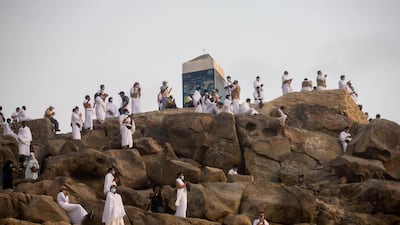
  • Muslim pilgrims pray on Mount Arafat, south-east of Makkah, Saudi Arabia, during the climax of the Hajj pilgrimage in July last year.
    Muslim pilgrims pray on Mount Arafat, south-east of Makkah, Saudi Arabia, during the climax of the Hajj pilgrimage in July last year.
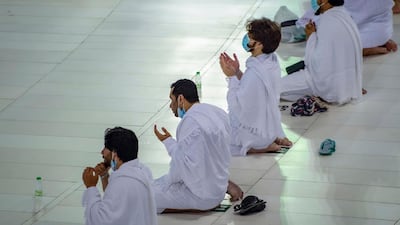
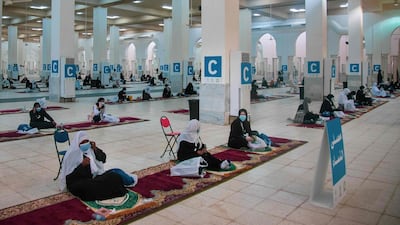
  • Muslims pray on Mount Arafat while on the Hajj pilgrimage during the Covid-19 pandemic last year.
    Muslims pray on Mount Arafat while on the Hajj pilgrimage during the Covid-19 pandemic last year.
  • Muslim pilgrims pray at the Namira Mosque on Arafat Day last year, the climax of the Hajj pilgrimage.
    Muslim pilgrims pray at the Namira Mosque on Arafat Day last year, the climax of the Hajj pilgrimage.
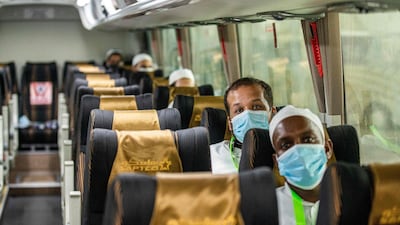
  • Arrivals for last year's Hajj pilgrimage travel to Makkah from Jeddah. Last year's Hajj was scaled back considerably to include just 1,000 Muslim pilgrims as Saudi Arabia battled a coronavirus surge.
    Arrivals for last year's Hajj pilgrimage travel to Makkah from Jeddah. Last year's Hajj was scaled back considerably to include just 1,000 Muslim pilgrims as Saudi Arabia battled a coronavirus surge.
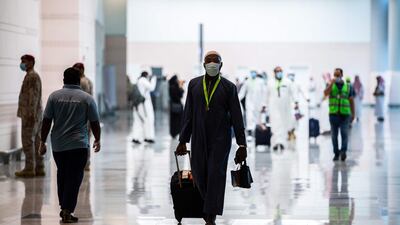
  • A traveller walking with his luggage as part of the first group of arrivals for last year's Hajj pilgrimage in Saudi Arabia.
    A traveller walking with his luggage as part of the first group of arrivals for last year's Hajj pilgrimage in Saudi Arabia.
  • Muslim pilgrims attend prayers at Namira Mosque on Arafat Day last year, the climax of the Hajj pilgrimage in Makkah.
    Muslim pilgrims attend prayers at Namira Mosque on Arafat Day last year, the climax of the Hajj pilgrimage in Makkah.
  • Muslim pilgrims attend prayers at Namira Mosque on Arafat Day last year, the climax of the Hajj pilgrimage in Makkah, Saudi Arabia.
    Muslim pilgrims attend prayers at Namira Mosque on Arafat Day last year, the climax of the Hajj pilgrimage in Makkah, Saudi Arabia.
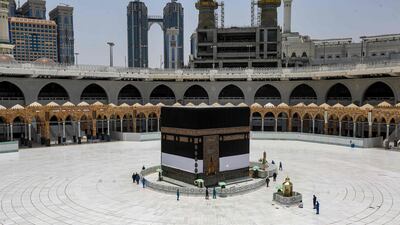
  • Workers at the Grand Mosque complex in Makkah work around the Kaaba before last year's Hajj pilgrimage.
    Workers at the Grand Mosque complex in Makkah work around the Kaaba before last year's Hajj pilgrimage.
  • Pilgrims in the Grand Mosque complex in Makkah pictured around the Kaaba during last year's Hajj.
    Pilgrims in the Grand Mosque complex in Makkah pictured around the Kaaba during last year's Hajj.

“Growing up in Makkah is like being in the United Nations,” Dr Hussain Ghanam, 64, said of growing up exposed to different nationalities, cultures and careers.

Hajj also made Makkah’s residents more open to people and accepting of new things.

“We learnt a lot from these pilgrims,” Dr Ghanam said. “For example, it impacted our cuisine – the Makkawi dishes now includes Indian, Bukhari and Indonesian dishes.”

The tradition of hosting pilgrims faded with the spread of hotels. Some families tried to hold on to it till a decade ago, but the Ministry of Hajj and the Authority of Civil Defence list long safety requirements that pushed many to stop.

However, some families keep old bonds alive by hosting the pilgrims for a short time. The Ozal grandchildren still stay with Mr Ahmetoglu's family for two or three days before going to a hotel, he said.

“They loved us, and we loved them, too,” Ms Al Ahmadi said.

Company%20profile
%3Cp%3EName%3A%20Tabby%3Cbr%3EFounded%3A%20August%202019%3B%20platform%20went%20live%20in%20February%202020%3Cbr%3EFounder%2FCEO%3A%20Hosam%20Arab%2C%20co-founder%3A%20Daniil%20Barkalov%3Cbr%3EBased%3A%20Dubai%2C%20UAE%3Cbr%3ESector%3A%20Payments%3Cbr%3ESize%3A%2040-50%20employees%3Cbr%3EStage%3A%20Series%20A%3Cbr%3EInvestors%3A%20Arbor%20Ventures%2C%20Mubadala%20Capital%2C%20Wamda%20Capital%2C%20STV%2C%20Raed%20Ventures%2C%20Global%20Founders%20Capital%2C%20JIMCO%2C%20Global%20Ventures%2C%20Venture%20Souq%2C%20Outliers%20VC%2C%20MSA%20Capital%2C%20HOF%20and%20AB%20Accelerator.%3Cbr%3E%3C%2Fp%3E%0A
Coming soon

Torno Subito by Massimo Bottura

When the W Dubai – The Palm hotel opens at the end of this year, one of the highlights will be Massimo Bottura’s new restaurant, Torno Subito, which promises “to take guests on a journey back to 1960s Italy”. It is the three Michelinstarred chef’s first venture in Dubai and should be every bit as ambitious as you would expect from the man whose restaurant in Italy, Osteria Francescana, was crowned number one in this year’s list of the World’s 50 Best Restaurants.

Akira Back Dubai

Another exciting opening at the W Dubai – The Palm hotel is South Korean chef Akira Back’s new restaurant, which will continue to showcase some of the finest Asian food in the world. Back, whose Seoul restaurant, Dosa, won a Michelin star last year, describes his menu as,  “an innovative Japanese cuisine prepared with a Korean accent”.

Dinner by Heston Blumenthal

The highly experimental chef, whose dishes are as much about spectacle as taste, opens his first restaurant in Dubai next year. Housed at The Royal Atlantis Resort & Residences, Dinner by Heston Blumenthal will feature contemporary twists on recipes that date back to the 1300s, including goats’ milk cheesecake. Always remember with a Blumenthal dish: nothing is quite as it seems. 

The five pillars of Islam

1. Fasting 

2. Prayer 

3. Hajj 

4. Shahada 

5. Zakat 

The alternatives

• Founded in 2014, Telr is a payment aggregator and gateway with an office in Silicon Oasis. It’s e-commerce entry plan costs Dh349 monthly (plus VAT). QR codes direct customers to an online payment page and merchants can generate payments through messaging apps.

• Business Bay’s Pallapay claims 40,000-plus active merchants who can invoice customers and receive payment by card. Fees range from 1.99 per cent plus Dh1 per transaction depending on payment method and location, such as online or via UAE mobile.

• Tap started in May 2013 in Kuwait, allowing Middle East businesses to bill, accept, receive and make payments online “easier, faster and smoother” via goSell and goCollect. It supports more than 10,000 merchants. Monthly fees range from US$65-100, plus card charges of 2.75-3.75 per cent and Dh1.2 per sale.

2checkout’s “all-in-one payment gateway and merchant account” accepts payments in 200-plus markets for 2.4-3.9 per cent, plus a Dh1.2-Dh1.8 currency conversion charge. The US provider processes online shop and mobile transactions and has 17,000-plus active digital commerce users.

• PayPal is probably the best-known online goods payment method - usually used for eBay purchases -  but can be used to receive funds, providing everyone’s signed up. Costs from 2.9 per cent plus Dh1.2 per transaction.

Tips for taking the metro

- set out well ahead of time

- make sure you have at least Dh15 on you Nol card, as there could be big queues for top-up machines

- enter the right cabin. The train may be too busy to move between carriages once you're on

- don't carry too much luggage and tuck it under a seat to make room for fellow passengers

Brief scores:

Manchester City 2

Gundogan 27', De Bruyne 85'

Crystal Palace 3

Schlupp 33', Townsend 35', Milivojevic 51' (pen)

Man of the Match: Andros Townsend (Crystal Palace)

Company profile

Date started: 2015

Founder: John Tsioris and Ioanna Angelidaki

Based: Dubai

Sector: Online grocery delivery

Staff: 200

Funding: Undisclosed, but investors include the Jabbar Internet Group and Venture Friends

Non-oil%20trade
%3Cp%3ENon-oil%20trade%20between%20the%20UAE%20and%20Japan%20grew%20by%2034%20per%20cent%20over%20the%20past%20two%20years%2C%20according%20to%20data%20from%20the%20Federal%20Competitiveness%20and%20Statistics%20Centre.%C2%A0%3C%2Fp%3E%0A%3Cp%3EIn%2010%20years%2C%20it%20has%20reached%20a%20total%20of%20Dh524.4%20billion.%C2%A0%3C%2Fp%3E%0A%3Cp%3ECars%20topped%20the%20list%20of%20the%20top%20five%20commodities%20re-exported%20to%20Japan%20in%202022%2C%20with%20a%20value%20of%20Dh1.3%20billion.%C2%A0%3C%2Fp%3E%0A%3Cp%3EJewellery%20and%20ornaments%20amounted%20to%20Dh150%20million%20while%20precious%20metal%20scraps%20amounted%20to%20Dh105%20million.%C2%A0%3C%2Fp%3E%0A%3Cp%3ERaw%20aluminium%20was%20ranked%20first%20among%20the%20top%20five%20commodities%20exported%20to%20Japan.%C2%A0%3C%2Fp%3E%0A%3Cp%3ETop%20of%20the%20list%20of%20commodities%20imported%20from%20Japan%20in%202022%20was%20cars%2C%20with%20a%20value%20of%20Dh20.08%20billion.%3C%2Fp%3E%0A
Updated: July 11, 2021, 5:15 PM