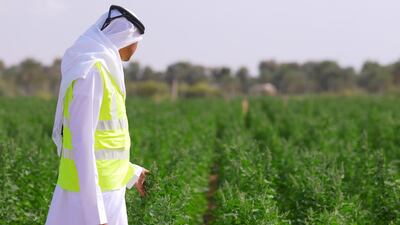

The UAE's artificial intelligence ambitions and affinity for agricultural innovation are helping the Gates Foundation to ensure that AI is a global equaliser, the organisation's chief executive has said.
Mark Suzman, who leads the organisation founded by former Microsoft chief executive Bill Gates, spoke with The National as the foundation released a report on AI.
Highlighting the UAE's drive to be a technological leader, Mr Suzman spoke of a 2023 partnership announcement designed to spur agricultural innovation and reduce hunger.

"We did a joint announcement with the UAE during Cop28 climate conference, called Aim for Scale, where we each put in $100 million," he said.
Mr Suzman said the UAE's Mohamed bin Zayed University of Artificial Intelligence has done "some really interesting work" in studying AI's potential to prevent diseases and improve weather forecasting.
It is that sort of thinking, Mr Suzman said – studying and implementing technology to benefit society – that was the cornerstone of the 2026 Make this Matter AI report.

The Gates Foundation has also announced it would be spending "at least $1 billion over the next two years to expand access to AI and the solutions, opportunities and knowledge that has too often been out of reach for many around the world".
The foundation's report arrives amid a growing concern about AI's potential effects on society, ranging from large-scale labour disruption to environmental impacts due to energy needs related to the technology.
Weeks before the foundation released its report, Mr Gates composed an almost 6,000-word essay in which he conveyed his worries about what unregulated AI might do to the fabric of society.
Mr Suzman said the Gates Foundation's report outlines the ideas that need to be prioritised so that AI's benefits can be equitably felt throughout society.
If the topics of AI language diversity, technology access, basic infrastructure development, and proper application to agriculture and environmental causes are not addressed, he said, the technology gap might widen for lower-income economies, he said.
"The risk is, rather than narrowing, which is usually what happens with a new technology, it might widen," Mr Suzman said. He said AI must be closely considered so that the positives outweigh the negatives.
If not, inequity in access to health, education and agriculture productivity services could intensify.
At the beginning of the Gates Foundation's recent report, Mr Gates echoed these sentiments.

"Some people have never been more worried, others have never been so excited … I understand where both are coming from," he wrote.
The analysis concludes that to ensure AI does not increase poverty, action must be taken to "make AI work in every language people speak", with tools and software tailor-made to people's use.
More broadly, it says that investments need to be made so that doctors, farmers, teachers and developers in every part of the world learn how to evaluate which AI technologies will work best for them.
Despite the development of multilingual AI language models in recent years, their learning abilities are still skewed to perform better in English, 2025 study from the MBZUAI found.
In 2025, the UAE’s government-backed Technology Innovation Institute announced a “leap forward” for AI with the introduction of Falcon Arabic, a model that it described as being “fluent in Arabic”.
Although Arabic is spoken by about 400 million people worldwide, according to the UN, it was not a focus during the initial growth of AI and large language models.
“Models had lower performance in low-resource languages like Amharic, Arabic and Yoruba on questions about science and technology,” the report stated.
"If AI is going to improve health on a continent with more than 2,000 languages [Africa], it has to understand what and how people actually speak – their dialects, accents and slang, too."
Mr Suzman says philanthropic partnerships such as those between the Gates Foundation and Microsoft, Google and others, can help to ensure that languages are not left behind.

Those partnerships are helping to assemble various language sets, and with this recent report, the Gates Foundation wants to encourage other companies to help invest to broaden language availabilities.
"The great things about languages is that this doesn't need to be done multiple times. Once it's done, it's done, and a public good has been achieved for the AI field and the world," Mr Suzman said.
He said the foundation may soon have more news to announce on this endeavour in the weeks ahead. "It really is in the interest of all technology companies and governments to get involved," he added.
In the US and other developed countries, Mr Suzman said there is heated debate about which AI approach – open-source or closed models – is superior, but in developing countries, time should not be wasted on it.
"What really matters are the outcomes of AI and the access of AI," he said. "Is the AI tool going to use educational data sets and a safe and secure way? Will people have access to AI at the lowest possible cost? That's what matters."

