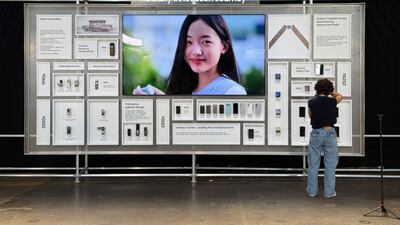
Visitors at an AI health forum on the sidelines of Samsung Galaxy Unpacked in Brooklyn, New York. Photo: Samsung

Samsung backs 'connected care' to mend broken health systems


Alvin R Cabral
  • English
  • Arabic

Samsung Electronics is betting that digital and connected care will be able to mend broken healthcare systems as it seeks to expand its reach in a category beyond its core businesses.

The South Korean company, in the lead-up to its Unpacked event last week, announced its acquisition of Xealth, a Seattle-based provider of digital health tools, for an undisclosed amount.

The move, Samsung says, will help its connected care ambitions and help to bridge a “holistic approach to preventive care to as many people as possible”.

Scaling connected care is expected to be the next step in the future of health that would help fix broken healthcare systems, industry executives said at a forum on the sidelines of Unpacked.

Dr Hon Pak, head of Samsung's digital health unit, Mike McSherry, chief executive of Xealth, Dr Rasu Shrestha, chief innovation and commercialisation officer of Advocate Health, and Jim Pursley, president of Hinge Health, at a panel discussion on the sidelines of Samsung Galaxy Unpacked in Brooklyn, New York. Photo: Samsung

“Health care is broken and part of the main reason it's broken is … [that] the incentives are misaligned. We know this from our everyday habits; if we are incentivising our kids to do the right things, they will do more of the right things,” Dr Rasu Shrestha, chief innovation and commercialisation officer of Charlotte-based health care provider Advocate Health, said at the forum.

“But if the incentives are misaligned, then the entire system starts to fall apart. So the opportunity here is … a connected ecosystem of devices and data really going after the dignity of those patients and consumers in a much more connected way.”

Research suggests that while conservative care works, it is inconvenient, hard to access and expensive, said Jim Pursley, president of Hinge Health, a Chicago-based software developer. But technology can address this.

“The [good] thing with digital health in general is we've operated historically independent of institutional health care, independent of an advocate,” he said.

Mr Pursley mentioned how tech has transformed the banking industry, with lenders able to provide on-demand services through devices, most notably through smartphone apps.

“The next decade of innovation is … to show that we can integrate with traditional in-person care to create a unified experience for patients, like banking,” he added.

Global investments in the digital health sector hit more than $25 billion last year, a 5.5 per cent annual rise and reversing two consecutive years of a funding drop, according to data from Galen Growth, a Singapore-based industry tracker.

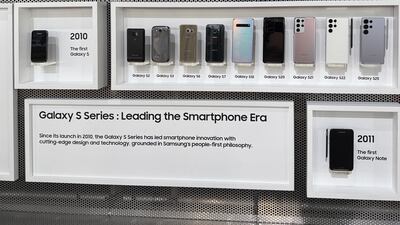
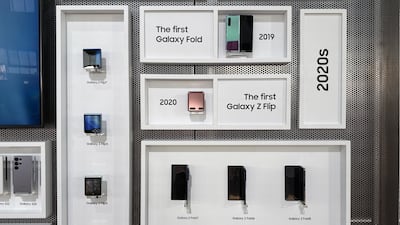
  • A multimedia board shows the history of Samsung Electronics, stretching more than five decades, at the company's Unpacked event in Brooklyn. All photos: Alvin R Cabral / The National
    A multimedia board shows the history of Samsung Electronics, stretching more than five decades, at the company's Unpacked event in Brooklyn. All photos: Alvin R Cabral / The National
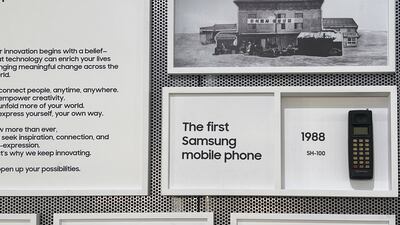
  • Samsung's first mobile phone, the SH-100, was launched in 1988.
    Samsung's first mobile phone, the SH-100, was launched in 1988.
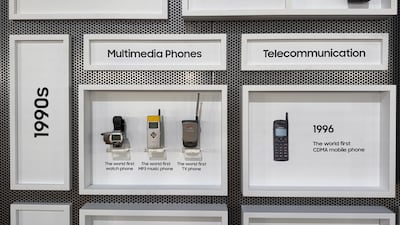
  • In the 1990s, Samsung started making multimedia phones, including the world's first mobiles with watch, MP3 and TV.
    In the 1990s, Samsung started making multimedia phones, including the world's first mobiles with watch, MP3 and TV.
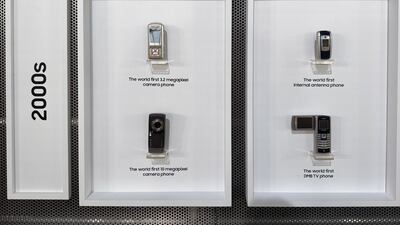
  • The early 2000s saw Samsung focusing on competitive camera features on its cellular phones.
    The early 2000s saw Samsung focusing on competitive camera features on its cellular phones.
  • The year 2010 would mark a turning point for Samsung with the launch of the original Galaxy S – which would become the main rival of Apple's iPhone.
    The year 2010 would mark a turning point for Samsung with the launch of the original Galaxy S – which would become the main rival of Apple's iPhone.
  • Samsung stepped up its game throughout the 2010s as it improved the Galaxy S line-up and launched the Galaxy Note.
    Samsung stepped up its game throughout the 2010s as it improved the Galaxy S line-up and launched the Galaxy Note.
  • In 2019, Samsung entered the foldable smartphone genre with the first Galaxy Fold, which would soon be followed by the Galaxy Flip.
    In 2019, Samsung entered the foldable smartphone genre with the first Galaxy Fold, which would soon be followed by the Galaxy Flip.

Samsung is focusing on health and the division has been active in research and development, in addition to signing partnerships and acquisitions to expand its reach. It is linking up with start-ups to develop health services on its Galaxy smartphones and smartwatches.

Samsung's AI push will help its strategy, and further expanding into health care will continue to remain a priority, said Dr Hon Pak, head of Samsung's digital health unit.

“I do feel that in 10 years, We're finally going to get to a point where health care is not about surviving – it's about thriving [using technology],” added Mr Pursley.

400 million Galaxy devices in 2025

Meanwhile, Samsung's plan to distribute 400 million Galaxy devices in 2025 is expected to be boosted by a push into ambient AI, a separate forum heard at Unpacked.

That would double the current reach of Galaxy devices, TM Roh, head of Samsung's mobile division, said at the event.

Ambient AI, which combines data analysis, machine learning, data analytics and natural language processing with humanlike behaviour, aims to provide personalised experiences.

In health care, that can translate to improved patient care, operational efficiency and information extraction, according to the Morsani College of Medicine.

Sabrina Ortiz, a senior editor at ZDNet, Jisun Park, corporate executive vice president at Samsung, Mindy Brooks, a vice president at Google, and Vinesh Sukumar, a vice president at Qualcomm Technologies, at a forum on the sidelines of Samsung Galaxy Unpacked in Brooklyn, New York. Photo: Samsung

“Some see AI as the start of a ‘post smartphone’ era, but we see it differently: the smartphone is becoming even more central to an ambient AI experience,” said Jisun Park, a corporate executive vice president at Samsung.

In addition, AI becoming more personalised needs a commitment to protect user information, and ambient AI's privacy, performance and personalisation “go hand in hand, [as] they are not competing priorities, but co-equal standards”, added Vinesh Sukumar, vice president of product management at US chipmaker Qualcomm Technology.


What are NFTs?

Are non-fungible tokens a currency, asset, or a licensing instrument? Arnab Das, global market strategist EMEA at Invesco, says they are mix of all of three.

You can buy, hold and use NFTs just like US dollars and Bitcoins. “They can appreciate in value and even produce cash flows.”

However, while money is fungible, NFTs are not. “One Bitcoin, dollar, euro or dirham is largely indistinguishable from the next. Nothing ties a dollar bill to a particular owner, for example. Nor does it tie you to to any goods, services or assets you bought with that currency. In contrast, NFTs confer specific ownership,” Mr Das says.

This makes NFTs closer to a piece of intellectual property such as a work of art or licence, as you can claim royalties or profit by exchanging it at a higher value later, Mr Das says. “They could provide a sustainable income stream.”

This income will depend on future demand and use, which makes NFTs difficult to value. “However, there is a credible use case for many forms of intellectual property, notably art, songs, videos,” Mr Das says.

The White Lotus: Season three

Creator: Mike White

Starring: Walton Goggins, Jason Isaacs, Natasha Rothwell

Rating: 4.5/5

Key facilities
  • Olympic-size swimming pool with a split bulkhead for multi-use configurations, including water polo and 50m/25m training lanes
  • Premier League-standard football pitch
  • 400m Olympic running track
  • NBA-spec basketball court with auditorium
  • 600-seat auditorium
  • Spaces for historical and cultural exploration
  • An elevated football field that doubles as a helipad
  • Specialist robotics and science laboratories
  • AR and VR-enabled learning centres
  • Disruption Lab and Research Centre for developing entrepreneurial skills
FIXTURES

Nov 04-05: v Western Australia XI, Perth
Nov 08-11: v Cricket Australia XI, Adelaide
Nov 15-18 v Cricket Australia XI, Townsville (d/n)
Nov 23-27: 1ST TEST v AUSTRALIA, Brisbane
Dec 02-06: 2ND TEST v AUSTRALIA, Adelaide (d/n)
Dec 09-10: v Cricket Australia XI, Perth
Dec 14-18: 3RD TEST v AUSTRALIA, Perth
Dec 26-30 4TH TEST v AUSTRALIA, Melbourne
Jan 04-08: 5TH TEST v AUSTRALIA, Sydney

Note: d/n = day/night

MATCH INFO

Uefa Champions League semi-final, first leg
Bayern Munich v Real Madrid

When: April 25, 10.45pm kick-off (UAE)
Where: Allianz Arena, Munich
Live: BeIN Sports HD
Second leg: May 1, Santiago Bernabeu, Madrid

Stree

Producer: Maddock Films, Jio Movies
Director: Amar Kaushik
Cast: Rajkummar Rao, Shraddha Kapoor, Pankaj Tripathi, Aparshakti Khurana, Abhishek Banerjee
Rating: 3.5

Dubai works towards better air quality by 2021

Dubai is on a mission to record good air quality for 90 per cent of the year – up from 86 per cent annually today – by 2021.

The municipality plans to have seven mobile air-monitoring stations by 2020 to capture more accurate data in hourly and daily trends of pollution.

These will be on the Palm Jumeirah, Al Qusais, Muhaisnah, Rashidiyah, Al Wasl, Al Quoz and Dubai Investment Park.

“It will allow real-time responding for emergency cases,” said Khaldoon Al Daraji, first environment safety officer at the municipality.

“We’re in a good position except for the cases that are out of our hands, such as sandstorms.

“Sandstorms are our main concern because the UAE is just a receiver.

“The hotspots are Iran, Saudi Arabia and southern Iraq, but we’re working hard with the region to reduce the cycle of sandstorm generation.”

Mr Al Daraji said monitoring as it stood covered 47 per cent of Dubai.

There are 12 fixed stations in the emirate, but Dubai also receives information from monitors belonging to other entities.

“There are 25 stations in total,” Mr Al Daraji said.

“We added new technology and equipment used for the first time for the detection of heavy metals.

“A hundred parameters can be detected but we want to expand it to make sure that the data captured can allow a baseline study in some areas to ensure they are well positioned.”

Updated: July 17, 2025, 1:30 PM