

In a move that seems straight out of the movie Jurassic Park, a company hoping to bring extinct species back to life through genetic engineering has used similar technology to create a woolly mouse.
Unveiled by US biotechnology and genetic engineering company Colossal Biosciences, the animal has a shaggy coat and an altered fat metabolism to make it able to cope with cold temperatures. Equivalent genetic engineering is being carried out with Asian elephants with the aim of producing animals that resemble woolly mammoths and can cope with icy conditions.
Colossal Biosciences also hopes to recreate the dodo, a flightless bird, and the Tasmanian tiger or thylacine, a carnivorous marsupial from Australia. The woolly mouse is the most visible result of several years of laboratory work to understand the genetic differences between the extinct species and similar living creatures. Dr Beth Shapiro, Colossal Biosciences’ chief scientific officer, told The National that the woolly mouse was “a really exciting accomplishment”.
“We’re editing cells, we have cell lines that have multiple edits in them, but with these species, it’s very hard to then turn them into a living animal so that we can see the end product of all the work that we put into this. The mouse makes this possible,” she said. “We’re using changes that we know occur in healthy, living mice; we’re not putting mammoth DNA into a mouse.”
New frontiers
Colossal Biosciences modified seven genes linked to cold tolerance, resulting in effects including a lighter, wavier and thicker coat. A gene called fibroblast growth factor 5 or FGF5 has been deactivated, causing the animals to have hair up to three times the normal length. Knocking out the activity of other genes affects the development and structure of hair follicles, resulting in woolly hair texture, wavy coats and curled whiskers.

A modification to the gene known as MC1R, which regulates production of the pigment melanin, causes the mice to have golden hair. A gene affecting fat metabolism has also been edited. To produce a woolly mammoth, which lived in northern Europe’s cold tundra regions before being driven to extinction 4,000 years ago, Colossal Biosciences expects to have to edit around 85 genes in the Asian elephant.
Analysis of the genomes of woolly, Columbian and steppe mammoths ranging in age from 3,500 to 1.2 million years old, and of African and Asian elephants, enabled the firm to identify the target genes. “The work that’s been done on the woolly mice that we’ve produced helps us validate the phenotypes or physical attributes that come from the gene targets that we’re already editing in the Asian elephant cells,” Ben Lamm, Colossal Biosciences’ co-founder and chief executive, told The National.
The aim is to create the first mammoth embryos late next year and, with a 22-month gestation time, the first calves could arrive in 2028. Mr Lamm said this means one of the other animals the company is recreating, the dodo or the thylacine, will probably arrive before the woolly mammoth.
Colossal Biosciences, which was founded in 2021 and has its headquarters in Texas, has sparked headlines because a recent $200 million investment valued the company at a claimed $10.2 billion, reflecting the likelihood that its technologies will have lucrative spin-off uses in fields such as health care. While it has captured the interest of the public and investors, the company’s work has proved controversial.
Ecological concerns
As the ultimate aim is to reintroduce these lost species to the wild, experts in the field have raised questions are the necessity or ethicalness of the project. Prof Andrew Knight, a veterinary surgeon and adjunct professor of animal welfare at Griffith University in Australia, said that while “on the face of it, it could be a wonderful thing to bring these animals back”, there were “major concerns” related to animal welfare.
He said that genetic modification had “very high failure rates”, with most implanted embryos not resulting in live births, and with surviving animals often more susceptible to disease. Prof Knight said that the mothers of these genetically engineered animals also face risks.
He added that if a genetically modified animal was raised by animals different to itself – as would be the case with the first woolly mammoth calves – there could be problems, because the offspring may have “different social needs [and be] driven by different psychological urges”.
“I think the resources would be better spent trying to preserve some of the existing animals that are in danger of going extinct,” Prof Knight said.
Dr Alexander Lees, a reader on conservation biology at Manchester Metropolitan University in the UK, said that a major challenge for de-extinction animals is that “rapid global change means it is unclear if they can fit neatly back into a much-changed world”.
Climate change means, he said, that any release into the wild would probably have to take place in an area geographically separate from where the species last existed, albeit within the same climate niche.
“That does mean that we can't easily predict interactions between the newly introduced species and native wildlife,” Dr Lees said. “However, it would seem unlikely that species that were historically extinction prone are likely to behave as invasives, and introduction failure seems a far more likely outcome.”
He said that species reintroductions often failed because the original problems that caused the extinction had not gone away.
In the case of the dodo, for example, habitat loss and predation by introduced mammals and by people caused extinction, and today the bird’s native island of Mauritius has, Dr Lees said, less than two per cent of the creature’s original habitat. “Even if a dodo-like creature could be created, there is little chance for a successful reintroduction given the realities of the 21st century,” he said.
-
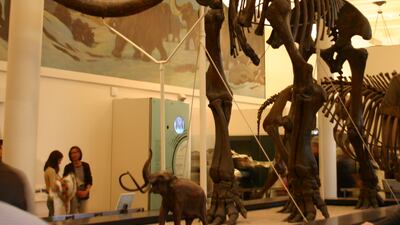
This specimen at the American Museum of Natural History in New York is believed to be a hybrid between Columbian and woolly mammoths. Photo: Ryan Somma -
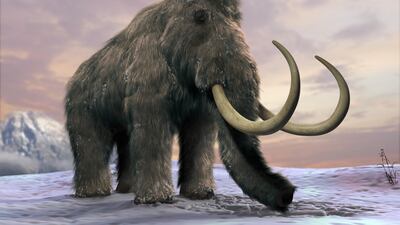
Ivory from woolly mammoth tusks has been used for various creations for centuries. Getty Images -

A skull of a woolly mammoth discovered by fishermen in May 1999 in the Netherlands. Photo: Celtic and Prehistoric Museum -
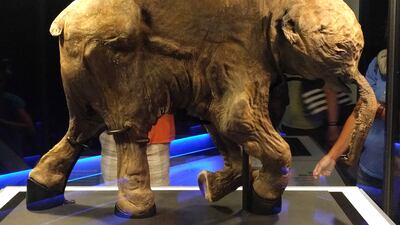
A woolly calf displayed at the Royal British Columbia Museum. Photo: Ruth Hartnup -
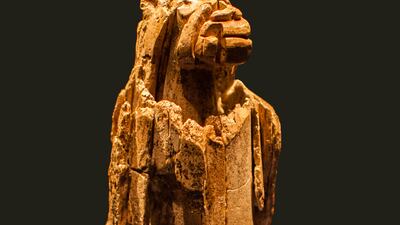
This artefact made from woolly mammoth ivory called the Lion-Man was found in the Hohlenstein-Stadel Cave, Germany. Photo: Dagmar Hollmann -
A mammoth tusk with carvings made in the 19th century in Yukon, Alaska, on display at the De Young Museum in San Francisco, California. Photo: BrokenSphere -

Venus of Brassempouy, a carving from mammoth ivory, on display at the Musee d'Archeologie Nationale in Saint-Germain-en-Laye, France. Photo: Dagmar Hollman -
A frozen calf named Yuka. Photo: Cyclonaut -
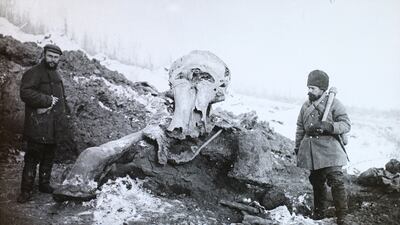
The Berezovka mammoth during excavation in 1901. Photo: Museum of Zoology in St Petersburg -
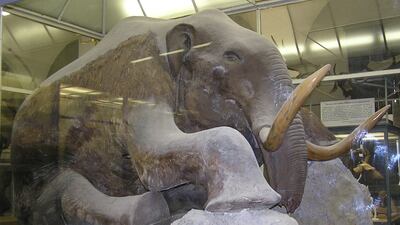
A model of the Berezovka mammoth partially covered by its skin at the Museum of Zoology in St Petersburg, Russia. Photo: Andrew Butko -

A leg with the skin and fur of a mammoth on display at the Museum of Natural History in Paris, France. Photo: Matt Mechtley -
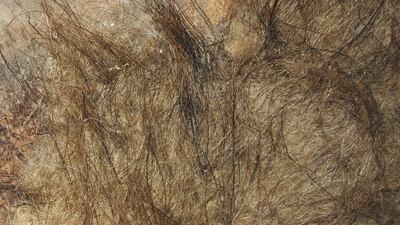
A close-up of preserved woolly mammoth fur on display at the Natural History Museum in Vienna, Austria. Photo: Tommy Arad -
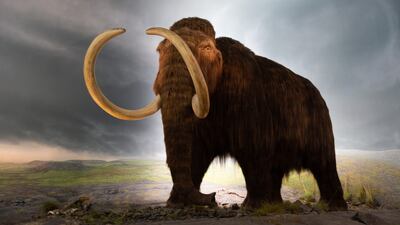
A recreation of a woolly mammoth at the Royal Victoria Museum, Victoria, British Columbia, Canada. Photo: Thomas Quine -
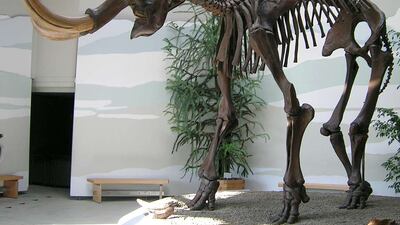
Mammoth remains on display at the Siegsdorf Natural History and Mammoth Museum in Siegsdorf, Germany. Photo: Lou Gruber -
A cast of remains at the State Museum of Natural History in Stuttgart, Germany. Photo: Ghedoghedo -
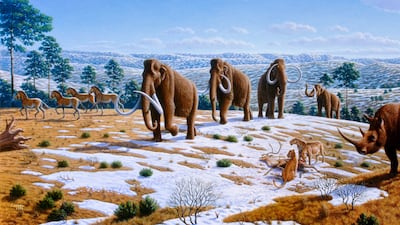
The image depicts a late Pleistocene landscape in northern Spain with woolly mammoths, equids, a woolly rhinoceros and European cave lions with a reindeer carcass. Photo: Mauricio Anton -
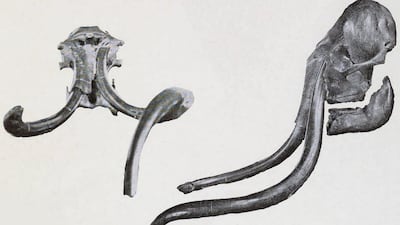
A woolly mammoth skull from Bzianka, Poland, with one downward spiralling tusk. Photo: Henryk Ferdynand Hoyer -
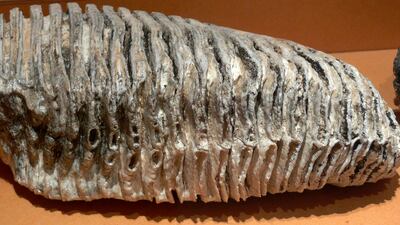
A mammoth molar featured in a display of artefacts at the Georges-Garret Museum in Vesoul, France. Photo: Remi Mathis -
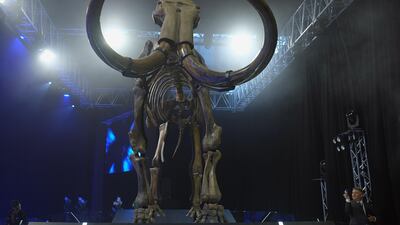
In 2015, a 15,000-year-old woolly mammoth was unveiled at Marina Mall in Abu Dhabi. Delores Johnson / The National -
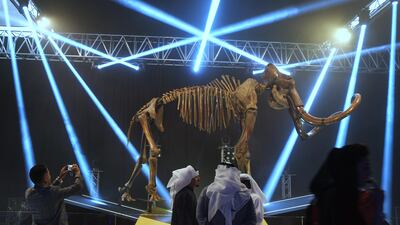
The woolly mammoth was roughly the same size as modern African elephants. Delores Johnson / The National -
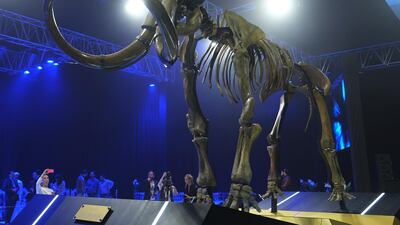
The woolly mammoth coexisted alongside early humans. This one lives in a mall. Delores Johnson / The National -
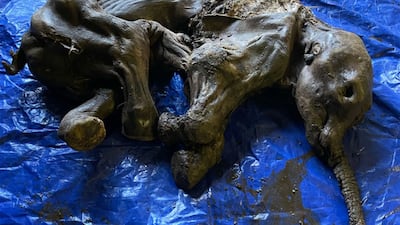
Miners in the Klondike gold fields of Canada's far north discovered the mummified remains of a baby woolly mammoth. Government of Yukon / AFP -
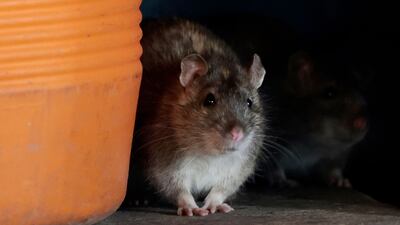
While some scientists are trying to bring the woolly mammoth back, others have studied how using gene editing can resurrect extinct animals such as the Christmas Island rat. Getty Images / AFP -
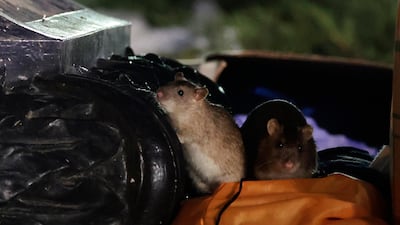
The team found they could reconstruct 95 per cent of the Christmas Island rat genome. Getty Images / AFP -
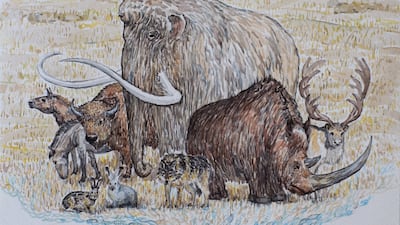
Climate change, not humans, caused the extinction of woolly mammoths. PA -
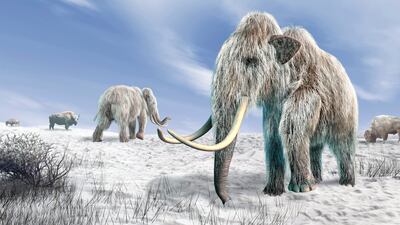
When icebergs melted, it became too wet for the mammoths to survive because their food source was wiped out. PA -
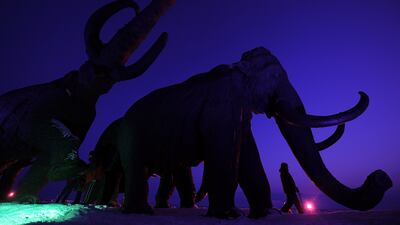
Giant bronze sculptures of mammoths on display during the World Biathlon Championships in the Siberian city of Khanty-Mansiysk. AFP -
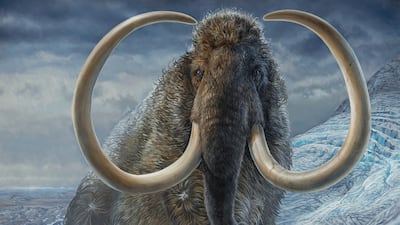
An imagined woolly mammoth on display at the University of Alaska Museum of the North in Fairbanks, Alaska. The Havens Studio / Reuters -
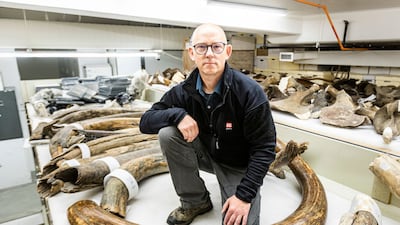
Mat Wooller, director of the Alaska Stable Isotope Facility, kneels among a collection of mammoth tusks at the University of Alaska Museum of the North. University of Alaska Fairbanks / AFP -

These woolly mammoth remains are a huge attraction at the Marina Mall in Abu Dhabi. Delores Johnson / The National -
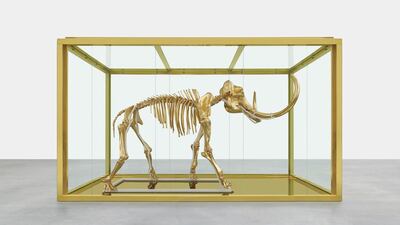
A gilded woolly mammoth skeleton was created to benefit the amfAR Cinema Against Aids in Cap d’Antibes, southern France. Prudence Cuming Associates / Damien Hirst / AP


Animal welfare
Dr Shapiro said Colossal Biosciences undertakes extensive screening of cells and computational analysis to ensure that only the correct edits to the animals’ genomes are carried out. “We do an extremely careful screening process before we even begin modifying these animals,” she said.
“Because we’re selecting variants that we know are compatible with healthy, living animals, this is yet another quality control that we put into place to make sure, as best we can, that there are going to be high efficiencies.”
Mr Lamm described animal welfare considerations as “critical” for the company, which he said worked with the American Humane Society to ensure its actions were ethical. He also said Colossal Biosciences was making its technology available free of charge to dozens of conservation organisations.
“Some of these technologies don’t always get the best view because many of the people who use these technologies are doing it for medical research, for other things; they’re not doing it to make more animals or to save species,” he said. “If we didn’t do all this screening and didn’t look to increase the efficiencies, it would be against the core ethos of what we stand for, being a conservation company.”
He said Colossal Biosciences is “100 per cent confident” that it will recreate extinct animals, and will do so “correctly and ethically”.

