
With a dramatic storyline in which dinosaurs cause havoc after being recreated from fossilised DNA, the film Jurassic Park certainly created a stir when it was released in 1993.
This dystopian vision of science taken too far seemed, when it hit cinemas, to be as far-fetched as it was thrilling.
Surely it would be impossible for a Tyrannosaurus Rex to be brought back to life tens of millions of years after it became extinct. Wouldn’t it?
Yet a US company called Colossal Biosciences, while not hoping to bring back dinosaurs, is looking to recreate three iconic animals that went extinct much more recently.
Rewriting history

Its focus is on the woolly mammoth (a cold-weather elephant-like beast), the dodo (a flightless bird) and the thylacine or Tasmanian tiger (a doglike carnivorous marsupial), all of which fell victim, in one way or another, to humans.
It is nothing if not a major effort: Colossal, recently received a $200 million investment that valued the firm, it says, at $10.2 billion, in part because the research it is carrying out to bring back extinct species could have spin-off benefits in fields such as health care. The Texas-based company has raised $435 million.
The chief executive, Ben Lamm, an entrepreneur who cofounded Colossal in 2021, said the three de-extinction projects were “on track or ahead of schedule” and that de-extinction is “closer than many people think”. The firm has stated that the mammoth project aims to bear fruit by 2027.
“I do believe it will be a starting point for a much wider effort,” he said. “We added the thylacine after excitement rose from the mammoth; based on the progress on the mammoth and the thylacine, we added the dodo, so I do think we will continue to add species over time.”
“[It is about] getting the right matrix of why should we bring it back – what is its cultural or spiritual connection, if there’s one with indigenous people’s groups, what is the ecological benefit, what is the scientific benefit, how does it help conservation.”
The company is not relying on harvesting preserved DNA in the way of Jurassic Park.
Revisiting a lost world
-
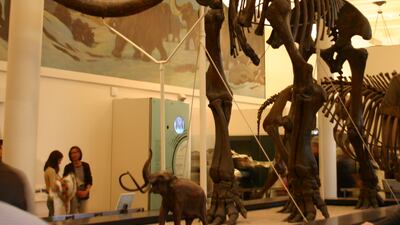
This specimen at the American Museum of Natural History in New York is believed to be a hybrid between Columbian and woolly mammoths. Photo: Ryan Somma -
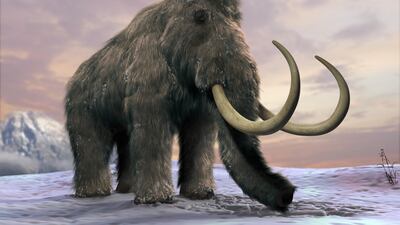
Ivory from woolly mammoth tusks has been used for various creations for centuries. Getty Images -

A skull of a woolly mammoth discovered by fishermen in May 1999 in the Netherlands. Photo: Celtic and Prehistoric Museum -
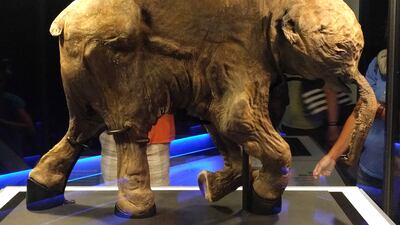
A woolly calf displayed at the Royal British Columbia Museum. Photo: Ruth Hartnup -
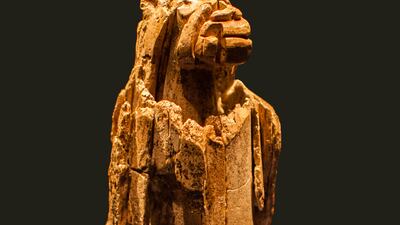
This artefact made from woolly mammoth ivory called the Lion-Man was found in the Hohlenstein-Stadel Cave, Germany. Photo: Dagmar Hollmann -
A mammoth tusk with carvings made in the 19th century in Yukon, Alaska, on display at the De Young Museum in San Francisco, California. Photo: BrokenSphere -

Venus of Brassempouy, a carving from mammoth ivory, on display at the Musee d'Archeologie Nationale in Saint-Germain-en-Laye, France. Photo: Dagmar Hollman -
A frozen calf named Yuka. Photo: Cyclonaut -
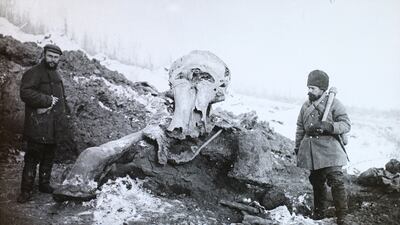
The Berezovka mammoth during excavation in 1901. Photo: Museum of Zoology in St Petersburg -
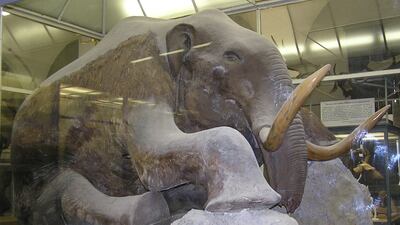
A model of the Berezovka mammoth partially covered by its skin at the Museum of Zoology in St Petersburg, Russia. Photo: Andrew Butko -

A leg with the skin and fur of a mammoth on display at the Museum of Natural History in Paris, France. Photo: Matt Mechtley -
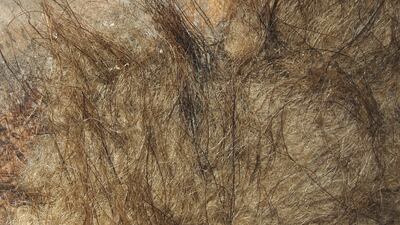
A close-up of preserved woolly mammoth fur on display at the Natural History Museum in Vienna, Austria. Photo: Tommy Arad -
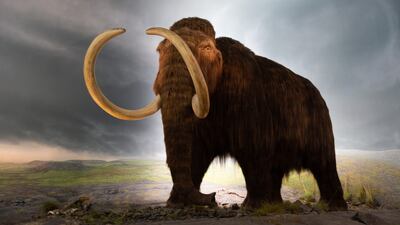
A recreation of a woolly mammoth at the Royal Victoria Museum, Victoria, British Columbia, Canada. Photo: Thomas Quine -
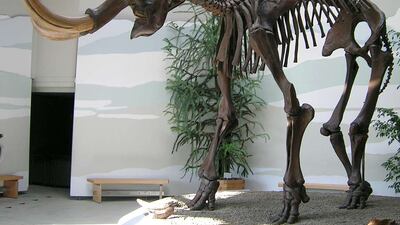
Mammoth remains on display at the Siegsdorf Natural History and Mammoth Museum in Siegsdorf, Germany. Photo: Lou Gruber -
A cast of remains at the State Museum of Natural History in Stuttgart, Germany. Photo: Ghedoghedo -
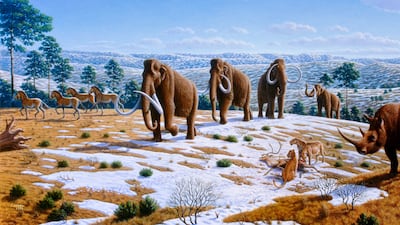
The image depicts a late Pleistocene landscape in northern Spain with woolly mammoths, equids, a woolly rhinoceros and European cave lions with a reindeer carcass. Photo: Mauricio Anton -
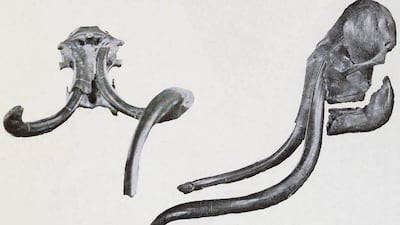
A woolly mammoth skull from Bzianka, Poland, with one downward spiralling tusk. Photo: Henryk Ferdynand Hoyer -
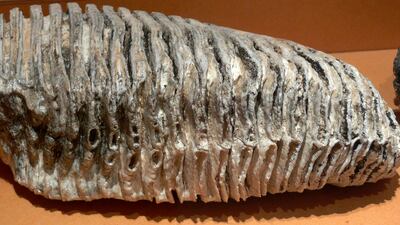
A mammoth molar featured in a display of artefacts at the Georges-Garret Museum in Vesoul, France. Photo: Remi Mathis -
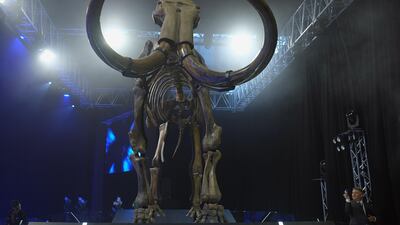
In 2015, a 15,000-year-old woolly mammoth was unveiled at Marina Mall in Abu Dhabi. Delores Johnson / The National -
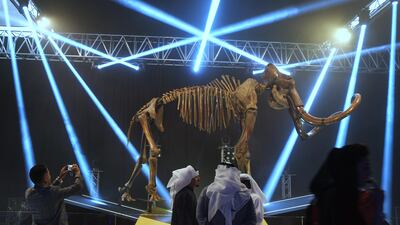
The woolly mammoth was roughly the same size as modern African elephants. Delores Johnson / The National -
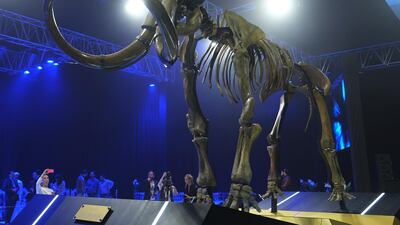
The woolly mammoth coexisted alongside early humans. This one lives in a mall. Delores Johnson / The National -
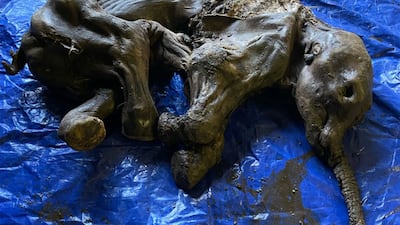
Miners in the Klondike gold fields of Canada's far north discovered the mummified remains of a baby woolly mammoth. Government of Yukon / AFP -
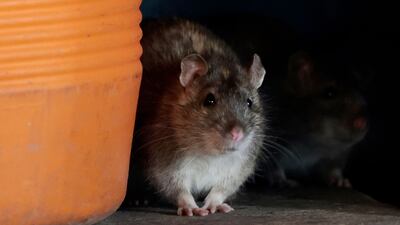
While some scientists are trying to bring the woolly mammoth back, others have studied how using gene editing can resurrect extinct animals such as the Christmas Island rat. Getty Images / AFP -
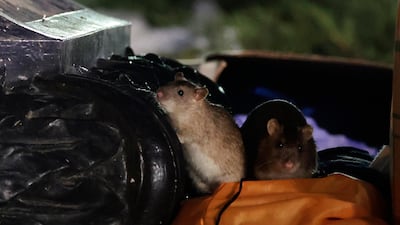
The team found they could reconstruct 95 per cent of the Christmas Island rat genome. Getty Images / AFP -
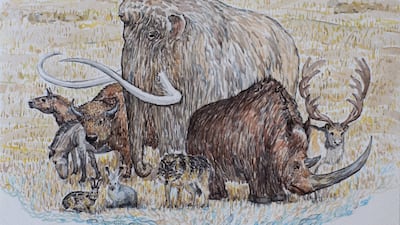
Climate change, not humans, caused the extinction of woolly mammoths. PA -
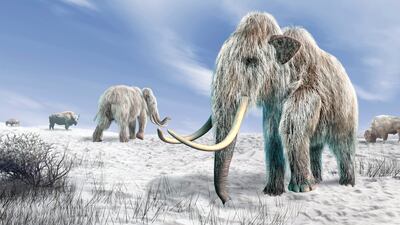
When icebergs melted, it became too wet for the mammoths to survive because their food source was wiped out. PA -
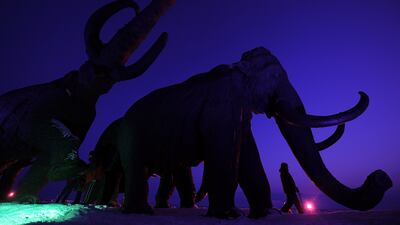
Giant bronze sculptures of mammoths on display during the World Biathlon Championships in the Siberian city of Khanty-Mansiysk. AFP -
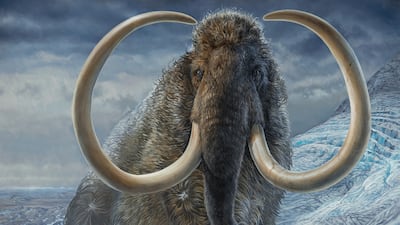
An imagined woolly mammoth on display at the University of Alaska Museum of the North in Fairbanks, Alaska. The Havens Studio / Reuters -
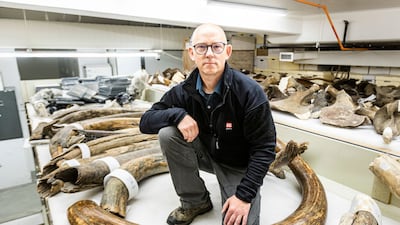
Mat Wooller, director of the Alaska Stable Isotope Facility, kneels among a collection of mammoth tusks at the University of Alaska Museum of the North. University of Alaska Fairbanks / AFP -

These woolly mammoth remains are a huge attraction at the Marina Mall in Abu Dhabi. Delores Johnson / The National -
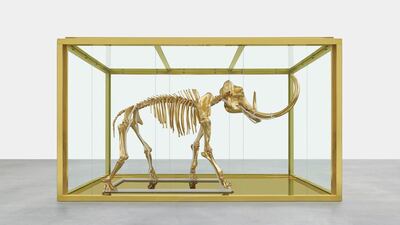
A gilded woolly mammoth skeleton was created to benefit the amfAR Cinema Against Aids in Cap d’Antibes, southern France. Prudence Cuming Associates / Damien Hirst / AP


Instead, it is taking living species as a starting point and looking to genetically engineer into them traits of the lost animals.
In the case of the woolly mammoth, which lived in cold tundra regions of northern Europe until it was driven to extinction about 4,000 years ago, this means genetically engineering Asian elephants to have characteristics such as a shaggy coat.
The effort is not small-scale: Colossal, which was cofounded by Dr George Church, a geneticist, has its own laboratories and states that it employs more than 170 scientists and partners with laboratories in the United States and Australia, and sponsors dozens of other scholars and research programmes. There is a scientific advisory board of 95 scientists.
The work is focused on, for example, understanding the link between genes and traits, and uncovering how, say, skull and face shape, coat patterns and tusks form. New tools for, among other things, inserting large-scale stretches of DNA are being developed.
Colossal has assembled what it describes as the most complete genomes for the three de-extinction species and will, it states, use these as the starting point for engineering traits.
It has also released a long list of achievements in molecular biology related to these extinct species or closely related living species.
These include creating cell lines (clusters of cells that can be grown indefinitely in the laboratory), generating stem cells (cells that can be turned into specialist cells) and carrying out gene editing at key genes linked to traits that it wishes to engineer.
Scientific community remains sceptical
Colossal’s efforts have proved controversial and not all scientists are enthusiasts. One prominent UK scientist and broadcaster branded de-extinction efforts “expensive vanity projects”.
Another scientist, Dr Alexander Lees, a reader in biodiversity at Manchester Metropolitan University in the UK, said that de-extinction was “an as-yet unproven technology” that, if successful, may create an “ecological substitute” for an extinct species.
“This substitute will, however, never share all the same genetic, behavioural and physiological characteristics of the lost species,” he said, while adding that such “ecological proxies” may enhance biodiversity.
The work would have conservation value only, Dr Lees said, if enough individuals could be created and taken to the wild to form a viable population.
“The world into which these surrogates would hypothetically be introduced into is massively changed, for many threats that drove them to extinction remain,” he said.

For example, Mauritius, where the dodo lived until it was hunted into extinction in the late 17th century, is now densely populated and has “next-to-no dodo habitat”, according to Dr Lees, so avoiding re-extinction would be a major challenge.
Management agencies “with already limited budgets” will likely be responsible for these released organisms and their habitats, Dr Lees suggested.
“There are massive upfront costs in attempting to create such a proxy species. [It is an] iterative process which requires solving numerous biotech challengers,” he added.
“This obviously leads to a lot of very lucrative patents and spin-off companies relevant to human health, a few of which may have some conservation relevance to threatened species.”
Colossal Biosciences highlights its efforts to preserve threatened species, such as through a foundation launched last year that assists conservation organisations. It allows dozens of conservation partners free use of its technology.
The company assists conservation efforts for the northern white rhinoceros, for example, by identifying genetic diversity that could be incorporated into this severely threatened subspecies.
Animal welfare concerns have been raised, such as through the planned use of surrogate animals to give birth to creatures different to themselves.
Mr Lamm said that Colossal Biosciences safeguarded welfare by working in partnership with the American Humane Society, the organisation known for supervising film sets to prevent animal cruelty. Colossal aims eventually to grow animals in artificial wombs.

When it comes to scepticism over the idea of de-extinction in a world that is destroying much remaining wildlife, Mr Lamm said that his company’s approach is not a “silver bullet”.
“I think combating biodiversity loss is a global initiative that needs a thousand companies, a thousand non-profits working on it. I think it’s a tapestry of technology solutions and we’re just one thread,” he said.
“A lot of people like to get fixated on our thread and my advice to people who aren’t as excited by our thread is, ‘Great, you should go do something.’”
He said that Colossal had, over time, convinced some sceptical scientists that its approach was worthwhile.
“Most of the feedback that we get that’s negative now is more philosophical perspectives, not science perspectives,” Mr Lamm said.
Illustrating how Colossal’s work has consequences for human healthcare, it has spun out a computational biology firm called Form Bio whose technology is now being used for drug discovery and analysis.
Also, a technique that Colossal is heavily involved with, multiplex gene editing, which involves making multiple targeted edits to the genome, will be “transformative for human healthcare long term”, according to Mr Lamm.
While much of Colossal Bioscience’s extraordinary $10 billion valuation may be linked to its creation of technology that could advance healthcare, its attempts at de-extinction are, like Jurassic Park, what is capturing the imagination. Mr Lamm is hopeful that the company’s bold vision will be realised.
“Being very close to it and seeing the progress every single day, I feel very confident,” he said.

