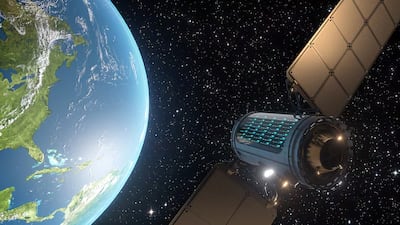

The US has given regulatory approval to SpaceX to eventually put data centres in space.
According to the Federal Communications Commission, this is the first authorisation for such a project, as demands from AI have caused an increase in the need for data centres.
"The FCC is granting SpaceX authorisation to deploy 1,000,000 orbital compute modules to process massive amounts of data to be used back here on Earth," a news release read.
Concerns about the environmental impact, noise and electricity consumption of data centres have risen in recent years, and governments at the state and local levels have enacted rules to slow down construction.
FCC chair Brendan Carr highlighted the work under way to eventually put data centres in space.
"This is the kind of American ingenuity that can unite our strengths in space and advanced technology, reinforce our economic leadership, and expand prosperity here at home," he said.
But the announcement doesn't mean data centres will suddenly start orbiting earth. Researchers and scientists are still in the early stages of figuring out how such an endeavour might be possible.
In early October, Google launched Project Suncatcher into orbit after several years of development to test the feasibility of data centres in space.
The company included its AI hardware to asses that idea onboard the Transporter-18 SpaceX mission.
Part of the space test involved seeing if the company's technology could generate enough computing power in space to answer basic AI queries.
“In low-Earth orbit, satellites can access near-constant sunlight, generating up to eight times more solar power than on Earth,” the technology company said. It added that if successful, all concerns about data centres might be nullified.
“It could be possible to link together multiple constellations of satellites, allowing them to manage larger AI workloads while in orbit.”
Earlier this year during a discussion at the World Economic Forum's annual meeting in Davos, Switzerland, technology tycoon and SpaceX chief executive Elon Musk spoke about putting AI infrastructure in orbit.
“There's so much room in space, and it's enormous what you can scale to,” he said. “I think, ultimately, you can have hundreds of terawatts in the air.”
Experts have warned, however, that while the idea of data centres in space might look good on paper, there are a lot of challenges that need to be overcome.
Speaking at the Semafor World Economy Summit in April, Ariel Ekblaw, founder and chief executive of non-profit space architecture lab the Aurelia Institute, said some of the more aggressive timelines for making space data centres a reality are not realistic.
She pointed out that space is far colder than most people realise, and that alone means that “it is not an advantageous arena to deploy a really hot little volcano of a bunch of computers in”.
Ms Ekblaw added that the climate issue was only one of several engineering challenges that come with the territory of orbital data centres. The radiation of space, she said, would be problematic, along with the need for data centres on Earth to upgrade their CPUs, GPUs and other technology.
“There's the fact that if you want to swap your chips out from Nvidia every six months, now you have to go all the way to space to do it, so that's not a trivial concern,” she said.

