• Salem Al Dawsari of Saudi Arabia, front, celebrates with teammates after scoring the second goal in their 2-1 victory against Argentina during the 2022 World Cup at the Lusail Stadium on Tuesday, November 22, 2022. EPA
    Salem Al Dawsari of Saudi Arabia, front, celebrates with teammates after scoring the second goal in their 2-1 victory against Argentina during the 2022 World Cup at the Lusail Stadium on Tuesday, November 22, 2022. EPA
  • Saudi Arabia celebrate their second goal by Salem Al Dawsari against Argentina at the Lusail Stadium. AFP
    Saudi Arabia celebrate their second goal by Salem Al Dawsari against Argentina at the Lusail Stadium. AFP
  • Saudi Arabia's Salem Al Dawsari after scoring his side's second goal. AP
    Saudi Arabia's Salem Al Dawsari after scoring his side's second goal. AP
  • Lionel Messi of Argentina reacts during the match against Saudi Arabia. Getty
    Lionel Messi of Argentina reacts during the match against Saudi Arabia. Getty
  • Saudi Arabia's Saleh Al Shehri, left, celebrates after scoring the equaliser against Argentina. AFP
    Saudi Arabia's Saleh Al Shehri, left, celebrates after scoring the equaliser against Argentina. AFP
  • Crowd attendance is shown on a giant screen at the Lusail Stadium. Getty
    Crowd attendance is shown on a giant screen at the Lusail Stadium. Getty
  • Saudi Arabia's goalkeeper Mohammed Al Owais saves a shot from Argentina. AP
    Saudi Arabia's goalkeeper Mohammed Al Owais saves a shot from Argentina. AP
  • Saudi Arabia's Nawaf Al Abid fights for the ball with Argentina's Enzo Fernandez. Reuters
    Saudi Arabia's Nawaf Al Abid fights for the ball with Argentina's Enzo Fernandez. Reuters
  • Saleh Al Shehri, right, scores his team's opening goal. EPA
    Saleh Al Shehri, right, scores his team's opening goal. EPA
  • Angel Di Maria of Argentina looked stunned. Getty
    Angel Di Maria of Argentina looked stunned. Getty
  • Lionel Messi after scoring the first goal. AFP
    Lionel Messi after scoring the first goal. AFP

Saudis' seismic shock and why all the injury time? World Cup day three talking points


Steve Luckings
  • English
  • Arabic

Matchday three of the 2022 World Cup delivered arguably the greatest shock in tournament history.

Saudis' seismic shock

USA usurp England in 1950, Cameroon conquer Argentina in 1990 and Senegal slay France in 2002.

On Tuesday, Saudi Arabia added their name to the list of biggest World Cup upsets when they pulled off a thrilling 2-1 smash-and-grab victory against tournament favourites Argentina.

The Saudis trailed to a first-half Lionel Messi penalty and were thankful to see three more Argentina goals ruled out for offside - but make no mistake, Herve Renard's team were well worth their "totally crazy" win at the Lusail Stadium.

The names of Saleh Al Shehri and Salem Al Dawsari will long be remembered for their goals against a team on an unbeaten 36-match run, but the Herculean efforts of the rest of the team - most notably Hassan Al Tambakti - should also be lauded.

While citizens of Saudi Arabia will enjoy a public holiday in recognition of the team's efforts in Qatar, their victory will now go down in World Cup folklore.

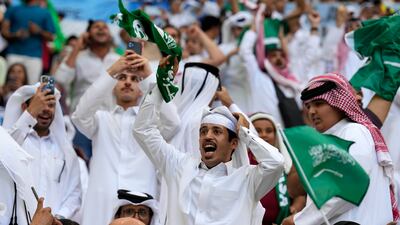
  • Saudi fans celebrate after their national team beat Argentina 2-1 in the World Cup at the Lusail Stadium in Qatar. PA
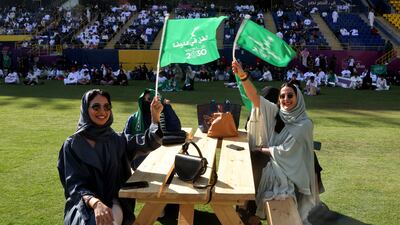
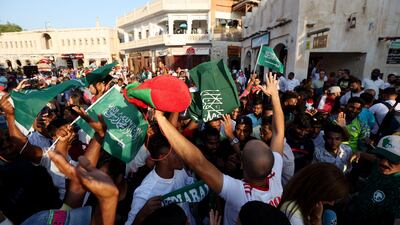
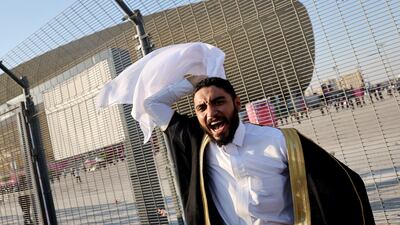
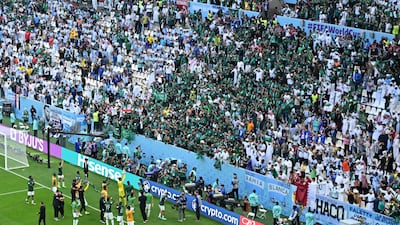
    Saudi fans celebrate after their national team beat Argentina 2-1 in the World Cup at the Lusail Stadium in Qatar. PA
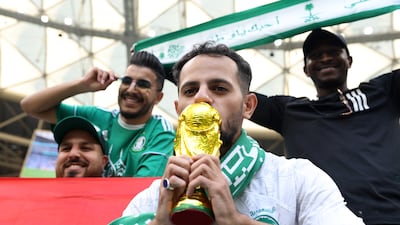
  • Saudi fans celebrate after their national team beat Argentina 2-1 in the World Cup at the Lusail Stadium in Qatar. Reuters
    Saudi fans celebrate after their national team beat Argentina 2-1 in the World Cup at the Lusail Stadium in Qatar. Reuters
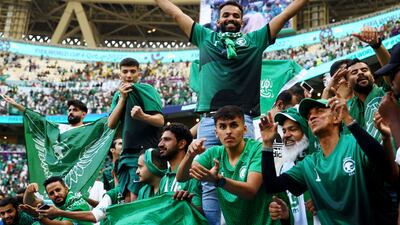
  • Saudi fans celebrate after their national team beat Argentina 2-1 in the World Cup at the Lusail Stadium in Qatar. Getty Images
    Saudi fans celebrate after their national team beat Argentina 2-1 in the World Cup at the Lusail Stadium in Qatar. Getty Images
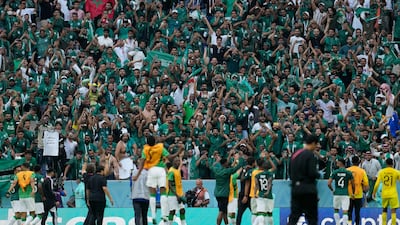
  • Saudi fans celebrate after their national team beat Argentina 2-1 in the World Cup at the Lusail Stadium in Qatar. Reuters
    Saudi fans celebrate after their national team beat Argentina 2-1 in the World Cup at the Lusail Stadium in Qatar. Reuters
  • Saudi fans celebrate after their national team beat Argentina 2-1 in the World Cup at the Lusail Stadium in Qatar. AFP
    Saudi fans celebrate after their national team beat Argentina 2-1 in the World Cup at the Lusail Stadium in Qatar. AFP
  • Saudi fans celebrate after their national team beat Argentina 2-1 in the World Cup at the Lusail Stadium in Qatar. AP Photo
    Saudi fans celebrate after their national team beat Argentina 2-1 in the World Cup at the Lusail Stadium in Qatar. AP Photo
  • Saudi fans celebrate after their national team beat Argentina 2-1 in the World Cup at the Lusail Stadium in Qatar. EPA
    Saudi fans celebrate after their national team beat Argentina 2-1 in the World Cup at the Lusail Stadium in Qatar. EPA
  • Saudi fans celebrate after their national team beat Argentina 2-1 in the World Cup at the Lusail Stadium in Qatar. Getty Images
    Saudi fans celebrate after their national team beat Argentina 2-1 in the World Cup at the Lusail Stadium in Qatar. Getty Images
  • Saudi fans celebrate after their national team beat Argentina 2-1 in the World Cup at the Lusail Stadium in Qatar. Reuters
    Saudi fans celebrate after their national team beat Argentina 2-1 in the World Cup at the Lusail Stadium in Qatar. Reuters
  • Saudi fans celebrate after their national team beat Argentina 2-1 in the World Cup at the Lusail Stadium in Qatar. AP Photo
    Saudi fans celebrate after their national team beat Argentina 2-1 in the World Cup at the Lusail Stadium in Qatar. AP Photo

Why all the injury time?

By the end of Saudi Arabia's famous win over Argentina - only the fifth match of a 64-match tournament - almost 90 minutes of injury time had been added on for all games played to the point in Doha.

More than 14 minutes were added on to the first half of England's Group B opener to allow Iranian goalkeeper Alireza Beiranvand to receive treatment following a clash of heads with his own player.

And while we all agree that concussion protocols will take as long as necessary, it became obvious to anyone watching Beiranvand would be in no fit state to continue in less than half that time.

Reasons the game is halted include injuries, video assistant referee (VAR) decisions, substitutions, penalties and red cards, with some players often deliberately delaying the restart after such incidents in order to wind down the clock – an annoying theme already prevalent at this tournament.

Fourth officials have been instructed by Fifa to keep track of time lost during the games in Qatar. Depending on your viewpoint, this has caused unnecessarily long games (see England-Iran and Argentina-Saudi Arabia) or allowed for us to witness last-minute goals that only enhance the tournament (see Davy Klaassen's strike for the Netherlands on 98 minutes and 17 seconds against Senegal).

And what happens when we get to the knockout stage? An extra half-hour (15 minutes each half) is played if the scores are level at the end of 90 minutes. Teams could potentially be forced to play three halves (see Mehdi Taremi's penalty for Iran against England came with 102:30 on the clock, the latest World Cup goal on record excluding extra time) or more if the fourth official deems it appropriate.

The clock should stop, so to speak, to allow injured players to receive treatment, but the time added on to celebrate a goal can be mitigated by hurrying the players along and time wasters can be dealt with by being shown a yellow card for repeated infringements.

Netherlands' midfielder Davy Klaassen celebrates his late goal in a 2-0 win over Senegal. AFP

Mbappe's superstar showing

While much of the plaudits for France's win over Australia are being directed at Olivier Giroud after his brace saw him draw level with Thierry Henry's national team record of 51 goals - it is another Bleus striker who will have opposition defences quaking in their boots.

Kylian Mbappe scored the third France goal as they claimed a 4-1 win over the Socceroos to get their World Cup defence off to a flying start, but that was arguably the least of the Frenchman's contribution.

The jet-heeled Paris Saint-Germain striker skinned the Australia defence on multiple occasions with his blistering pace, and his flick to to Adrien Rabiot in the buildup to the first of Giroud's goals was simply scrumptious.

The 23-year-old Mbappe already has a World Cup winner's medal after announcing himself on the world stage in Russia four years ago. On Tuesday's showing, he is ready to elevate himself above the status of his fellow PSG superstars Messi and Neymar.


France's Kylian Mbappe celebrates scoring their third goal against Australia. Reuters

THE SPECS

Engine: 3-litre V6

Transmission: eight-speed automatic

Power: 424hp

Torque: 580 Nm

Price: From Dh399,000

On sale: Now

MORE FROM CON COUGHLIN
Who has lived at The Bishops Avenue?
  • George Sainsbury of the supermarket dynasty, sugar magnate William Park Lyle and actress Dame Gracie Fields were residents in the 1930s when the street was only known as ‘Millionaires’ Row’.
  • Then came the international super rich, including the last king of Greece, Constantine II, the Sultan of Brunei and Indian steel magnate Lakshmi Mittal who was at one point ranked the third richest person in the world.
  • Turkish tycoon Halis Torprak sold his mansion for £50m in 2008 after spending just two days there. The House of Saud sold 10 properties on the road in 2013 for almost £80m.
  • Other residents have included Iraqi businessman Nemir Kirdar, singer Ariana Grande, holiday camp impresario Sir Billy Butlin, businessman Asil Nadir, Paul McCartney’s former wife Heather Mills. 
Hunting park to luxury living
  • Land was originally the Bishop of London's hunting park, hence the name
  • The road was laid out in the mid 19th Century, meandering through woodland and farmland
  • Its earliest houses at the turn of the 20th Century were substantial detached properties with extensive grounds


The specs

Engine: 4-litre twin-turbo V8

Transmission: nine-speed

Power: 542bhp

Torque: 700Nm

Price: Dh848,000

On sale: now

The smuggler

Eldarir had arrived at JFK in January 2020 with three suitcases, containing goods he valued at $300, when he was directed to a search area.
Officers found 41 gold artefacts among the bags, including amulets from a funerary set which prepared the deceased for the afterlife.
Also found was a cartouche of a Ptolemaic king on a relief that was originally part of a royal building or temple. 
The largest single group of items found in Eldarir’s cases were 400 shabtis, or figurines.

Khouli conviction

Khouli smuggled items into the US by making false declarations to customs about the country of origin and value of the items.
According to Immigration and Customs Enforcement, he provided “false provenances which stated that [two] Egyptian antiquities were part of a collection assembled by Khouli's father in Israel in the 1960s” when in fact “Khouli acquired the Egyptian antiquities from other dealers”.
He was sentenced to one year of probation, six months of home confinement and 200 hours of community service in 2012 after admitting buying and smuggling Egyptian antiquities, including coffins, funerary boats and limestone figures.

For sale

A number of other items said to come from the collection of Ezeldeen Taha Eldarir are currently or recently for sale.
Their provenance is described in near identical terms as the British Museum shabti: bought from Salahaddin Sirmali, "authenticated and appraised" by Hossen Rashed, then imported to the US in 1948.

- An Egyptian Mummy mask dating from 700BC-30BC, is on offer for £11,807 ($15,275) online by a seller in Mexico

- A coffin lid dating back to 664BC-332BC was offered for sale by a Colorado-based art dealer, with a starting price of $65,000

- A shabti that was on sale through a Chicago-based coin dealer, dating from 1567BC-1085BC, is up for $1,950

What went into the film

25 visual effects (VFX) studios

2,150 VFX shots in a film with 2,500 shots

1,000 VFX artists

3,000 technicians

10 Concept artists, 25 3D designers

New sound technology, named 4D SRL


The biog

Hometown: Cairo

Age: 37

Favourite TV series: The Handmaid’s Tale, Black Mirror

Favourite anime series: Death Note, One Piece and Hellsing

Favourite book: Designing Brand Identity, Fifth Edition

Milestones on the road to union

1970

October 26: Bahrain withdraws from a proposal to create a federation of nine with the seven Trucial States and Qatar. 

December: Ahmed Al Suwaidi visits New York to discuss potential UN membership.

1971

March 1:  Alex Douglas Hume, Conservative foreign secretary confirms that Britain will leave the Gulf and “strongly supports” the creation of a Union of Arab Emirates.

July 12: Historic meeting at which Sheikh Zayed and Sheikh Rashid make a binding agreement to create what will become the UAE.

July 18: It is announced that the UAE will be formed from six emirates, with a proposed constitution signed. RAK is not yet part of the agreement.

August 6:  The fifth anniversary of Sheikh Zayed becoming Ruler of Abu Dhabi, with official celebrations deferred until later in the year.

August 15: Bahrain becomes independent.

September 3: Qatar becomes independent.

November 23-25: Meeting with Sheikh Zayed and Sheikh Rashid and senior British officials to fix December 2 as date of creation of the UAE.

November 29:  At 5.30pm Iranian forces seize the Greater and Lesser Tunbs by force.

November 30: Despite  a power sharing agreement, Tehran takes full control of Abu Musa. 

November 31: UK officials visit all six participating Emirates to formally end the Trucial States treaties

December 2: 11am, Dubai. New Supreme Council formally elects Sheikh Zayed as President. Treaty of Friendship signed with the UK. 11.30am. Flag raising ceremony at Union House and Al Manhal Palace in Abu Dhabi witnessed by Sheikh Khalifa, then Crown Prince of Abu Dhabi.

December 6: Arab League formally admits the UAE. The first British Ambassador presents his credentials to Sheikh Zayed.

December 9: UAE joins the United Nations.

Q&A with Dash Berlin

Welcome back. What was it like to return to RAK and to play for fans out here again?
It’s an amazing feeling to be back in the passionate UAE again. Seeing the fans having a great time that is what it’s all about.

You're currently touring the globe as part of your Legends of the Feels Tour. How important is it to you to include the Middle East in the schedule?
The tour is doing really well and is extensive and intensive at the same time travelling all over the globe. My Middle Eastern fans are very dear to me, it’s good to be back.

You mix tracks that people know and love, but you also have a visually impressive set too (graphics etc). Is that the secret recipe to Dash Berlin's live gigs?
People enjoying the combination of the music and visuals are the key factor in the success of the Legends Of The Feel tour 2018.

Have you had some time to explore Ras al Khaimah too? If so, what have you been up to?
Coming fresh out of Las Vegas where I continue my 7th annual year DJ residency at Marquee, I decided it was a perfect moment to catch some sun rays and enjoy the warm hospitality of Bab Al Bahr.


Dust and sand storms compared

Sand storm

  • Particle size: Larger, heavier sand grains
  • Visibility: Often dramatic with thick "walls" of sand
  • Duration: Short-lived, typically localised
  • Travel distance: Limited 
  • Source: Open desert areas with strong winds

Dust storm

  • Particle size: Much finer, lightweight particles
  • Visibility: Hazy skies but less intense
  • Duration: Can linger for days
  • Travel distance: Long-range, up to thousands of kilometres
  • Source: Can be carried from distant regions

Sleep Well Beast
The National
4AD

65
%3Cp%3E%3Cstrong%3EDirectors%3A%20%3C%2Fstrong%3EScott%20Beck%2C%20Bryan%20Woods%3C%2Fp%3E%0A%3Cp%3E%3Cstrong%3EStars%3A%20%3C%2Fstrong%3EAdam%20Driver%2C%20Ariana%20Greenblatt%2C%20Chloe%20Coleman%3C%2Fp%3E%0A%3Cp%3E%3Cstrong%3ERating%3A%20%3C%2Fstrong%3E2%2F5%3C%2Fp%3E%0A
Scoreline

Swansea 2

Grimes 20' (pen), Celina, 29'

Man City 3

Silva 69', Nordfeldt 78' (og), Aguero 88'

Ten tax points to be aware of in 2026

1. Domestic VAT refund amendments: request your refund within five years

If a business does not apply for the refund on time, they lose their credit.

2. E-invoicing in the UAE

Businesses should continue preparing for the implementation of e-invoicing in the UAE, with 2026 a preparation and transition period ahead of phased mandatory adoption. 

3. More tax audits

Tax authorities are increasingly using data already available across multiple filings to identify audit risks. 

4. More beneficial VAT and excise tax penalty regime

Tax disputes are expected to become more frequent and more structured, with clearer administrative objection and appeal processes. The UAE has adopted a new penalty regime for VAT and excise disputes, which now mirrors the penalty regime for corporate tax.

5. Greater emphasis on statutory audit

There is a greater need for the accuracy of financial statements. The International Financial Reporting Standards standards need to be strictly adhered to and, as a result, the quality of the audits will need to increase.

6. Further transfer pricing enforcement

Transfer pricing enforcement, which refers to the practice of establishing prices for internal transactions between related entities, is expected to broaden in scope. The UAE will shortly open the possibility to negotiate advance pricing agreements, or essentially rulings for transfer pricing purposes. 

7. Limited time periods for audits

Recent amendments also introduce a default five-year limitation period for tax audits and assessments, subject to specific statutory exceptions. While the standard audit and assessment period is five years, this may be extended to up to 15 years in cases involving fraud or tax evasion. 

8. Pillar 2 implementation 

Many multinational groups will begin to feel the practical effect of the Domestic Minimum Top-Up Tax (DMTT), the UAE's implementation of the OECD’s global minimum tax under Pillar 2. While the rules apply for financial years starting on or after January 1, 2025, it is 2026 that marks the transition to an operational phase.

9. Reduced compliance obligations for imported goods and services

Businesses that apply the reverse-charge mechanism for VAT purposes in the UAE may benefit from reduced compliance obligations. 

10. Substance and CbC reporting focus

Tax authorities are expected to continue strengthening the enforcement of economic substance and Country-by-Country (CbC) reporting frameworks. In the UAE, these regimes are increasingly being used as risk-assessment tools, providing tax authorities with a comprehensive view of multinational groups’ global footprints and enabling them to assess whether profits are aligned with real economic activity. 

Contributed by Thomas Vanhee and Hend Rashwan, Aurifer

INDIA SQUADS

India squad for third Test against Sri Lanka
Virat Kohli (capt), Murali Vijay, Lokesh Rahul, Shikhar Dhawan, Cheteshwar Pujara, Ajinkya Rahane, Rohit Sharma, Wriddhiman Saha, Ravichandran Ashwin, Ravindra Jadeja, Kuldeep Yadav, Mohammed Shami, Umesh Yadav, Ishant Sharma, Vijay Shankar

India squad for ODI series against Sri Lanka
Rohit Sharma (capt), Shikhar Dhawan, Ajinkya Rahane, Shreyas Iyer, Manish Pandey, Kedar Jadhav, Dinesh Karthik, Mahendra Singh Dhoni, Hardik Pandya, Axar Patel, Kuldeep Yadav, Yuzvendra Chahal, Jasprit Bumrah, Bhuvneshwar Kumar, Siddarth Kaul

Updated: November 23, 2022, 8:21 AM