


In 1983, Welsh folk singer Dafydd Iwan wrote a song about his country.
It railed against oppression, and its determination not to be silenced by its English neighbour.
What does Yma o Hyd mean?
Yma o Hyd, which translates to Still Here, was written against a background of political and economic turmoil, referencing Margaret Thatcher and the closure of coal pits in the country's industrial heartlands. It also stretched further into history to the time the Romans pulled out of Wales.
It was a defiant song about Wales's culture and identity. Its voice would still be heard, in its own language, was its message.
Demoralised by defeat in the 1979 independence referendum, Iwan, a political and language activist jailed a number of times, felt Wales was being “lost”. He has said he wrote a a song to say, “in spite of everything, we're still here”.
It became a standard for nationalists and supporters of the Welsh language.
What he could never have imagined, was that almost 40 years later it would become an anthem for the Wales football team and its fans. Its chorus be heard ringing out in the crowd throughout its opening World Cup match against USA, which resulted in a draw.
What are the lyrics to Yma o Hyd?
While England fans sing Football's Coming Home, Wales fans sing in Welsh:
Cofiwn i Facsen Wledig
Adael ein gwlad yn un darn
(We remember that Macsen the Emperor
left our country in one whole piece)
A bloeddiwn gerbron y gwledydd
Mi fyddwn yma tan Ddydd y Farn
(And we shall shout before the nations,
“We'll be here until Judgement Day!)
It goes on to repeat the words:
Ry'n ni yma o hyd
Er gwaetha pawb a phopeth
(We are still here,
in spite of everyone and everything)
Why do Wales fans sing Yma o Hyd?
The song was adopted by the team in recent seasons after fans began singing it during games. The Football Association of Wales spotted the chance to connect with those supporters and incorporated it into the match entertainment.
Before Wales's final qualifying game against Ukraine this summer, Iwan, now 79, was asked to perform the song in front of the crowd — known as the Red Wall — at the Cardiff City Stadium.
USA v Wales player ratings
-
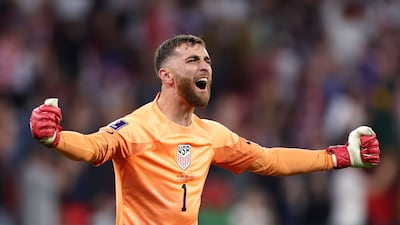
USA RATINGS: Matt Turner – 5 The Arsenal goalkeeper had little to do in the first half, and stood little chance of saving Bale’s powerful penalty in the second. Getty -
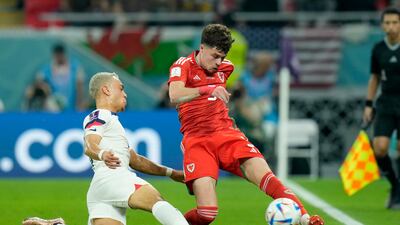
Sergio Dest – 6 Booked early on for a challenge on Williams, the AC Milan man was solid throughout, particularly when Wales started turning up the pressure. He was also willing to make the forward moves that sparked attacks. AP -
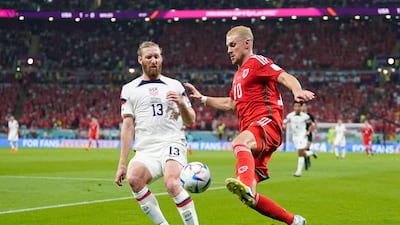
Tim Ream – 6 The Fulham defender left Moore unmarked for Wales’ best opportunity in the second half but was largely comfortable in the backline. Booked. PA -

Walker Zimmerman – 4 The Nashville centre-back was guilty of a reckless challenge on Bale in the box, conceding the penalty that allowed Wales back into the game. AFP -

Antonee Robinson – 6 One of four Fulham players on the pitch, Robinson was lively on the wing and fared well throughout. EPA -
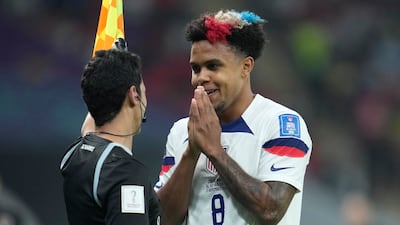
Weston McKennie – 5 The Juventus player was sloppy in possession at times and looked off the pace as the game went on. Booked. AP -

Tyler Adams – 6 The 23-year-old became America’s youngest captain at a World Cup since 1950 and put in a top display in the middle of the pitch, especially as Wales applied the pressure after the break. AP -
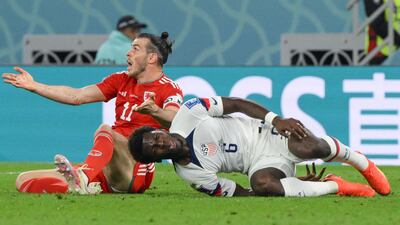
Yunus Musah – 6 The Valencia midfielder was lively and keen to use his pace to dribble at the Wales defence from the wing. AFP -
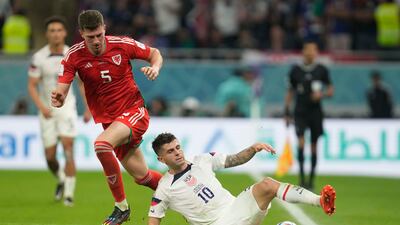
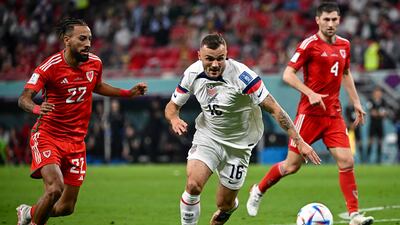
Christian Pulisic – 6 Wales were unable to handle the Chelsea man in the first half and they were caught out when Pulisic threaded a ball to Weah to tap home. The American’s impact weakened as the game went on. AP -

Tim Weah – 7 After a strong start, he scored a much deserved goal to break the deadlock when he beat the offside trap and beat Hennessey to tap home. AFP -

Josh Sargent – 5 The Norwich City striker started his first USA game in over a year and could have opened the scoring when his header hit the side netting inside 10 minutes. Saw little of the ball otherwise. AFP -
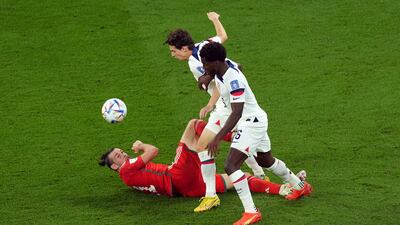
SUBS: Brenden Aaronson (McKennie 66’) – 5 Unable to get his header on target in his first action of the game. PA -
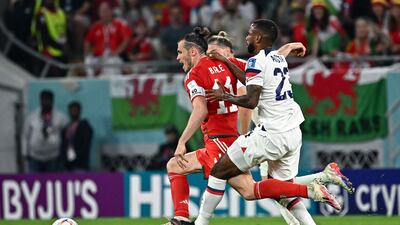
Kellyn Acosta – (Musah 75’) N/A Took one for the team against his LA teammate Bale when he brought down the Welshman with Turner exposed and out of position in the closing stages. AFP -
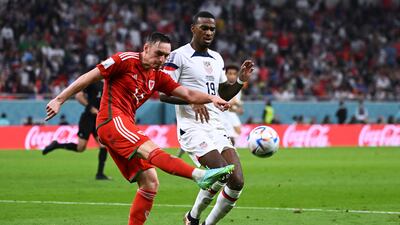
Haji Wright (Dest 75’) – N/A Part of a triple substitution, and he struggled to keep pace with the game. AFP -

DeAndre Yedlin (Sargent 74’) – N/A USA seemed to struggle to retain possession as well when Yedlin entered the pitch. Getty -
Jordan Morris (Weah 88’) – N/A The former Swansea City player made a late entrance. AFP -

WALES RATINGS: Wayne Hennessey – 6 The Nottingham Forest goalkeeper saved his side from an awkward own goal with a point-blank save to stop Rodon heading into his own net, but could only watch Weah round him for USA’s opener. Reuters -
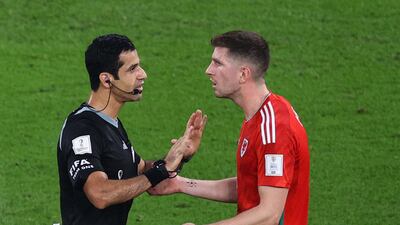
Chris Mepham – 5 The Welshman found it hard to deal with Pulisic on the wing in the first half, but grew into the pressure as the game went on and as Wales started to attack. Booked. AFP -
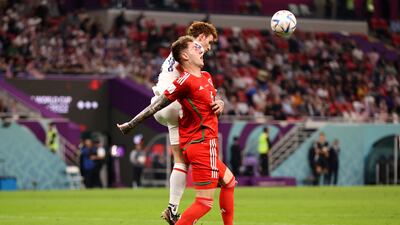
Joe Rodon – 5 Got lucky when Hennessey’s point-blank save denied a headed own goal. Later, he was drawn into an aerial duel which he failed to win, leaving his side exposed for Weah’s opener. Getty -
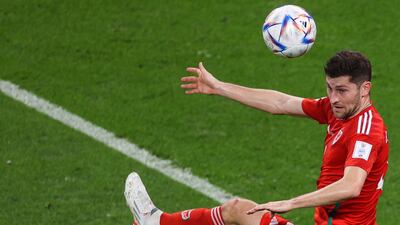
Ben Davies – 5 The Spurs man thought he’d found the equaliser for Wales when his header forced Turner into a smart save. AFP -
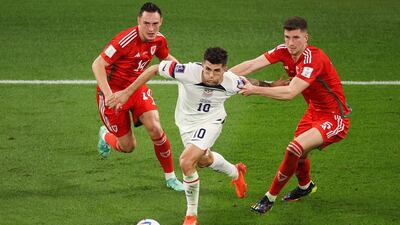
Connor Roberts – 6 The Burnley man had a better second half when he started making more meaningful runs on the wing, which allowed Wales to advance forward. Managed to get a touch on the ball when Pulisic was played into the box. AFP -
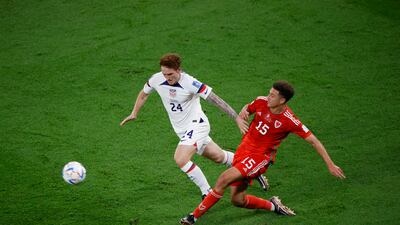
Ethan Ampadu – 6 The Spenzia midfielder saw an ambitious attempt fly over the crossbar inside 15 minutes. He was keen to get stuck in throughout the contest and showed plenty of energy, encapsulated by a superb tackle on Zimmermann late on. EPA -

Aaron Ramsey – 5 The Nice midfielder took a while to get into the game and will be hoping to better influence the proceedings as the World Cup progresses. Getty -
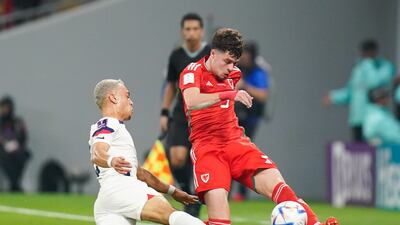
Neco Williams – 6 The 21-year-old was at fault and unaware of Weah, who he played onside, when Pulisic released the pacy American in the build up to the goal. Utilised the wing more in an attacking sense in the second half. PA -

Harry Wilson – 5 Given a surprise nod ahead of Kieffer Moore, Wilson seemed to grow into the game after the restart. AFP -
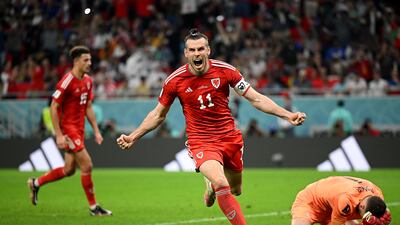
Gareth Bale – 6 Anonymous for much of the game, but it was no surprise when he finally got on the ball that things happened. No hesitation from the spot to level. Booked. Getty -

Daniel James – 5 The Fulham forward was unable to get a hold of the game and was substituted at half-time. Getty -
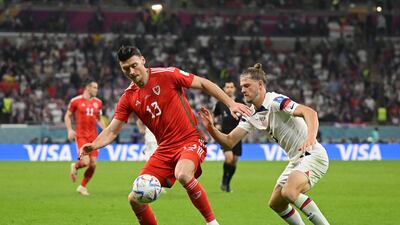
SUBS: Kieffer Moore (James 46’) – 7 The Bournemouth striker was brought on at half-time and his presence made an instant impact. He came close with a towering header. Getty -
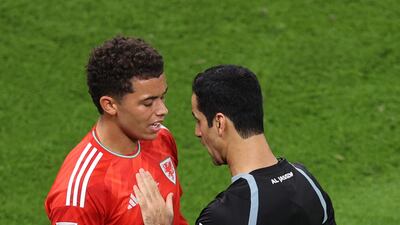
Brennan Johnson (Williams 79’) – 5 The Nottingham Forest forward was looking to get back on goalscoring form but could only direct a shot into Turner’s arms after a solo break forward. AFP -

Sorba Thomas (Wilson 90+1’) – N/A Earned his seventh cap in a late change. AFP -
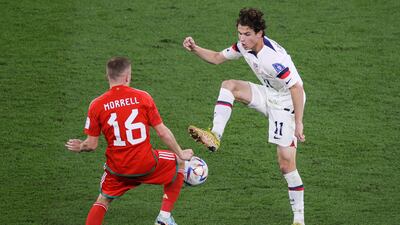
Joe Morrell (Ampadu 96’) – N/A A late injury substitution. AFP


With football fans as sons who have travelled to away matches, he knew it would mean a lot to the players and fans. With more than a few tears in his eyes, Iwan stepped up to deliver an emotional performance, made all the sweeter as Wales' 2-1 victory saw them reach the World Cup finals for the first time since 1958.
He told WalesOnline afterwards: “I get quite emotional singing certain songs, especially this one. But the atmosphere and sound made it all the more special. The Red Wall was like one big choir singing it with me. It was fantastic to realise for myself in that moment what it meant to the fans — the song has almost become like an anthem to them, and what's even more fantastic is knowing that Welsh and non-Welsh speakers were singing it too.”
He continued: “The song is essentially about survival — Wales is still here and the Welsh language is very much alive. It's also about celebrating being a small nation. The Welsh football team has contributed a lot to those aspects as well.”
After the Ukraine victory, Wales's most-capped player Chris Gunter invited Iwan onto the pitch to celebrate with the team. Gunter was the catalyst for the song being taken up by the team after adding it to their prematch playlist.
“Chris Gunter started it,” said Wales manager Rob Page earlier this year. “We played it every day before training and on the coach, and that is something we have now got as our anthem. It is a big part of what we are all about. The song is very poignant. We can all relate to it. We are all passionate Welsh people who love our country.”
The surge in Wales’s on-pitch fortunes has coincided with a new era of self-confidence for its fans, and perhaps the country as a whole.
The Red Wall, a term coined by Bale when talking about the lift his team get when walking on to the pitch and seeing the fans, has its own identity, from bucket hats and retro shirts to the songs and anthems they sing.
Their numbers have grown from the brave dozens who would travel abroad in the early 2000s to thousands now.
Among the long-standing and frequently suffering has been author Tim Hartley, who has travelled the world writing about his love of football and its fans.
The Welsh language is something that unites many Welsh fans, he told The National.
According to the Welsh government’s Annual Population Survey, about 29 per cent of Welsh people, or 899,500 people, can speak Welsh to some degree.
But it punched above its weight when it comes to football supporters, many of whom come from North Wales where the proportion of first-language speakers is greatest.
The self-confident, bilingual atmosphere has not arrived by accident.
The Football Association of Wales, rare among sporting governing bodies in that it is actually popular with fans, has been at pains not to dictate how its matches should be supported.
“The feeling around football is very authentic,” said Rob Dowling, head of content and engagement at the association. “It’s run by people that really care about the game and it’s been embraced by the Welsh public.
“We use language in a really accessible way in terms of mixing it with English. It has really pulled the country together.”
That tactic was noticeable in the stands at Ahmed bin Ali Stadium on Monday, when behind the goals, the Red Wall sprang into voice. Wales are still here.
The ups and downs of Welsh football — in pictures
-
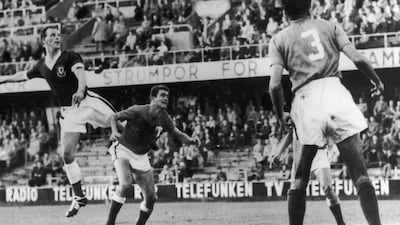
Wales qualified for their first World Cup Finals in 1958, when the tournament was played in Sweden. Wales drew with Mexico 1-1 in a group stage match, with star centre-forward John Charles scoring, above. All photos: Getty Images -

Swedish goalkeeper Kalle Svensson, assisted by full back Sven Axbom, saves a shot from John Charles during a group stage match between Sweden and Wales at the 1958 World Cup. Wales progressed from the group stage to face Brazil in the quarter finals. -
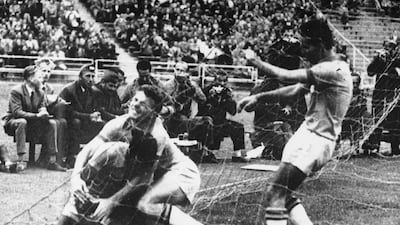
A 17-year-old Pele throws himself over the ball in the net after Brazil scored the single, winning goal of the World Cup quarter final against Wales in the 1958 World Cup. -
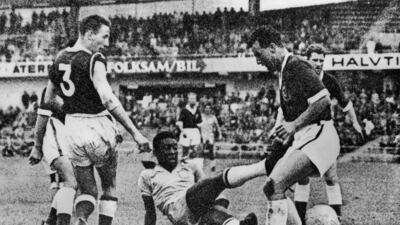
Pele is tackled by two Welsh players during the 1958 quarter final. -
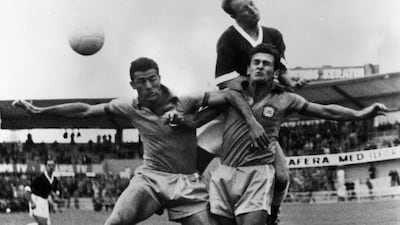
Ivor Allchurch of Wales competes for the ball against Hideraldo Bellini and Nilton De Sordi of Brazil during the quarter final. -
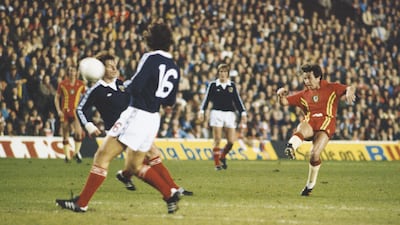
Brian Flynn of Wales gets in a shot at goal during the 1978 World Cup play-off match between Wales and Scotland at Anfield in Liverpool. Scotland won the match 2-0, booking their spot at the World Cup in Argentina, with Wales missing out. -
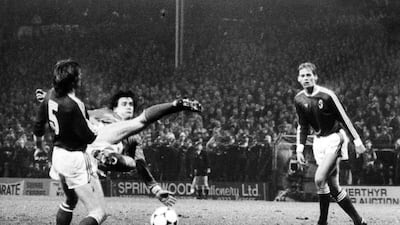
Welsh striker, and future national team manager, Mark Hughes during a World Cup qualifying match against Iceland in 1984 in Cardiff. Wales again failed to end the qualifying campaign successfully, missing out on a place at the 1986 World Cup in Mexico. -
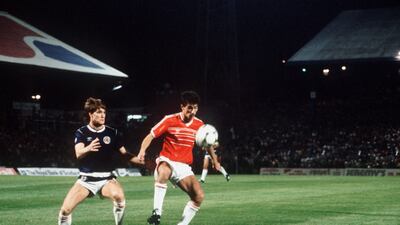
Ian Rush in action for Wales in 1985 against Scotland in a World Cup qualifier. Rush was Wales's record goal scorer, until his tally was surpassed by Gareth Bale in 2018. -

The Wales squad in 1993, ahead of a qualifying campaign for the 1994 World Cup to be held in the USA. -
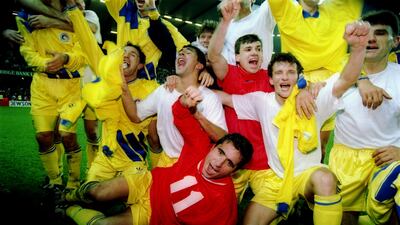
Wales were in the running to qualify for the 1994 World Cup right up until their final qualification match against Romania. Seven minutes from the end of the game, Romania took a 2-1 lead to qualify for the finals and confirm another year of disappointment for Wales. -

Wales captain Vinnie Jones sings the national anthem alongside goalkeeper Neville Southall before the World Cup qualifier against the Netherlands in 1996 in Eindhoven. Wales again failed to reach the World Cup again, missing out on a spot at the 1998 tournament in France. -
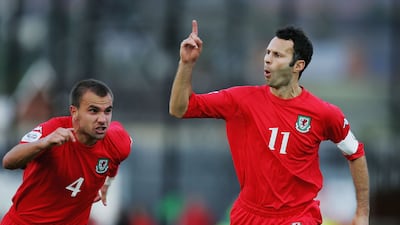
Ryan Giggs celebrates scoring for Wales during the World Cup qualifier between Northern Ireland and Wales in Belfast in 2005. Giggs, one of the most high-profile players to represent the country, never made it to the World Cup with the team. -
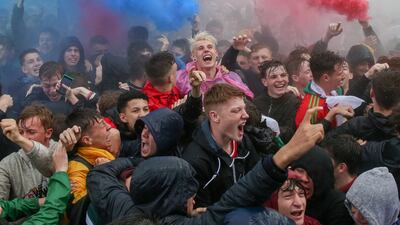
Wales made it to a major finals in 2016, qualifying for the European Championships held in France. Here Welsh fans in Cardiff celebrate after Gareth Bale scored the first goal during the Euro 2016 group match against England in France. -
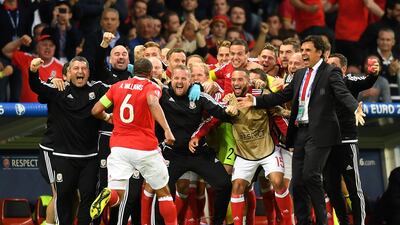
Welsh manager Chris Coleman celebrates with Ashley Williams after he scored his team's first goal during the Euro 2016 quarter-final against Belgium in Lille, France. -
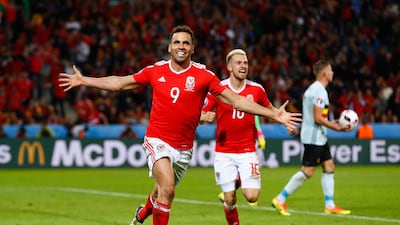
Hal Robson-Kanu celebrates scoring the second goal during Wales's 3-1 Euro 2016 quarter-final win against Belgium. -
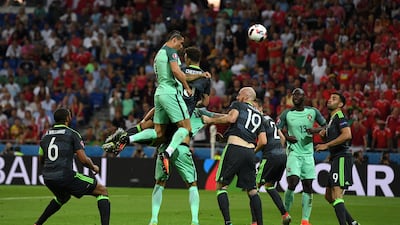
Wales made it all the way to the semi-finals of Euro 2016, where Cristiano Ronaldo and Portugal defeated them at Stade des Lumieres in Lyon. -
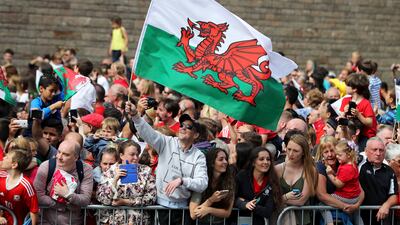
Fans in Cardiff wait to welcome home the Wales team after their exit from the Euro 2016 championships. -
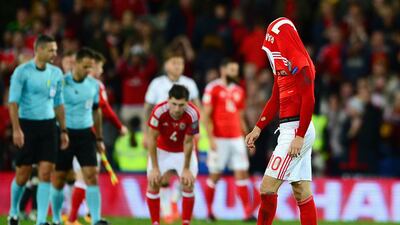
Despite their success at Euro 2016, Wales again failed to qualify for the World Cup in their next campaign – a dejected Aaron Ramsey after defeat in a 2018 World Cup qualifier between Wales and Republic of Ireland in Cardiff, which meant they failed to clinch a play-off spot. -
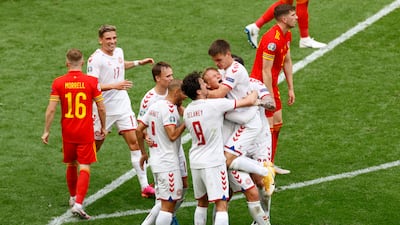
Wales qualified for their second European Championships in a row, booking a place in the Euro 2020 finals, which took place in 2021 because of the Covid-19 Pandemic. They were knocked out by Denmark in the round of 16 match. -
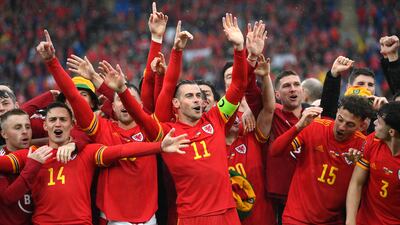
Wales reach their first World Cup since 1958 – Gareth Bale celebrates with team mates after victory in the World Cup qualifier between Wales and Ukraine at Cardiff, sending the team to the 2022 finals in Qatar.


Lyrics — Yma o Hyd chorus
Ry'n ni yma o hyd
Ry'n ni yma o hyd
Er gwaetha pawb a phopeth
Er gwaetha pawb a phopeth
Er gwaetha pawb a phopeth
Ry'n ni yma o hyd
Ry'n ni yma o hyd
Er gwaetha pawb a phopeth
Er gwaetha pawb a phopeth
Er gwaetha pawb a phopeth
Ry'n ni yma o hyd
(We are still here,
we are still here,
in spite of everyone and everything,
in spite of everyone and everything,
in spite of everyone and everything.
We are still here,
we are still here,
in spite of everyone and everything,
in spite of everyone and everything,
in spite of everyone and everything.
We are still here.)

