


A gene associated with strong immune response following Covid-19 vaccination has been identified by scientists from the University of Oxford.
People who carry a version of an HLA gene known as HLA-DQB1*06 are more likely to generate a higher antibody response after getting their vaccination than those who do not, researchers found.
Experts said the effect was seen in both Pfizer/BioNTech as well as Oxford/AstraZeneca vaccines.
The team said their findings, published in the journal Nature Medicine, could in future improve vaccines and help prevent infection.
“We have seen a wide variation in how quickly people test positive for Covid-19 after vaccination,” said Dr Alexander Mentzer, NIHR academic clinical lecturer at the Wellcome Centre for Human Genetics and a lead researcher on the study.
“Our findings suggest that our genetic code may influence how likely this is to happen over time.
“We hope that our findings will help us improve vaccines for the future so they not only stop us developing severe disease, but also keep us symptom-free for as long as possible.”
Coronavirus pandemic around the world — in pictures
-

A young woman receives a Pfizer jab in Diepsloot Township near Johannesburg, South Africa. AP Photo -

A girl wearing a face mask rides on a merry-go-round at the Christmas market in Frankfurt, Germany. AP Photo -

People travel on a London underground tube train on the Jubilee Line, in London, during the pandemic. AP Photo -

People wait for the tram in Vienna, Austria, amid the crisis. AP Photo -

A woman passes by an empty terrace in the Marrolles quarter in Brussels, Belgium. AP Photo -

A teacher gives online lessons via webcam at the temporarily closed elementary school in the town of Trebisov, eastern Slovakia. TASR via AP -

Hairdressers and clients wear masks in Amsterdam, Netherlands. AFP -

A man disinfects seats for tourists at a beach in Kuta, Bali, Indonesia. EPA -
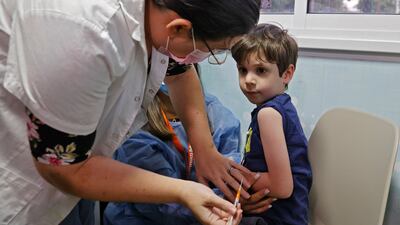
Israeli boy Itamar, 5, receives a dose of the Pfizer/BioNTech Covid-19 vaccine at the Meuhedet Healthcare Services Organisation in Tel Aviv. AFP -

A patient suffering from Covid-19 is admitted in the intensive care unit of the Basaksehir Cam and Sakura City Hospital in Istanbul, Turkey. Reuters -
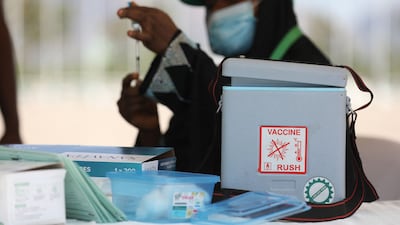
A health worker prepares to administer the AstraZeneca jab in Abuja, Nigeria. AFP


The team analysed DNA samples from 1,190 participants enrolled in the University of Oxford’s vaccine clinical trials, as well as from 1,677 adults who had enrolled on the Com-COV research programme.
They also looked at samples from children who had participated in clinical trials for the AstraZeneca vaccine.
The researchers found individuals carrying the HLA-DQB1*06 gene recorded higher antibody responses against the Covid-19 vaccines at 28 days following the first dose.
Participants who had the gene were also less likely to experience breakthrough infection — where people still get infected with coronavirus despite being vaccinated.
Around 30-40 per cent of people in the UK are thought to carry the HLA-DQB1*06 gene.
UK approves world's first variant-adapted Covid vaccine — video
“Further work is needed to better understand the clinical significance of this specific association, and more broadly what identifying this gene variant can tell us about how effective immune responses are generated and ways to continue to improve vaccines for everyone,” said Julian Knight, professor of genomic medicine at the University’s Wellcome Centre for Human Genetics and chief investigator on the study.
The findings come as Covid-19 booster doses become available to over 50s in England on Friday — with 26 million people being eligible for the autumn jab.
A majority of them will be offered the newer bivalent vaccine which targets the original Covid-19 variant and the newer Omicron one.

