Medics criticise UK doctor who’s become ‘anti-vaxxer’s dream’


Soraya Ebrahimi
  • English
  • Arabic

Senior British medics have reacted with fury against the doctor who confronted Health Secretary Sajid Javid over the vaccine mandate for National Health Service staff amid fears that tens of thousands will lose their jobs over the policy.

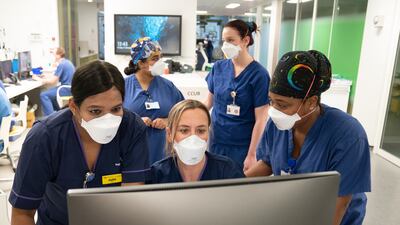
Dr Steve James, a consultant anaesthetist on the intensive care ward at King’s College Hospital in London, questioned the government’s policy during Mr Javid’s visit to the hospital on Friday, claiming that “the science is not strong enough” and that he had acquired immunity through infection.

Dr James gave several broadcast interviews at the weekend and took to social media to urge NHS colleagues to “stand up and make your voices heard” if they disagreed with the vaccine mandate.

“I’d like to suggest to those of you who feel you haven’t had a chance to speak up that I’ve just had to do so," he said "Please contact your local media outlets. Write to your executive staff at your hospital.

"Write to [the government’s chief medical adviser Prof] Chris Whitty, write to Boris Johnson, write to Sajid Javid and make your views known. Please stand up and make your voices heard as best as you can.”

But his stance has provoked a backlash from NHS staff across the country.

“I completely disagree with Steve James who told Sajid Javid that he didn’t believe in vaccines – a deluded, irresponsible and dangerous intervention,” said Dr Rich Breeze, an anaesthetist at University Hospital Lewisham.

Thousands of NHS staff took to Twitter with similar messages explaining why they had received both doses and a booster shot.

Many said it was the “single most important thing” they could so to avoid being admitted to intensive care or dying from the virus.

Luton doctor Meenal Viz said she felt uncomfortable listening to Dr James’s views.

“I fear it will set us back,” Dr Viz said. “Dr Steve James was asked about vaccine mandates. He is entitled to give his personal opinions.

"But he didn’t do that. He cast doubt on the efficacy of vaccines. Dr James conflated his own Covid experience with an entire population’s.”

One senior figure said Dr James had been “naive and spectacularly unhelpful” by challenging Mr Javid on camera.

“Some of the stuff the guy said was intrinsically selfish: it was about him and his immunisation status when of course the greatest benefit of vaccinating people is to stop the transmission in others,” they said.

“And his grasp of immunology was pretty shabby as well. If you’re boosted you have far greater protection than just having one lot of natural antibodies.

"I do worry about him. He might have quite a rude awakening for someone who’s never put their head above the parapet before. What he said and being amplified so much is an anti-vaxxer’s dream, sadly.

“If I was the government this would harden my resolve to make this happen. Healthcare professionals will not be on the side of angels if they are opposed to vaccination on the one hand and then asking the public to be vaccinated on the other.”

The head of the Academy of Medical Royal Colleges said that the row over Dr James’s comments came at a critical time in the pandemic and could lead hesitant staff who were considering getting the shot to change their minds.

“Healthcare professionals are being so welcoming of people who are coming forward for their vaccine,” Prof Dame Helen Stokes-Lampard said.

"There is no stigma or shame in doing so and they will be welcomed warmly by people keen to see colleagues vaccinated and protected – not just for themselves but also the vulnerable people around them.

“This is an unwelcome distraction for the important matter of maximising the uptake of booster doses and we strongly encourage those who have been reluctant so far, for whatever reason, to come forward.

“The worst thing that can happen is that healthcare professionals who were a bit hesitant and considering getting vaccinated will now dig in and not take the opportunity.

“That will create division and distress for many at a time when we might have been able to persuade them. We need to be pulling together not this risks pulling people apart.

“The strength of the NHS has been about the brilliant teams within it and how they work together and support one another, and this sort of situation creates division and discord.

“The vast majority of health professionals are already vaccinated or will have legitimate exemption. For the small percentage that hold out, they will inevitably be redeployed or lose their jobs, which is a great sadness and a great waste."

The Academy, the co-ordinating body for the UK and Ireland’s 23 medical royal colleges and faculties, had been opposed to mandatory shots for NHS staff, calling the move “not sensible or necessary”.

Tens of thousands of NHS staff could lose their jobs if they have not had two doses of the vaccine by April, when the law comes into effect.

Last year, the government decided all NHS staff dealing with patients must have received their first dose of the Covid-19 vaccine by February 3, and two doses by April 2022.

Trusts will be told this week how they should go about dismissing NHS staff who have decided not to be vaccinated.

On Sunday, King’s College Hospital chief executive Dr Clive Kay said the centre could lose 1,000 staff members if they did not get vaccinated.

Dr Kay told the BBC he was “worried” as 10 per cent of about 14,000 workers at the hospital were yet to receive a first dose.

More than 1,000 members of staff could be lost in an “extreme” scenario unless vaccine acceptance within the workforce improves, he said.

“The law is now such that individuals who are not vaccinated, if they can’t be redeployed, will not be able to work in hospitals if they deal with patients,” Dr Kay said.

“We’re having conversations with staff, their line managers are having conversations, we have a helpline where colleagues seek clarification and help.”

The number of unvaccinated staff is higher in London where vaccine hesitancy is stronger than the rest of the country.

Overall, 93.5 per cent of NHS England staff have had at least one dose and 90.7 per cent two doses. The figure for doctors is about 95 per cent.

“It is a real concern that significant numbers of patient facing staff remain unvaccinated,” said Chris Hopson, chief executive of NHS Providers.

"Trusts are continuing to work hard to overcome vaccine hesitancy, listening to concerns, and offering clarification and support.

“This respectful and constructive approach has helped to ensure a high uptake, but there is still some way to go, and with the NHS so stretched, even a small number of staff taken off regular frontline duties could jeopardise some services.

“In the coming weeks trusts will redouble their efforts to persuade vaccine hesitant colleagues that it is best for patients, colleagues, loved ones and for themselves to get jabbed and boosted."


Cinco in numbers

Dh3.7 million

The estimated cost of Victoria Swarovski’s gem-encrusted Michael Cinco wedding gown

46

The number, in kilograms, that Swarovski’s wedding gown weighed.

1,000

The hours it took to create Cinco’s vermillion petal gown, as seen in his atelier [note, is the one he’s playing with in the corner of a room]

50

How many looks Cinco has created in a new collection to celebrate Ballet Philippines’ 50th birthday

3,000

The hours needed to create the butterfly gown worn by Aishwarya Rai to the 2018 Cannes Film Festival.

1.1 million

The number of followers that Michael Cinco’s Instagram account has garnered.

MEDIEVIL%20(1998)
%3Cp%3E%3Cstrong%3EDeveloper%3A%3C%2Fstrong%3E%20SCE%20Studio%20Cambridge%3Cbr%3E%3Cstrong%3EPublisher%3A%3C%2Fstrong%3E%20Sony%20Computer%20Entertainment%3Cbr%3E%3Cstrong%3EConsole%3A%3C%2Fstrong%3E%20PlayStation%2C%20PlayStation%204%20and%205%3Cbr%3E%3Cstrong%3ERating%3A%3C%2Fstrong%3E%203.5%2F5%3C%2Fp%3E%0A
The specs

Engine: 2.0-litre 4cyl turbo

Power: 261hp at 5,500rpm

Torque: 405Nm at 1,750-3,500rpm

Transmission: 9-speed auto

Fuel consumption: 6.9L/100km

On sale: Now

Price: From Dh117,059

Afro%20salons
%3Cp%3E%3Cstrong%3EFor%20women%3A%3C%2Fstrong%3E%3Cbr%3ESisu%20Hair%20Salon%2C%20Jumeirah%201%2C%20Dubai%3Cbr%3EBoho%20Salon%2C%20Al%20Barsha%20South%2C%20Dubai%3Cbr%3EMoonlight%2C%20Al%20Falah%20Street%2C%20Abu%20Dhabi%3Cbr%3E%3Cstrong%3EFor%20men%3A%3C%2Fstrong%3E%3Cbr%3EMK%20Barbershop%2C%20Dar%20Al%20Wasl%20Mall%2C%20Dubai%3Cbr%3ERegency%20Saloon%2C%20Al%20Zahiyah%2C%20Abu%20Dhabi%3Cbr%3EUptown%20Barbershop%2C%20Al%20Nasseriya%2C%20Sharjah%3C%2Fp%3E%0A
Some of Darwish's last words

"They see their tomorrows slipping out of their reach. And though it seems to them that everything outside this reality is heaven, yet they do not want to go to that heaven. They stay, because they are afflicted with hope." - Mahmoud Darwish, to attendees of the Palestine Festival of Literature, 2008

His life in brief: Born in a village near Galilee, he lived in exile for most of his life and started writing poetry after high school. He was arrested several times by Israel for what were deemed to be inciteful poems. Most of his work focused on the love and yearning for his homeland, and he was regarded the Palestinian poet of resistance. Over the course of his life, he published more than 30 poetry collections and books of prose, with his work translated into more than 20 languages. Many of his poems were set to music by Arab composers, most significantly Marcel Khalife. Darwish died on August 9, 2008 after undergoing heart surgery in the United States. He was later buried in Ramallah where a shrine was erected in his honour.

The%20specs
%3Cp%3E%3Cstrong%3EEngine%3A%20%3C%2Fstrong%3E3.5-litre%20twin-turbo%20V6%20%0D%3Cbr%3E%3Cstrong%3EPower%3A%20%3C%2Fstrong%3E456hp%20at%205%2C000rpm%0D%3Cbr%3E%3Cstrong%3ETorque%3A%20%3C%2Fstrong%3E691Nm%20at%203%2C500rpm%0D%3Cbr%3E%3Cstrong%3ETransmission%3A%20%3C%2Fstrong%3E10-speed%20auto%20%0D%3Cbr%3E%3Cstrong%3EFuel%20consumption%3A%20%3C%2Fstrong%3E14.6L%2F100km%0D%3Cbr%3E%3Cstrong%3EPrice%3A%20%3C%2Fstrong%3Efrom%20Dh349%2C545%0D%3Cbr%3E%3Cstrong%3EOn%20sale%3A%20%3C%2Fstrong%3Enow%3C%2Fp%3E%0A

White hydrogen: Naturally occurring hydrogenChromite: Hard, metallic mineral containing iron oxide and chromium oxideUltramafic rocks: Dark-coloured rocks rich in magnesium or iron with very low silica contentOphiolite: A section of the earth’s crust, which is oceanic in nature that has since been uplifted and exposed on landOlivine: A commonly occurring magnesium iron silicate mineral that derives its name for its olive-green yellow-green colour

Who's who in Yemen conflict

Houthis: Iran-backed rebels who occupy Sanaa and run unrecognised government

Yemeni government: Exiled government in Aden led by eight-member Presidential Leadership Council

Southern Transitional Council: Faction in Yemeni government that seeks autonomy for the south

Habrish 'rebels': Tribal-backed forces feuding with STC over control of oil in government territory

Will the pound fall to parity with the dollar?

The idea of pound parity now seems less far-fetched as the risk grows that Britain may split away from the European Union without a deal.

Rupert Harrison, a fund manager at BlackRock, sees the risk of it falling to trade level with the dollar on a no-deal Brexit. The view echoes Morgan Stanley’s recent forecast that the currency can plunge toward $1 (Dh3.67) on such an outcome. That isn’t the majority view yet – a Bloomberg survey this month estimated the pound will slide to $1.10 should the UK exit the bloc without an agreement.

New Prime Minister Boris Johnson has repeatedly said that Britain will leave the EU on the October 31 deadline with or without an agreement, fuelling concern the nation is headed for a disorderly departure and fanning pessimism toward the pound. Sterling has fallen more than 7 per cent in the past three months, the worst performance among major developed-market currencies.

“The pound is at a much lower level now but I still think a no-deal exit would lead to significant volatility and we could be testing parity on a really bad outcome,” said Mr Harrison, who manages more than $10 billion in assets at BlackRock. “We will see this game of chicken continue through August and that’s likely negative for sterling,” he said about the deadlocked Brexit talks.

The pound fell 0.8 per cent to $1.2033 on Friday, its weakest closing level since the 1980s, after a report on the second quarter showed the UK economy shrank for the first time in six years. The data means it is likely the Bank of England will cut interest rates, according to Mizuho Bank.

The BOE said in November that the currency could fall even below $1 in an analysis on possible worst-case Brexit scenarios. Options-based calculations showed around a 6.4 per cent chance of pound-dollar parity in the next one year, markedly higher than 0.2 per cent in early March when prospects of a no-deal outcome were seemingly off the table.

Bloomberg

Under 19 World Cup

Group A: India, Japan, New Zealand, Sri Lanka

Group B: Australia, England, Nigeria, West Indies

Group C: Bangladesh, Pakistan, Scotland, Zimbabwe

Group D: Afghanistan, Canada, South Africa, UAE


UAE fixtures

Saturday, January 18, v Canada

Wednesday, January 22, v Afghanistan

Saturday, January 25, v South Africa

UAE currency: the story behind the money in your pockets

Mercer, the investment consulting arm of US services company Marsh & McLennan, expects its wealth division to at least double its assets under management (AUM) in the Middle East as wealth in the region continues to grow despite economic headwinds, a company official said.

Mercer Wealth, which globally has $160 billion in AUM, plans to boost its AUM in the region to $2-$3bn in the next 2-3 years from the present $1bn, said Yasir AbuShaban, a Dubai-based principal with Mercer Wealth.

Within the next two to three years, we are looking at reaching $2 to $3 billion as a conservative estimate and we do see an opportunity to do so,” said Mr AbuShaban.

Mercer does not directly make investments, but allocates clients’ money they have discretion to, to professional asset managers. They also provide advice to clients.

“We have buying power. We can negotiate on their (client’s) behalf with asset managers to provide them lower fees than they otherwise would have to get on their own,” he added.

Mercer Wealth’s clients include sovereign wealth funds, family offices, and insurance companies among others.

From its office in Dubai, Mercer also looks after Africa, India and Turkey, where they also see opportunity for growth.

Wealth creation in Middle East and Africa (MEA) grew 8.5 per cent to $8.1 trillion last year from $7.5tn in 2015, higher than last year’s global average of 6 per cent and the second-highest growth in a region after Asia-Pacific which grew 9.9 per cent, according to consultancy Boston Consulting Group (BCG). In the region, where wealth grew just 1.9 per cent in 2015 compared with 2014, a pickup in oil prices has helped in wealth generation.

BCG is forecasting MEA wealth will rise to $12tn by 2021, growing at an annual average of 8 per cent.

Drivers of wealth generation in the region will be split evenly between new wealth creation and growth of performance of existing assets, according to BCG.

Another general trend in the region is clients’ looking for a comprehensive approach to investing, according to Mr AbuShaban.

“Institutional investors or some of the families are seeing a slowdown in the available capital they have to invest and in that sense they are looking at optimizing the way they manage their portfolios and making sure they are not investing haphazardly and different parts of their investment are working together,” said Mr AbuShaban.

Some clients also have a higher appetite for risk, given the low interest-rate environment that does not provide enough yield for some institutional investors. These clients are keen to invest in illiquid assets, such as private equity and infrastructure.

“What we have seen is a desire for higher returns in what has been a low-return environment specifically in various fixed income or bonds,” he said.

“In this environment, we have seen a de facto increase in the risk that clients are taking in things like illiquid investments, private equity investments, infrastructure and private debt, those kind of investments were higher illiquidity results in incrementally higher returns.”

The Abu Dhabi Investment Authority, one of the largest sovereign wealth funds, said in its 2016 report that has gradually increased its exposure in direct private equity and private credit transactions, mainly in Asian markets and especially in China and India. The authority’s private equity department focused on structured equities owing to “their defensive characteristics.”

500 People from Gaza enter France

115 Special programme for artists

25   Evacuation of injured and sick

Infiniti QX80 specs

Engine: twin-turbocharged 3.5-liter V6

Power: 450hp

Torque: 700Nm

Price: From Dh450,000, Autograph model from Dh510,000

Available: Now

Skoda Superb Specs

Engine: 2-litre TSI petrol

Power: 190hp

Torque: 320Nm

Price: From Dh147,000

Available: Now

UAE currency: the story behind the money in your pockets
EA Sports FC 26

Publisher: EA Sports

Consoles: PC, PlayStation 4/5, Xbox Series X/S

Rating: 3/5

Key findings of Jenkins report
  • Founder of the Muslim Brotherhood, Hassan al Banna, "accepted the political utility of violence"
  • Views of key Muslim Brotherhood ideologue, Sayyid Qutb, have “consistently been understood” as permitting “the use of extreme violence in the pursuit of the perfect Islamic society” and “never been institutionally disowned” by the movement.
  • Muslim Brotherhood at all levels has repeatedly defended Hamas attacks against Israel, including the use of suicide bombers and the killing of civilians.
  • Laying out the report in the House of Commons, David Cameron told MPs: "The main findings of the review support the conclusion that membership of, association with, or influence by the Muslim Brotherhood should be considered as a possible indicator of extremism."
In numbers: PKK’s money network in Europe

Germany: PKK collectors typically bring in $18 million in cash a year – amount has trebled since 2010

Revolutionary tax: Investigators say about $2 million a year raised from ‘tax collection’ around Marseille

Extortion: Gunman convicted in 2023 of demanding $10,000 from Kurdish businessman in Stockholm

Drug trade: PKK income claimed by Turkish anti-drugs force in 2024 to be as high as $500 million a year

Denmark: PKK one of two terrorist groups along with Iranian separatists ASMLA to raise “two-digit million amounts”

Contributions: Hundreds of euros expected from typical Kurdish families and thousands from business owners

TV channel: Kurdish Roj TV accounts frozen and went bankrupt after Denmark fined it more than $1 million over PKK links in 2013 

UAE currency: the story behind the money in your pockets
Updated: January 11, 2022, 1:31 AM