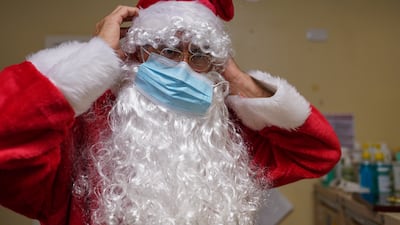
A student dressed as Santa Claus distributes sweets at a school in Chennai, India. The vaccination of children comes as schools and colleges across the country reopen after nearly two years. Photo: EPA
A student dressed as Santa Claus distributes sweets at a school in Chennai, India. The vaccination of children comes as schools and colleges across the country reopen after nearly two years. Photo: EP

India to start vaccinating children and give Covid-19 booster shots


Taniya Dutta
  • English
  • Arabic

Live updates: follow the latest news on Covid-19 variant Omicron

India will start giving Covid-19 vaccines to children aged 15 and older, and offer booster shots to at-risk adults as the Omicron coronavirus variant threatens to trigger a third wave of infections.

Prime Minister Narendra Modi announced the decision in a late-night address to the nation on Saturday.

The vaccination of children between 15 and 18 years will begin on January 3, while a third “precaution dose” will be available to healthcare and frontline workers, senior citizens and people with underlying health conditions from January 10.

“Coronavirus is not gone. The world is now talking about Omicron,” Mr Modi said.

“This decision is taken to not only fight against corona but also to give a sense of relief to those students and their parents who are going to schools and colleges."

The government on Sunday gave emergency use approval to the home-grown Covaxin vaccine for immunising 12 to 18-year-olds. It is the second shot to get the nod for use in children after ZyCoV-D, a locally developed vaccine requiring three doses that received approval in November.

The vaccination of children comes as schools and colleges across the country reopen after nearly two years.

Nearly 8 per cent of India's 1.3 billion population is between 15 and 18 years of age.

The government said in November that it was in no rush to administer jabs to children and that its top advisers were studying the scientific data.

India began inoculating frontline workers and senior citizens in January this year before extending the campaign to everyone over 18.

About 90 per cent of its 944 million adults have received at least one dose of a Covid vaccine and 61 per cent have been fully inoculated with two doses. Along with Covaxin, the vaccines being used are Covishield – a locally produced version of the AstraZeneca vaccine, and Russia's Sputnik V.

However, scientific studies worldwide show that currently available vaccines are not as effective at preventing infection by the Omicron variant, which was first detected in southern Africa in late November. The new variant has since spread globally and is blamed for surging infections in Europe and the US.

  • A man wearing a protective face shield and two mask waits be vaccinated in Quito, Ecuador. Elderly people waited hours to be inoculated. AP Photo
    A man wearing a protective face shield and two mask waits be vaccinated in Quito, Ecuador. Elderly people waited hours to be inoculated. AP Photo
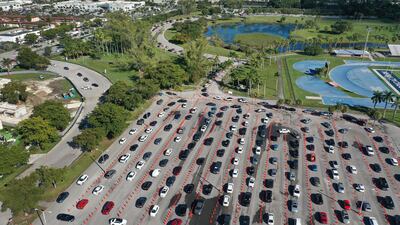
  • An aerial view of cars queuing at a drive-in Covid-19 testing site in the car park of Hiram Bithorn baseball stadium, in San Juan, Puerto Rico. Reuters
    An aerial view of cars queuing at a drive-in Covid-19 testing site in the car park of Hiram Bithorn baseball stadium, in San Juan, Puerto Rico. Reuters
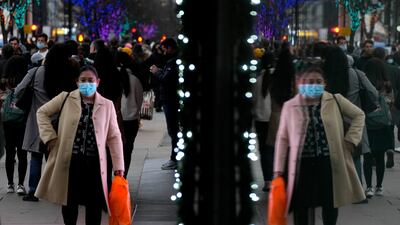
  • A shopper wearing a mask is reflected in a window as she walks down Oxford Street in London. Daily numbers of Covid-19 cases have passed 100,000 for the first time in the UK. AP Photo
    A shopper wearing a mask is reflected in a window as she walks down Oxford Street in London. Daily numbers of Covid-19 cases have passed 100,000 for the first time in the UK. AP Photo
  • A nurse holds a vial of the Pfizer-BioNtech vaccine, in the Israeli town of Ramat Gan, near Tel Aviv. Israelis over the age of 60 and medical teams are being offered a fourth Covid shot.
    A nurse holds a vial of the Pfizer-BioNtech vaccine, in the Israeli town of Ramat Gan, near Tel Aviv. Israelis over the age of 60 and medical teams are being offered a fourth Covid shot.
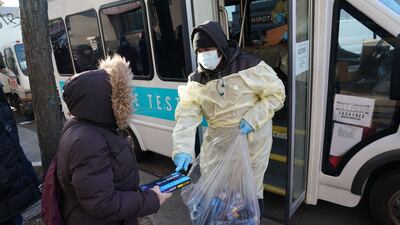
  • An official hands out Covid-19 testing kits in Bensonhurst, Brooklyn, in New York. The resumption of holiday travel and the emergence of Omicron has left Americans scrambling to find Covid tests. AFP
    An official hands out Covid-19 testing kits in Bensonhurst, Brooklyn, in New York. The resumption of holiday travel and the emergence of Omicron has left Americans scrambling to find Covid tests. AFP
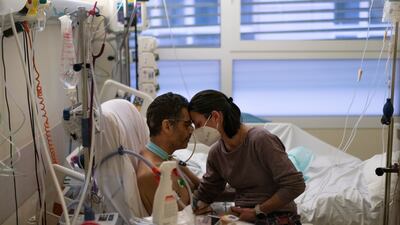
  • Amelie and Ludo Khayat hold each other during a visit at the Covid-19 unit of Marseille University Hospital Timone, in Marseille, southern France. Ludo, 41, is recovering after spending 24 days in a coma. AP Photo
    Amelie and Ludo Khayat hold each other during a visit at the Covid-19 unit of Marseille University Hospital Timone, in Marseille, southern France. Ludo, 41, is recovering after spending 24 days in a coma. AP Photo
  • Christmas shoppers brave the rain in Sydney's central business district. Covid-19 cases are rising in the Australian city and elsewhere in New South Wales, where health authorities have reported cases of the Omicron variant. Getty
    Christmas shoppers brave the rain in Sydney's central business district. Covid-19 cases are rising in the Australian city and elsewhere in New South Wales, where health authorities have reported cases of the Omicron variant. Getty
  • Travellers and vehicles crowd the departures and arrivals areas outside Tom Bradley International Terminal at Los Angeles International Airport during the holiday season. Reuters
    Travellers and vehicles crowd the departures and arrivals areas outside Tom Bradley International Terminal at Los Angeles International Airport during the holiday season. Reuters
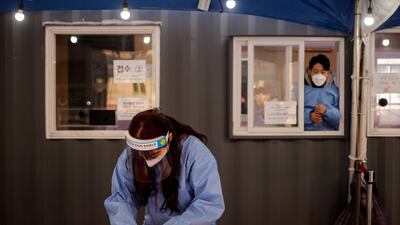
  • Medical workers prepare to conduct Covid-19 tests at a pop-up screening clinic in front of Seoul Station in South Korea. New coronavirus cases in the country have fallen to 7,000, but critical cases and deaths have surged to record highs of 1,083 and 109, respectively. EPA
    Medical workers prepare to conduct Covid-19 tests at a pop-up screening clinic in front of Seoul Station in South Korea. New coronavirus cases in the country have fallen to 7,000, but critical cases and deaths have surged to record highs of 1,083 and 109, respectively. EPA
  • Car queue at a drive-through testing centre at Bondi Beach, in Sydney, Australia. New South Wales has broken another daily record for Covid-19 case numbers as Omicron takes hold, with hospital admissions almost doubling in a week. EPA
    Car queue at a drive-through testing centre at Bondi Beach, in Sydney, Australia. New South Wales has broken another daily record for Covid-19 case numbers as Omicron takes hold, with hospital admissions almost doubling in a week. EPA
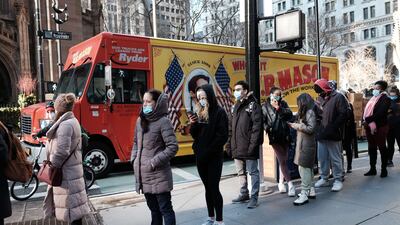
  • A queue for Covid screening in Manhattan. Test provider CityMD closed 13 branches in New York temporarily because of staff shortages as demand surged. AFP
    A queue for Covid screening in Manhattan. Test provider CityMD closed 13 branches in New York temporarily because of staff shortages as demand surged. AFP
  • Travellers queue outside the security checkpoint at Hartsfield-Jackson Atlanta International Airport in Georgia, US, as the Omicron variant spurs a rise in case numbers in many countries. Reuters
    Travellers queue outside the security checkpoint at Hartsfield-Jackson Atlanta International Airport in Georgia, US, as the Omicron variant spurs a rise in case numbers in many countries. Reuters
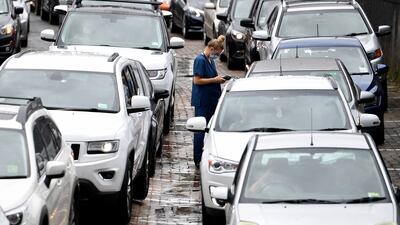
  • Cars line up at a drive-through Covid-19 testing site at Tropical Park in Miami, Florida. As Covid-19 cases rise in the US, healthcare workers are urging people to take precautions during holiday get-togethers. AFP
    Cars line up at a drive-through Covid-19 testing site at Tropical Park in Miami, Florida. As Covid-19 cases rise in the US, healthcare workers are urging people to take precautions during holiday get-togethers. AFP
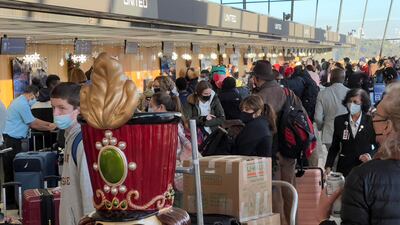
  • People wait in the check-in queue for Air France/KLM at Tom Bradley International Terminal at Los Angeles International Airport. EPA
    People wait in the check-in queue for Air France/KLM at Tom Bradley International Terminal at Los Angeles International Airport. EPA
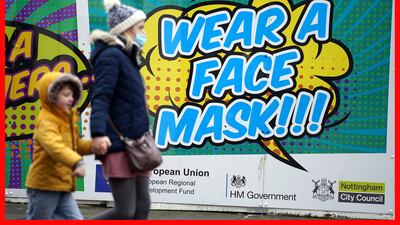
  • Christmas shoppers pictured out and about in Nottingham, England. The UK government has not imposed further restrictions in England to slow the spread of the Omicron variant. PA
    Christmas shoppers pictured out and about in Nottingham, England. The UK government has not imposed further restrictions in England to slow the spread of the Omicron variant. PA
  • Pastor David Shrimpton, 57, known as the ‘flying padre’, puts on a face mask as he prepares to speak to pupils about Christmas at a school in Broken Hill, Australia. Since 2003, he has flown to some of Australia’s most isolated communities to preach. Reuters
    Pastor David Shrimpton, 57, known as the ‘flying padre’, puts on a face mask as he prepares to speak to pupils about Christmas at a school in Broken Hill, Australia. Since 2003, he has flown to some of Australia’s most isolated communities to preach. Reuters
  • Medical workers treat a patient with Covid-19 in intensive care during the fifth wave of the pandemic in Neuchatel, Switzerland. EPA
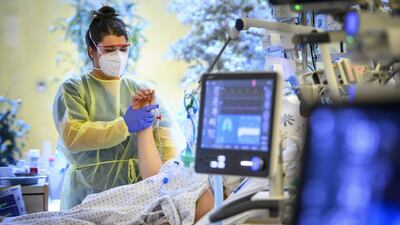
    Medical workers treat a patient with Covid-19 in intensive care during the fifth wave of the pandemic in Neuchatel, Switzerland. EPA
  • A protester wears a latex mask with syringes attached to it during a rally in front of the government headquarters in Bucharest, Romania. Marchers object to a Covid-19 ‘green certificate’ in workplaces to limit infections. AP
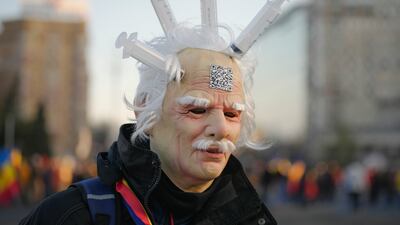
    A protester wears a latex mask with syringes attached to it during a rally in front of the government headquarters in Bucharest, Romania. Marchers object to a Covid-19 ‘green certificate’ in workplaces to limit infections. AP
  • Dr Sydney Sewall fills a syringe with a Covid-19 vaccine at a clinic in Augusta, Maine, US. AP
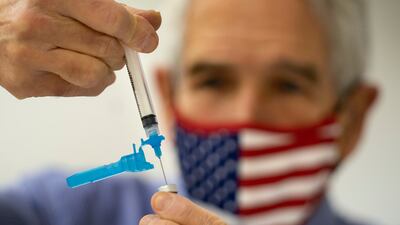
    Dr Sydney Sewall fills a syringe with a Covid-19 vaccine at a clinic in Augusta, Maine, US. AP
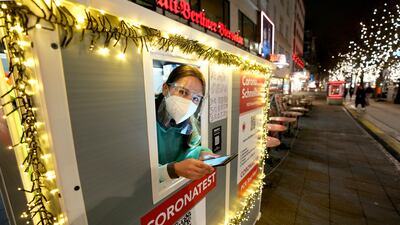
  • A coronavirus test centre employee waits for clients on the shop-lined Kurfuerstendamm street in Berlin. Germany has announced new restrictions aimed at slowing the spread of the Omicron variant. AP
    A coronavirus test centre employee waits for clients on the shop-lined Kurfuerstendamm street in Berlin. Germany has announced new restrictions aimed at slowing the spread of the Omicron variant. AP
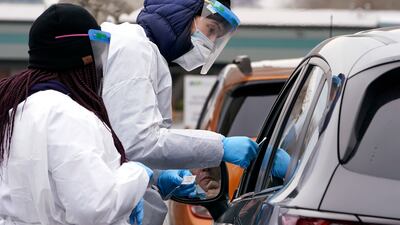
  • A drive-through testing centre in Bellingham, Washington. The US state, which was hit hard early in the pandemic, has reported at least 400 cases of Omicron. AP
    A drive-through testing centre in Bellingham, Washington. The US state, which was hit hard early in the pandemic, has reported at least 400 cases of Omicron. AP
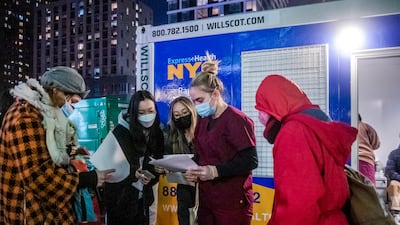
  • New Yorkers check their Covid-19 results outside a rapid testing centre in Manhattan. AP
    New Yorkers check their Covid-19 results outside a rapid testing centre in Manhattan. AP
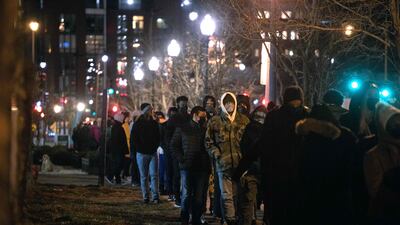
  • People line up to be tested for Covid-19 in Washington, DC. Omicron variant is now the main coronavirus variant in the US. AFP
    People line up to be tested for Covid-19 in Washington, DC. Omicron variant is now the main coronavirus variant in the US. AFP
  • Holiday travellers transit through Dulles International Airport in Virginia. United Airlines chief executive Scott Kirby has said the coming two weeks are expected to be its busiest since the pandemic began, despite Omicron. AFP
    Holiday travellers transit through Dulles International Airport in Virginia. United Airlines chief executive Scott Kirby has said the coming two weeks are expected to be its busiest since the pandemic began, despite Omicron. AFP
  • Early closing for Oliver St John Gogarty, a pub in Temple Bar, Dublin. Under Irish coronavirus rules, which will last until January 30, hospitality venues must shut by 8pm. Getty
    Early closing for Oliver St John Gogarty, a pub in Temple Bar, Dublin. Under Irish coronavirus rules, which will last until January 30, hospitality venues must shut by 8pm. Getty
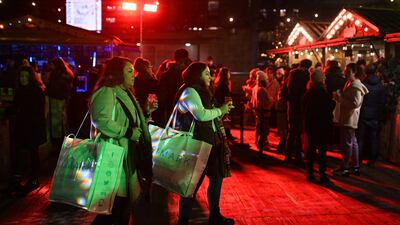
  • People enjoy refreshments at a Christmas market in Piccadilly Gardens in Manchester. The UK government has faced pressure to tighten coronavirus restrictions. AFP
    People enjoy refreshments at a Christmas market in Piccadilly Gardens in Manchester. The UK government has faced pressure to tighten coronavirus restrictions. AFP
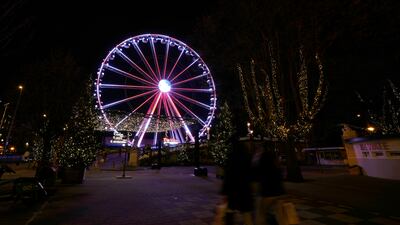
  • A Ferris wheel in the historic centre of Antwerp, Belgium. The government will meet to decide whether new Covid-19 measures will be taken. AP
    A Ferris wheel in the historic centre of Antwerp, Belgium. The government will meet to decide whether new Covid-19 measures will be taken. AP
  • A child watches a Covid-19 test being administered in Washington, DC. EPA
    A child watches a Covid-19 test being administered in Washington, DC. EPA
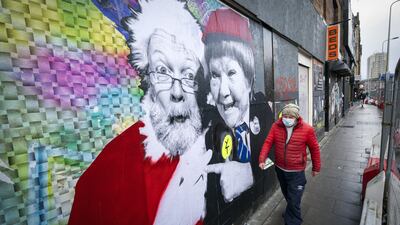
  • A poster featuring Father Christmas and Wee Jimmy Krankie, a popular character from children’s TV, on Leith Walk, Edinburgh. The Scottish government is considering whether to tighten Covid restrictions. PA
    A poster featuring Father Christmas and Wee Jimmy Krankie, a popular character from children’s TV, on Leith Walk, Edinburgh. The Scottish government is considering whether to tighten Covid restrictions. PA
  • A man receives his Covid-19 vaccine inside a National Health Service bus in the town of Farnworth, near Manchester in north-west England. AFP
    A man receives his Covid-19 vaccine inside a National Health Service bus in the town of Farnworth, near Manchester in north-west England. AFP
  • A trader works on the floor of the New York Stock Exchange at the start of trading on Monday after Friday’s steep decline in global stocks amid fears about the Omicron variant. Stocks fell sharply in morning trading, with the Dow falling more than 500 points. Getty
    A trader works on the floor of the New York Stock Exchange at the start of trading on Monday after Friday’s steep decline in global stocks amid fears about the Omicron variant. Stocks fell sharply in morning trading, with the Dow falling more than 500 points. Getty
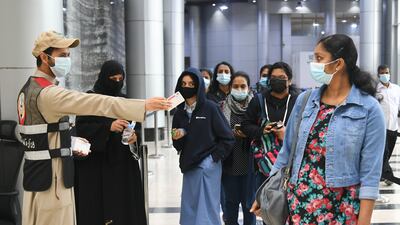
  • People arrive to receive a booster dose of Covid-19 vaccine at an inoculation centre in Kuwait City. EPA
    People arrive to receive a booster dose of Covid-19 vaccine at an inoculation centre in Kuwait City. EPA
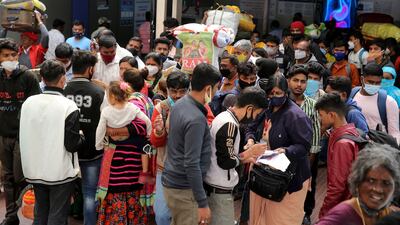
  • People crowd together without social distancing at a railway station in Bangalore, India. EPA
    People crowd together without social distancing at a railway station in Bangalore, India. EPA
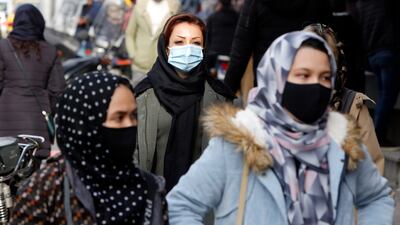
  • Women wear masks in Tehran. The Iranian Health Ministry said it had found a case of the Omicron variant in the country. EPA
    Women wear masks in Tehran. The Iranian Health Ministry said it had found a case of the Omicron variant in the country. EPA
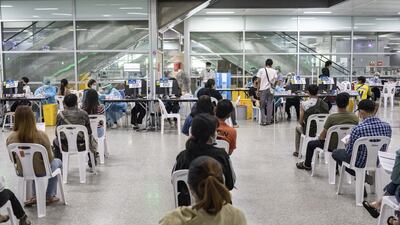
  • People wait to receive a dose of the Pfizer-BioNTech Covid-19 vaccine in Bangkok, Thailand. Bloomberg
    People wait to receive a dose of the Pfizer-BioNTech Covid-19 vaccine in Bangkok, Thailand. Bloomberg
  • Churchgoers wearing masks observe social distancing as they attend a pre-dawn Mass at a church in Paranaque, Metro Manila, Philippines. Getty
    Churchgoers wearing masks observe social distancing as they attend a pre-dawn Mass at a church in Paranaque, Metro Manila, Philippines. Getty
  • An intubated Covid-19 patient receives treatment in the intensive care unit of Westerstede Clinical Centre in north-west Germany. AP
    An intubated Covid-19 patient receives treatment in the intensive care unit of Westerstede Clinical Centre in north-west Germany. AP

India reported its first Omicron infection on December 2, with the total number of confirmed cases rising to 456 on Sunday.

The Health Ministry said analysis of 183 Omicron infections showed that 87 were in fully vaccinated people and three involved patients who had received booster doses.

The head of the government’s Covid task force has said an Omicron outbreak could cause as many as 1.4 million infections a day – much higher than the peak of about 400,000 daily cases seen during the country's second wave in April and May.

Several Indian states have re-imposed restrictions to curb the spread of the new variant but infections are spreading fast across the country.

India reported 6,967 Covid infections on Sunday and 162 deaths. Nearly 35 million people have been infected since the coronavirus pandemic began in early 2020, of whom nearly 480,000 died.


UAE currency: the story behind the money in your pockets
Company profile

Company: Eighty6 

Date started: October 2021 

Founders: Abdul Kader Saadi and Anwar Nusseibeh 

Based: Dubai, UAE 

Sector: Hospitality 

Size: 25 employees 

Funding stage: Pre-series A 

Investment: $1 million 

Investors: Seed funding, angel investors  

About Housecall

Date started: July 2020

Founders: Omar and Humaid Alzaabi

Based: Abu Dhabi

Sector: HealthTech

# of staff: 10

Funding to date: Self-funded

COMPANY PROFILE

Name: Lamsa

Founder: Badr Ward

Launched: 2014

Employees: 60

Based: Abu Dhabi

Sector: EdTech

Funding to date: $15 million

UAE central contracts

Full time contracts

Rohan Mustafa, Ahmed Raza, Mohammed Usman, Chirag Suri, Mohammed Boota, Sultan Ahmed, Zahoor Khan, Junaid Siddique, Waheed Ahmed, Zawar Farid

Part time contracts

Aryan Lakra, Ansh Tandon, Karthik Meiyappan, Rahul Bhatia, Alishan Sharafu, CP Rizwaan, Basil Hameed, Matiullah, Fahad Nawaz, Sanchit Sharma

The specs

Engine: 2.0-litre 4-cylinder turbo

Power: 240hp at 5,500rpm

Torque: 390Nm at 3,000rpm

Transmission: eight-speed auto

Price: from Dh122,745

On sale: now

Company%20profile
%3Cp%3E%3Cstrong%3EName%3A%3C%2Fstrong%3E%20WonderTree%3Cbr%3E%3Cstrong%3EStarted%3A%3C%2Fstrong%3E%20April%202016%3Cbr%3E%3Cstrong%3ECo-founders%3A%3C%2Fstrong%3E%20Muhammad%20Waqas%20and%20Muhammad%20Usman%3Cbr%3E%3Cstrong%3EBased%3A%3C%2Fstrong%3E%20Karachi%2C%20Pakistan%2C%20Abu%20Dhabi%2C%20UAE%2C%20and%20Delaware%2C%20US%3Cbr%3E%3Cstrong%3ESector%3A%3C%2Fstrong%3E%20Special%20education%2C%20education%20technology%2C%20assistive%20technology%2C%20augmented%20reality%3Cbr%3EN%3Cstrong%3Eumber%20of%20staff%3A%20%3C%2Fstrong%3E16%3Cbr%3E%3Cstrong%3EInvestment%20stage%3A%20%3C%2Fstrong%3EGrowth%3Cbr%3E%3Cstrong%3EInvestors%3A%3C%2Fstrong%3E%20Grants%20from%20the%20Lego%20Foundation%2C%20UAE's%20Anjal%20Z%2C%20Unicef%2C%20Pakistan's%20Ignite%20National%20Technology%20Fund%3C%2Fp%3E%0A
Who are the Sacklers?

The Sackler family is a transatlantic dynasty that owns Purdue Pharma, which manufactures and markets OxyContin, one of the drugs at the centre of America's opioids crisis. The family is well known for their generous philanthropy towards the world's top cultural institutions, including Guggenheim Museum, the National Portrait Gallery, Tate in Britain, Yale University and the Serpentine Gallery, to name a few. Two branches of the family control Purdue Pharma.

Isaac Sackler and Sophie Greenberg were Jewish immigrants who arrived in New York before the First World War. They had three sons. The first, Arthur, died before OxyContin was invented. The second, Mortimer, who died aged 93 in 2010, was a former chief executive of Purdue Pharma. The third, Raymond, died aged 97 in 2017 and was also a former chief executive of Purdue Pharma. 

It was Arthur, a psychiatrist and pharmaceutical marketeer, who started the family business dynasty. He and his brothers bought a small company called Purdue Frederick; among their first products were laxatives and prescription earwax remover.

Arthur's branch of the family has not been involved in Purdue for many years and his daughter, Elizabeth, has spoken out against it, saying the company's role in America's drugs crisis is "morally abhorrent".

The lawsuits that were brought by the attorneys general of New York and Massachussetts named eight Sacklers. This includes Kathe, Mortimer, Richard, Jonathan and Ilene Sackler Lefcourt, who are all the children of either Mortimer or Raymond. Then there's Theresa Sackler, who is Mortimer senior's widow; Beverly, Raymond's widow; and David Sackler, Raymond's grandson.

Members of the Sackler family are rarely seen in public.

The bio

Favourite vegetable: Broccoli

Favourite food: Seafood

Favourite thing to cook: Duck l'orange

Favourite book: Give and Take by Adam Grant, one of his professors at University of Pennsylvania

Favourite place to travel: Home in Kuwait.

Favourite place in the UAE: Al Qudra lakes

The Orwell Prize for Political Writing

Twelve books were longlisted for The Orwell Prize for Political Writing. The non-fiction works cover various themes from education, gender bias, and the environment to surveillance and political power. Some of the books that made it to the non-fiction longlist include: 

  • Appeasing Hitler: Chamberlain, Churchill and the Road to War by Tim Bouverie
  • Some Kids I Taught and What They Taught Me by Kate Clanchy
  • Invisible Women: Exposing Data Bias in a World Designed for Men by Caroline Criado Perez
  • Follow Me, Akhi: The Online World of British Muslims by Hussein Kesvani
  • Guest House for Young Widows: Among the Women of ISIS by Azadeh Moaveni
UAE currency: the story behind the money in your pockets
AI traffic lights to ease congestion at seven points to Sheikh Zayed bin Sultan Street

The seven points are:

Shakhbout bin Sultan Street

Dhafeer Street

Hadbat Al Ghubainah Street (outbound)

Salama bint Butti Street

Al Dhafra Street

Rabdan Street

Umm Yifina Street exit (inbound)

Ten tax points to be aware of in 2026

1. Domestic VAT refund amendments: request your refund within five years

If a business does not apply for the refund on time, they lose their credit.

2. E-invoicing in the UAE

Businesses should continue preparing for the implementation of e-invoicing in the UAE, with 2026 a preparation and transition period ahead of phased mandatory adoption. 

3. More tax audits

Tax authorities are increasingly using data already available across multiple filings to identify audit risks. 

4. More beneficial VAT and excise tax penalty regime

Tax disputes are expected to become more frequent and more structured, with clearer administrative objection and appeal processes. The UAE has adopted a new penalty regime for VAT and excise disputes, which now mirrors the penalty regime for corporate tax.

5. Greater emphasis on statutory audit

There is a greater need for the accuracy of financial statements. The International Financial Reporting Standards standards need to be strictly adhered to and, as a result, the quality of the audits will need to increase.

6. Further transfer pricing enforcement

Transfer pricing enforcement, which refers to the practice of establishing prices for internal transactions between related entities, is expected to broaden in scope. The UAE will shortly open the possibility to negotiate advance pricing agreements, or essentially rulings for transfer pricing purposes. 

7. Limited time periods for audits

Recent amendments also introduce a default five-year limitation period for tax audits and assessments, subject to specific statutory exceptions. While the standard audit and assessment period is five years, this may be extended to up to 15 years in cases involving fraud or tax evasion. 

8. Pillar 2 implementation 

Many multinational groups will begin to feel the practical effect of the Domestic Minimum Top-Up Tax (DMTT), the UAE's implementation of the OECD’s global minimum tax under Pillar 2. While the rules apply for financial years starting on or after January 1, 2025, it is 2026 that marks the transition to an operational phase.

9. Reduced compliance obligations for imported goods and services

Businesses that apply the reverse-charge mechanism for VAT purposes in the UAE may benefit from reduced compliance obligations. 

10. Substance and CbC reporting focus

Tax authorities are expected to continue strengthening the enforcement of economic substance and Country-by-Country (CbC) reporting frameworks. In the UAE, these regimes are increasingly being used as risk-assessment tools, providing tax authorities with a comprehensive view of multinational groups’ global footprints and enabling them to assess whether profits are aligned with real economic activity. 

Contributed by Thomas Vanhee and Hend Rashwan, Aurifer

Mercer, the investment consulting arm of US services company Marsh & McLennan, expects its wealth division to at least double its assets under management (AUM) in the Middle East as wealth in the region continues to grow despite economic headwinds, a company official said.

Mercer Wealth, which globally has $160 billion in AUM, plans to boost its AUM in the region to $2-$3bn in the next 2-3 years from the present $1bn, said Yasir AbuShaban, a Dubai-based principal with Mercer Wealth.

Within the next two to three years, we are looking at reaching $2 to $3 billion as a conservative estimate and we do see an opportunity to do so,” said Mr AbuShaban.

Mercer does not directly make investments, but allocates clients’ money they have discretion to, to professional asset managers. They also provide advice to clients.

“We have buying power. We can negotiate on their (client’s) behalf with asset managers to provide them lower fees than they otherwise would have to get on their own,” he added.

Mercer Wealth’s clients include sovereign wealth funds, family offices, and insurance companies among others.

From its office in Dubai, Mercer also looks after Africa, India and Turkey, where they also see opportunity for growth.

Wealth creation in Middle East and Africa (MEA) grew 8.5 per cent to $8.1 trillion last year from $7.5tn in 2015, higher than last year’s global average of 6 per cent and the second-highest growth in a region after Asia-Pacific which grew 9.9 per cent, according to consultancy Boston Consulting Group (BCG). In the region, where wealth grew just 1.9 per cent in 2015 compared with 2014, a pickup in oil prices has helped in wealth generation.

BCG is forecasting MEA wealth will rise to $12tn by 2021, growing at an annual average of 8 per cent.

Drivers of wealth generation in the region will be split evenly between new wealth creation and growth of performance of existing assets, according to BCG.

Another general trend in the region is clients’ looking for a comprehensive approach to investing, according to Mr AbuShaban.

“Institutional investors or some of the families are seeing a slowdown in the available capital they have to invest and in that sense they are looking at optimizing the way they manage their portfolios and making sure they are not investing haphazardly and different parts of their investment are working together,” said Mr AbuShaban.

Some clients also have a higher appetite for risk, given the low interest-rate environment that does not provide enough yield for some institutional investors. These clients are keen to invest in illiquid assets, such as private equity and infrastructure.

“What we have seen is a desire for higher returns in what has been a low-return environment specifically in various fixed income or bonds,” he said.

“In this environment, we have seen a de facto increase in the risk that clients are taking in things like illiquid investments, private equity investments, infrastructure and private debt, those kind of investments were higher illiquidity results in incrementally higher returns.”

The Abu Dhabi Investment Authority, one of the largest sovereign wealth funds, said in its 2016 report that has gradually increased its exposure in direct private equity and private credit transactions, mainly in Asian markets and especially in China and India. The authority’s private equity department focused on structured equities owing to “their defensive characteristics.”

Our legal consultant

Name: Hassan Mohsen Elhais

Position: legal consultant with Al Rowaad Advocates and Legal Consultants.

What is dialysis?

Dialysis is a way of cleaning your blood when your kidneys fail and can no longer do the job.

It gets rid of your body's wastes, extra salt and water, and helps to control your blood pressure. The main cause of kidney failure is diabetes and hypertension.

There are two kinds of dialysis — haemodialysis and peritoneal.

In haemodialysis, blood is pumped out of your body to an artificial kidney machine that filter your blood and returns it to your body by tubes.

In peritoneal dialysis, the inside lining of your own belly acts as a natural filter. Wastes are taken out by means of a cleansing fluid which is washed in and out of your belly in cycles.

It isn’t an option for everyone but if eligible, can be done at home by the patient or caregiver. This, as opposed to home haemodialysis, is covered by insurance in the UAE.

Updated: December 27, 2021, 11:19 AM