People enjoy Christmas decorations in Melrose Arch, Johannesburg, on December 21. AFP

South Africa abandons use of quarantine as Covid containment strategy


  • English
  • Arabic

Live updates: follow the latest news on Covid-19 variant Omicron

South Africans without symptoms of Covid-19 will no longer need to isolate or test if they have been in contact with a positive case, as the government said a shift from containment measures towards mitigation was justified.

The country has led the continent in terms of Covid-19 cases and deaths, as well as vaccinations, and its experience has been closely watched around the world after it was among the first countries to identify the highly transmissible Omicron variant.

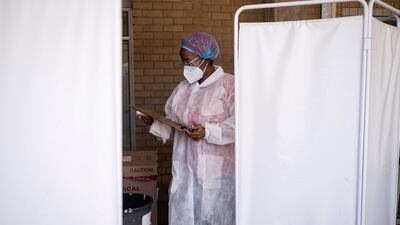
  • A healthcare worker prepares to conduct a PCR test for the coronavirus at the Lancet laboratory in Johannesburg. AFP
    A healthcare worker prepares to conduct a PCR test for the coronavirus at the Lancet laboratory in Johannesburg. AFP
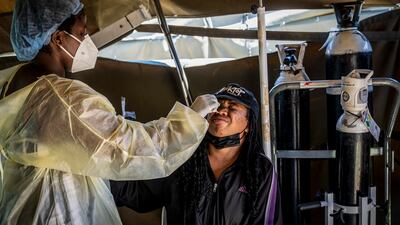
  • A woman is tested for Covid-19 at the Lenasia South Hospital, near Johannesburg. AP
    A woman is tested for Covid-19 at the Lenasia South Hospital, near Johannesburg. AP
  • A Johnson & Johnson booster vaccine is prepared at the Vaccination Centre of Hope at the Cape Town International Convention Centre in Cape Town. AP
    A Johnson & Johnson booster vaccine is prepared at the Vaccination Centre of Hope at the Cape Town International Convention Centre in Cape Town. AP
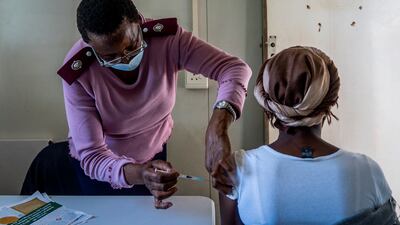
  • A woman is vaccinated against Covid-19 in Lawley, south of Johannesburg. AP
    A woman is vaccinated against Covid-19 in Lawley, south of Johannesburg. AP
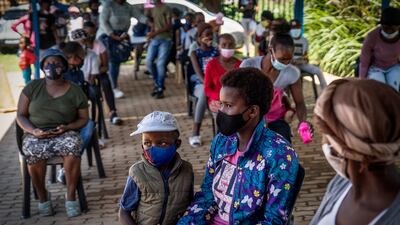
  • People line up to be vaccinated against Covid-19 in Lawley. AP
    People line up to be vaccinated against Covid-19 in Lawley. AP
  • People queue to be vaccinated against Covid-19 in Lenasia South, near Johannesburg. AP Photo
    People queue to be vaccinated against Covid-19 in Lenasia South, near Johannesburg. AP Photo
  • Pupils wear face masks in class at the Kgololo Academy in Alexandra township, Johannesburg. AP
    Pupils wear face masks in class at the Kgololo Academy in Alexandra township, Johannesburg. AP
  • Pupils wear their masks in the playground at Kgololo Academy. AP
    Pupils wear their masks in the playground at Kgololo Academy. AP
  • Passengers wearing masks at Johannesburg OR Tambo International Airport. AP
    Passengers wearing masks at Johannesburg OR Tambo International Airport. AP
  • Passengers prepare to check in at a quiet OR Tambo International Airport. Many flights at the continent's busiest airport were cancelled amid the spread of the new variant. EPA
    Passengers prepare to check in at a quiet OR Tambo International Airport. Many flights at the continent's busiest airport were cancelled amid the spread of the new variant. EPA
  • Graffiti in Soweto educates about the dangers of the coronavirus. EPA
    Graffiti in Soweto educates about the dangers of the coronavirus. EPA

The health ministry said that asymptomatic people who had been in contact with a case of Covid-19 no longer had to isolate, but should monitor for symptoms for five to seven days and avoid attending large gatherings.

Only people who develop symptoms need to get tested, the ministry said. Those with mild symptoms should isolate for eight days and severe cases for 10 days.

All quarantine facilities outside the home would be stopped, it continued, while contact tracing efforts would also be scrapped, aside from in specific scenarios such as cluster outbreaks.

The move was “based on advice from our scientists that it is not really having an impact any more”, Deputy Health Minister Sibongiseni Dhlomo told local broadcaster SABC.

He said the decision did not replace existing guidance on protective measures such as social distancing and wearing masks.

The department's statement said factors that influenced the move included the emergence of highly infectious variants like Omicron; estimates that at least 60 per cent of the population have some protection from vaccination or infection; and new information, including on the high level of asymptomatic cases and small number of actual cases diagnosed.

Mr Dhlomo said vaccination rates among the country's high-risk groups were 66 per cent in those aged over 60 and 63 per cent in those aged 50-59.

Harry Moultrie, from the country's National Institute for Communicable Diseases, backed the changes.

“South Africa cancels contact tracing and quarantining and pivots to mitigation. Good decision,” he said in a post on Twitter.

In a Christmas Eve address, Deputy President David Mabuza said the country had come a long way since the start of the pandemic.

We have edged closer to reclaiming our normal lives and freedoms
South African Deputy President David Mabuza

“We have edged closer to reclaiming our normal lives and freedoms,” he said, encouraging more people to get vaccinated.

South Africa remains in the lowest level of a five-tier lockdown system. While Omicron has driven a sharp rise in infections, these have not been accompanied by the increases in hospital admissions and deaths seen during previous waves.

On Thursday, the country reported 21,157 new Covid-19 infections, taking the total to 3.37 million since the start of the pandemic. It recorded 75 new deaths.

Cases have already peaked in the country's commercial hub of Gauteng, the province of the country where Omicron was first detected, with infections also levelling out in three other provinces.

South Africa began offering booster shots to the general public for the first time on Friday.

Mercer, the investment consulting arm of US services company Marsh & McLennan, expects its wealth division to at least double its assets under management (AUM) in the Middle East as wealth in the region continues to grow despite economic headwinds, a company official said.

Mercer Wealth, which globally has $160 billion in AUM, plans to boost its AUM in the region to $2-$3bn in the next 2-3 years from the present $1bn, said Yasir AbuShaban, a Dubai-based principal with Mercer Wealth.

Within the next two to three years, we are looking at reaching $2 to $3 billion as a conservative estimate and we do see an opportunity to do so,” said Mr AbuShaban.

Mercer does not directly make investments, but allocates clients’ money they have discretion to, to professional asset managers. They also provide advice to clients.

“We have buying power. We can negotiate on their (client’s) behalf with asset managers to provide them lower fees than they otherwise would have to get on their own,” he added.

Mercer Wealth’s clients include sovereign wealth funds, family offices, and insurance companies among others.

From its office in Dubai, Mercer also looks after Africa, India and Turkey, where they also see opportunity for growth.

Wealth creation in Middle East and Africa (MEA) grew 8.5 per cent to $8.1 trillion last year from $7.5tn in 2015, higher than last year’s global average of 6 per cent and the second-highest growth in a region after Asia-Pacific which grew 9.9 per cent, according to consultancy Boston Consulting Group (BCG). In the region, where wealth grew just 1.9 per cent in 2015 compared with 2014, a pickup in oil prices has helped in wealth generation.

BCG is forecasting MEA wealth will rise to $12tn by 2021, growing at an annual average of 8 per cent.

Drivers of wealth generation in the region will be split evenly between new wealth creation and growth of performance of existing assets, according to BCG.

Another general trend in the region is clients’ looking for a comprehensive approach to investing, according to Mr AbuShaban.

“Institutional investors or some of the families are seeing a slowdown in the available capital they have to invest and in that sense they are looking at optimizing the way they manage their portfolios and making sure they are not investing haphazardly and different parts of their investment are working together,” said Mr AbuShaban.

Some clients also have a higher appetite for risk, given the low interest-rate environment that does not provide enough yield for some institutional investors. These clients are keen to invest in illiquid assets, such as private equity and infrastructure.

“What we have seen is a desire for higher returns in what has been a low-return environment specifically in various fixed income or bonds,” he said.

“In this environment, we have seen a de facto increase in the risk that clients are taking in things like illiquid investments, private equity investments, infrastructure and private debt, those kind of investments were higher illiquidity results in incrementally higher returns.”

The Abu Dhabi Investment Authority, one of the largest sovereign wealth funds, said in its 2016 report that has gradually increased its exposure in direct private equity and private credit transactions, mainly in Asian markets and especially in China and India. The authority’s private equity department focused on structured equities owing to “their defensive characteristics.”

The specs

Engine: 4.0-litre V8 twin-turbocharged and three electric motors

Power: Combined output 920hp

Torque: 730Nm at 4,000-7,000rpm

Transmission: 8-speed dual-clutch automatic

Fuel consumption: 11.2L/100km

On sale: Now, deliveries expected later in 2025

Price: expected to start at Dh1,432,000

GAC GS8 Specs

Engine: 2.0-litre 4cyl turbo

Power: 248hp at 5,200rpm

Torque: 400Nm at 1,750-4,000rpm

Transmission: 8-speed auto

Fuel consumption: 9.1L/100km

On sale: Now

Price: From Dh149,900

Global state-owned investor ranking by size

1.

United States

2.

China

3.

UAE

4.

Japan

5

Norway

6.

Canada

7.

Singapore

8.

Australia

9.

Saudi Arabia

10.

South Korea

Email sent to Uber team from chief executive Dara Khosrowshahi

From: Dara

To: Team@

Date: March 25, 2019 at 11:45pm PT

Subj: Accelerating in the Middle East

Five years ago, Uber launched in the Middle East. It was the start of an incredible journey, with millions of riders and drivers finding new ways to move and work in a dynamic region that’s become so important to Uber. Now Pakistan is one of our fastest-growing markets in the world, women are driving with Uber across Saudi Arabia, and we chose Cairo to launch our first Uber Bus product late last year.

Today we are taking the next step in this journey—well, it’s more like a leap, and a big one: in a few minutes, we’ll announce that we’ve agreed to acquire Careem. Importantly, we intend to operate Careem independently, under the leadership of co-founder and current CEO Mudassir Sheikha. I’ve gotten to know both co-founders, Mudassir and Magnus Olsson, and what they have built is truly extraordinary. They are first-class entrepreneurs who share our platform vision and, like us, have launched a wide range of products—from digital payments to food delivery—to serve consumers.

I expect many of you will ask how we arrived at this structure, meaning allowing Careem to maintain an independent brand and operate separately. After careful consideration, we decided that this framework has the advantage of letting us build new products and try new ideas across not one, but two, strong brands, with strong operators within each. Over time, by integrating parts of our networks, we can operate more efficiently, achieve even lower wait times, expand new products like high-capacity vehicles and payments, and quicken the already remarkable pace of innovation in the region.

This acquisition is subject to regulatory approval in various countries, which we don’t expect before Q1 2020. Until then, nothing changes. And since both companies will continue to largely operate separately after the acquisition, very little will change in either teams’ day-to-day operations post-close. Today’s news is a testament to the incredible business our team has worked so hard to build.

It’s a great day for the Middle East, for the region’s thriving tech sector, for Careem, and for Uber.

Uber on,

Dara

The specs

Engine: 6.2-litre V8

Transmission: ten-speed

Power: 420bhp

Torque: 624Nm

Price: Dh325,125

On sale: Now

Know your Camel lingo

The bairaq is a competition for the best herd of 50 camels, named for the banner its winner takes home

Namoos - a word of congratulations reserved for falconry competitions, camel races and camel pageants. It best translates as 'the pride of victory' - and for competitors, it is priceless

Asayel camels - sleek, short-haired hound-like racers

Majahim - chocolate-brown camels that can grow to weigh two tonnes. They were only valued for milk until camel pageantry took off in the 1990s

Millions Street - the thoroughfare where camels are led and where white 4x4s throng throughout the festival

PROFILE OF SWVL

Started: April 2017

Founders: Mostafa Kandil, Ahmed Sabbah and Mahmoud Nouh

Based: Cairo, Egypt

Sector: transport

Size: 450 employees

Investment: approximately $80 million

Investors include: Dubai’s Beco Capital, US’s Endeavor Catalyst, China’s MSA, Egypt’s Sawari Ventures, Sweden’s Vostok New Ventures, Property Finder CEO Michael Lahyani

The%20specs%20
%3Cp%3E%3Cstrong%3EEngine%3A%20%3C%2Fstrong%3E2.0-litre%204cyl%20turbo%0D%3Cbr%3E%3Cstrong%3EPower%3A%20%3C%2Fstrong%3E261hp%20at%205%2C500rpm%0D%3Cbr%3E%3Cstrong%3ETorque%3A%20%3C%2Fstrong%3E400Nm%20at%201%2C750-4%2C000rpm%0D%3Cbr%3E%3Cstrong%3ETransmission%3A%20%3C%2Fstrong%3E7-speed%20dual-clutch%20auto%0D%3Cbr%3E%3Cstrong%3EFuel%20consumption%3A%20%3C%2Fstrong%3E10.5L%2F100km%0D%3Cbr%3E%3Cstrong%3EOn%20sale%3A%20%3C%2Fstrong%3ENow%0D%3Cbr%3E%3Cstrong%3EPrice%3A%20%3C%2Fstrong%3EFrom%20Dh129%2C999%20(VX%20Luxury)%3B%20from%20Dh149%2C999%20(VX%20Black%20Gold)%3C%2Fp%3E%0A
Updated: December 24, 2021, 4:02 PM