


Live updates: follow the latest news on Covid-19 variant Omicron
People with long Covid who were admitted to hospital and continued to experience symptoms five months later showed a limited recovery one year on, research suggests.
The study also confirmed earlier research that those who were female, obese and needed mechanical ventilation in hospital were less likely to make a full recovery from the disease.
Researchers assessed 2,230 adults who had been admitted to hospital with coronavirus.
All completed a five-month assessment and, so far, 807 people have completed the five-month and 12-month assessments.
In the study, recovery was measured using data from patients' reports of how they felt, physical performance and organ function tests.
At the five-month visit, blood samples were analysed for about 300 substances linked to inflammation and immunity.
Researchers found that one year after being discharged from hospital, fewer than three in 10 patients in the study reported they felt fully recovered, largely unchanged from 2.5 in 10 at five months.
The most common continuing symptoms were fatigue, muscle pain, physically slowing down, poor sleep and breathlessness.
According to the Phosp-Covid study, participants felt their health-related quality of life remained substantially worse one year after hospital discharge, compared to before Covid-19 infection.
Scientists say this suggests the physical and mental health impairments reported in the study are unlikely to be pre-existing conditions.
A cluster analysis – a mathematical method to group participants according to similar traits and characteristics – identified four distinct groups based on the severity of physical, mental and cognitive impairments at five months.
The number of persistent symptoms was much higher in the very severe group compared to the mild group.
There was little improvement in physical and mental health from the five-month to one-year assessments in all of these clusters.
The researchers compared the blood profiles across the four clusters and identified higher levels of substances associated with whole-body inflammation and molecules associated with tissue damage and repair, in participants with very severe long Covid, compared to mild.
They also found a pattern of substances linked to poor cognition, often referred to as brain fog, in the cluster of patients reporting the symptom, suggesting possible neuro-inflammation.
Chris Brightling, National Institute for Health Research (NIHR) senior investigator and professor of respiratory medicine at the University of Leicester, is chief investigator for the Phosp-Covid study.
“Our findings show that people who were hospitalised and went on to develop long-Covid are not getting substantially better a year after they were discharged from hospital," Prof Brightling said.
“Many patients in our study had not fully recovered at five months and most of these reported little positive change in their health condition at one year.
“When you consider that over half a million people in the UK have been admitted to hospital as a result of Covid-19, we are talking about a sizeable population at risk of persistent ill-health and reduced quality of life.”
-

Children walk through the settlement of Vlakfontein outside Johannesburg in South Africa. Although children under 12 are not taking part in the country's Covid-19 vaccination campaign, cases in young children are on the rise since the discovery of the Omicron variant. AP -

People wearing face masks to protect against Covid-19 cross the Concorde square in Paris. The World Health Organisation says early evidence suggests the omicron variant may be spreading faster than the highly transmissible delta variant, but brings with it less severe coronavirus disease. AP -

President Joe Biden delivers remarks in the state dinning room at the White House in Washington. The US president and the vice president held a meeting with members of the White House Covid-19 Response Team on the latest developments related to the Omicron variant. EPA -
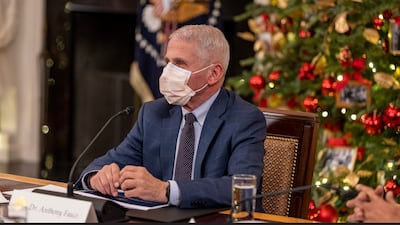
Dr Anthony Fauci, chief medical advisor to President Joe Biden, attends a Covid-19 meeting at the White House. EPA -

People wait in line to get tested for Covid-19 in Times Square, New York. AFP -

The Omicron variant of Covid-19 has been detected in at least 19 US states. Health officials are urging Americans to get vaccinated and receive their booster shots. AFP -

Leonardo Velasco, 4, reacts as he receives a dose of the Sinopharm vaccine in Caracas, Venezuela, Reuters -

People wear face masks as they ride a bus after the first case of the Omicron variant was detected in Pakistan. The case was reported in a private hospital in Karachi by a patient with a history of international travel. EPA -
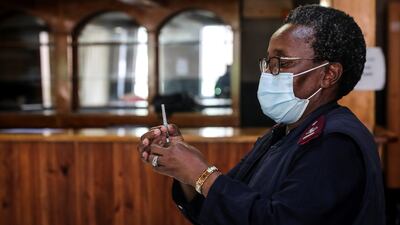
A health care worker prepares a dose of the Pfizer vaccine in Johannesburg, South Africa. Reuters -

A medical worker holds a sign for visitors to prepare for coronavirus tests at a temporary screening clinic in Seoul, South Korea. AP -
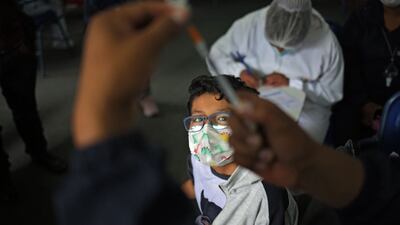
A child waits to receive a dose of the Sinofarm vaccine in La Paz, after Bolivian President Luis Arce authorised the vaccination of children between five and 11 years old. AFP -

Ice skaters take a selfie on the ice rink at the Natural History Museum in central London. AFP -

A health professional points to a Christmas tree made with Covid-19 and flu vaccine vials at the Public Health Basic Unit 'Ernani Agricola' in the Lapa neighborhood in Rio de Janeiro, Brazil. AFP -

Skaters, most wearing face masks to combat the spread of coronavirus, skate on the ice rink at the Natural History Museum in London. AFP -

A medical worker prepares a Moderna vaccine on the first day of the re-opening of a Covid-19 vaccination centre in Merignac, on the outskirts of Bordeaux, France. AFP


Dr Rachael Evans, an associate professor at the University of Leicester and respiratory consultant at Leicester’s hospitals, was a lead author of the paper.
“The findings that many patients had not fully recovered one year after leaving hospital indicate that healthcare professionals will need to proactively continue assessing their patients for some time to come, in order to identify their ongoing healthcare needs and provide support," Dr Evans said.
“However, we urgently need healthcare packages and medicines that target the potentially treatable traits of long Covid to help people feel better and get back to their normal lives.
“Without these, long Covid has the potential to become highly prevalent as a new long-term condition.”
Prof Louise Wain, GSK-BLF chair in respiratory research at the University of Leicester and another lead author of the paper, said: “The good news is that we have identified some differences in the blood samples of those who are still experiencing the long-term physical and cognitive effects of their Covid-19 hospital admission.
“These differences give us clues about the potential underlying mechanisms and suggest that we may be able to use existing medicines that target these mechanisms to help these subgroups of patients.”
The findings are released as a pre-print on medRxiv, which means they have not yet been peer-reviewed,
The study was led by NIHR Leicester Biomedical Research Centre – a partnership between Leicester’s hospitals, the University of Leicester and Loughborough University – and jointly funded by the NIHR and MRC-UK Research and Innovation.

