



Five million people have now died of Covid-19, the Johns Hopkins University said in its live global death toll tracker on Monday.
Nearly two years into a pandemic that has ruined countless lives and wrecked economies, the death toll is still shocking, with The National Geographic giving a warning that the crisis is far from over.
economist and statistician
But data scientists have said the five million figure probably falls short of the true death toll.
Covid-19 may have killed at least 10 million people globally, they say.
Johns Hopkins said that, along with factors such as the quality of health care in a country and its demographic profile, there were "other factors, many of which remain unknown", when assessing mortality data.
That was also the assessment of the World Health Organisation, which is working on a study to evaluate how severe the pandemic has been, Ariel Karlinsky, a scientist working on a coming assessment, told The National.
Estimates placing the true death toll far higher follow a trend of several studies highlighting a surge in unexplained deaths in some of the world’s poorest countries.
Excess deaths vs Covid deaths
In July, a study by the Centre for Global Development, a US think tank, and Arvind Subramanian, former chief economic adviser to the Indian government, said the Covid-19 death toll in India alone could be five million.
That is far higher than the country's official toll of 400,000 at the time the study was published.
The researchers looked at “excess deaths” – recorded deaths beyond the “normal” number of fatalities in the population before the crisis.
They examined household survey data and other international trends involving the Covid-19 fatality rate to draw their conclusions.
-

India administered its billionth Covid-19 vaccine dose on October 21, according to the health ministry, half a year after a devastating surge in cases brought the health system close to collapse. Prakash Singh / AFP -
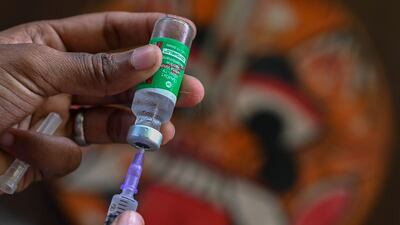
A health worker prepares to administer a Covishield vaccine in Chennai. Arun Sankar / AFP -
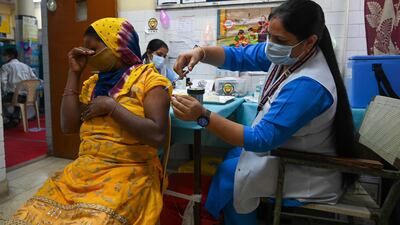
A health worker inoculates a woman with a dose of the Covaxin vaccine in New Delhi. Prakash Singh / AFP -
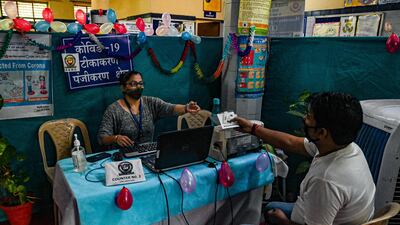
A health worker, left, registers a man for a dose of the Covaxin vaccine in New Delhi. Prakash Singh / AFP -
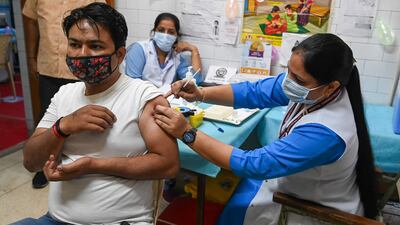
A health worker inoculates a man with a dose of the Covaxin vaccine in New Delhi. Prakash Singh/ AFP -

Volunteers decorate a vaccination centre to celebrate India administering its billionth Covid-19 vaccine. Prakash Singh / AFP


A significant problem with Covid-19 death tolls is that in countries such as India – and much of the developing world – the health services needed to diagnose the virus and accurately determine the cause of death simply are not there, meaning many deaths were never logged as Covid-19 fatalities.
Mr Karlinsky, an economist at the Kohelet Policy Forum think tank in Israel, and Dmitry Kovak of the University of Tubingen have studied excess deaths in 94 countries during the pandemic to formulate a more accurate estimate of global Covid-19 fatalities.
“We found that in several worst-affected countries – Peru, Ecuador, Bolivia, Mexico – the excess mortality was above 50 per cent of the expected annual mortality,” they wrote in a paper outlining the rationale for their now regularly updated World Mortality Dataset for evaluating Covid-19 deaths.
Their research, during which they contacted “national statistics offices, population registries, ministries of health” around the world for data on deaths, captures the difficulty of estimating the true Covid-19 toll in fragile states, as their response from Liberia illustrated.
“As you may also be aware, death or mortality registration or reporting is yet a huge challenge in developing countries,” a Liberian government official told the authors.
Mr Karlinsky is now on the World Health Organisation's technical advisory group on Covid-19 mortality assessment. He told The National that the group's work is continuing but there should be a report released by the end of 2021.
"The five million threshold we just crossed – it's an undercount, it's a vast undercount," he said.
"Especially for settings like India, and Pakistan, which have released relatively low numbers but have huge populations. In India alone, I think we have reliable estimates that double the death toll.
"For other places, like in Africa, I think it will probably show something similar, but there we have even less of an idea of what's going on because we don't have good-quality state governments that can track accurate data."

