


Human antibodies produced to fight the virus that causes Covid-19 remain stable and may even increase seven months after infection, a new study suggests.
Researchers from Barcelona Institute for Global Health (ISGlobal) conducted a review on the duration of immunity to SARS-CoV-2 and the role of pre-existing antibodies against similar coronaviruses that cause common colds.
They examined blood samples from 578 healthcare workers taken at four intervals between March and October 2020 that showed a robust response to the SARS-CoV-2 spike protein.
The results, published in Nature Communications, support the theory that pre-existing antibodies against common cold coronaviruses could protect people against Covid-19.
Researcher Dr Carlota Dobano and her team followed a cohort of healthcare workers at Barcelona Hospital Clinic from the beginning of the pandemic, to evaluate the levels of IgG antibodies against different Covid-19 antigens over time.
“This is the first study that evaluates antibodies to such a large panel of SARS-CoV-2 antibodies over seven months,” she said.
Dr Gemma Moncunill, a co-author of the study, said: “Rather surprisingly, we even saw an increase of IgG anti-spike antibodies in 75 per cent of the participants from month five onwards, without any evidence of re-exposure to the virus.”
-
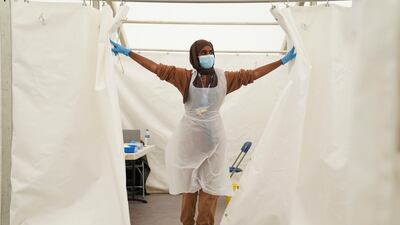
A National Health Service worker prepares for patients at a pop-up vaccination centre during a four-day Covid-19 vaccine festival in Langdon Park, east London. -

Young people line up to receive shots of Sinovac's Covid-19 vaccine at the Phnom Penh Thmey Health Centre, in Phnom Penh, Cambodia. -
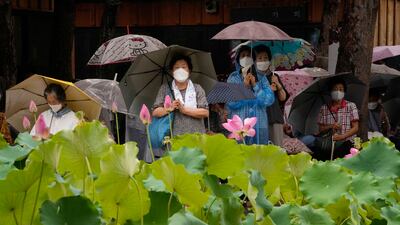
People wearing face masks as a precaution against the coronavirus pray during a service at the Chogyesa temple in Seoul, South Korea. -
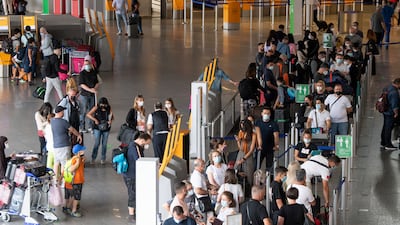
Passengers wearing face masks wait in the outbound queue at Frankfurt airport, in Germany. -

Demonstrators clash with police at the end of a national day of protest against French legislation making a Covid-19 health pass compulsory to visit a cafe, board a plane or travel on an inter-city train, in Paris. -
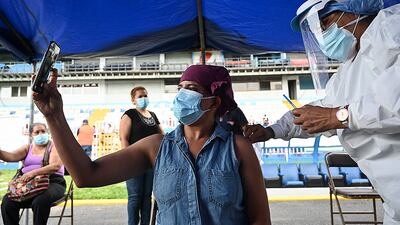
A woman takes a selfie while receiving the first dose of the Moderna vaccine against Covid-19, during the vaccination day called 'Vacunaton', which aims to immunise 50,000 Hondurans aged over 35 in the National Stadium, in Tegucigalpa. -
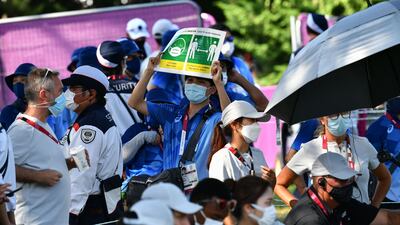
A volunteer holds up a sign to remind people to adhere to Covid-19 protocols during round 4 of the men’s golf individual stroke play during the Tokyo 2020 Olympic Games at the Kasumigaseki Country Club in Kawagoe. -
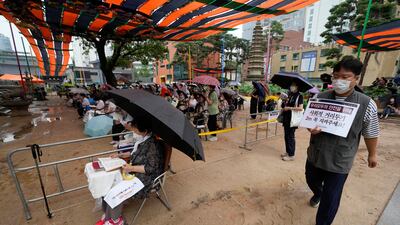
A man with a notice walks around people wearing face masks as a precaution against the coronavirus during a service at the Chogyesa temple in Seoul, South Korea. -
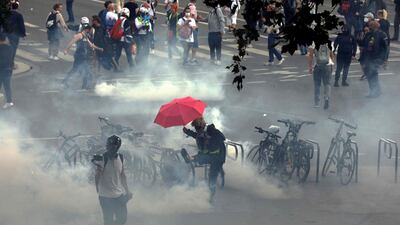
A demonstrator kicks away a smoking teargas shell during a national day of protest against compulsory Covid-19 vaccinations for certain workers and the compulsory use of health passes, in Paris. -
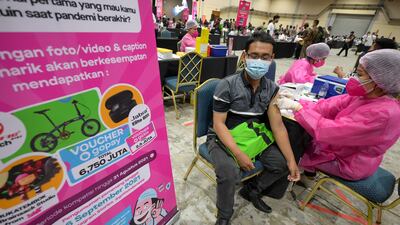
A health worker, right, administers the Sinovac vaccine during a mass vaccination drive against the Covid-19 coronavirus outbreak in Jakarta.


Results also suggested antibodies against human cold coronaviruses (HCoV) could confer cross-protection against Covid-19 infection or disease.
The authors also discovered that people infected by SARS-CoV-2 had lower levels of HCoV antibodies, and that the level of antibodies was higher in asymptomatic carriers than in those with symptoms.
“Although cross-protection by pre-existing immunity to common-cold coronaviruses remains to be confirmed, this could help explain the big differences in susceptibility to the disease within the population,” Dr Dobano said.

