

US climate envoy John Kerry said the US would not accept an “imposed standard of liability” to help vulnerable countries overcome the effects of climate change.
In an interview with The National, the former secretary of state said the US could be relied upon for climate-related disaster relief — but “that's different from paying for a loss that hasn't been purely defined”.
“The United States will not accept … some imposed standard of liability,” said Mr Kerry, who was in Abu Dhabi for an Atlantic Council event.
The creation of a Loss and Damage Fund was one of the biggest outcomes of the last United Nations Climate Conference (Cop27).
The fund's contributors and exactly which countries will benefit are still to be decided, but the aim is to provide financial assistance to nations hardest hit by the effects of climate change.
Looking ahead to Cop28, Mr Kerry said he had “high expectations” of the UAE as host nation.
“The UAE has really been a solid leader on new technologies,” he said. “They're highly invested in alternative renewable energy, even though they're a gas and oil producer.
“The new president of the Cop [Dr Sultan Al Jaber] was very public about it: that this is a time for transition.
“And UAE understands they are transitioning away from gas and oil into a new energy future. They're determined to be leaders in that effort. And I have high expectations that they're really going to put this issue on the table, as people prepare for the next meeting in December.”
No drawing down on fossil fuels
He disagreed with the notion of setting targets to draw down fossil fuel production at Cop28 — a topic that was debated at Cop27 — and instead suggested setting emissions reduction targets.
He said the transition to low-carbon energy is under way and there should be no negotiations over drawing down fossil fuels at Cop28.
“I don't think we have to be specifically prohibiting one thing or another,” Mr Kerry said.
“We have to prohibit emissions. We have to set standards for the way those emissions need to be reduced,” he said, adding that adequate energy supply to keep economies growing is a must.
Mr Kerry said the goal of limiting the warming of the planet to that 1.5°C is in jeopardy amid a lack of co-operation among the world's biggest economies.

The world would be “so far ahead … in the fight” against emissions if there was greater international co-operation.
“We've got to move faster,” he said.
More than 190 countries are part of the legally binding Paris Agreement, a framework agreed to in 2015 to avoid dangerous climate change by limiting the Earth's warming to 1.5°C above pre-industrial levels. Breaching the 1.5ºC threshold would mean the worst consequences of global warming, according to climate scientists.
Emissions would have to fall at rates comparable to 2020 — when Covid-19 restrictions shut down transport, industry and economic activities — every year to keep temperature rises to 1.5°C in the long term, according to the Global Carbon Brief.
Instead, global CO2 emissions rebounded to their highest level in history in 2021.
Mr Kerry criticised the lack of investment in global energy transition efforts, saying not enough money was being “put on the table” to achieve net-zero targets.
'No trying to do it on the cheap'
“We're either not trying to do it or we're trying to do it on the cheap, and the result is that we're not doing it,” said Mr Kerry on stage at the Atlantic Council Global Energy Forum on Sunday.
“The system is broken in terms of how we're trying to fix this and we need to respond more effectively.”
Investment in renewable energy needs to double to more than $4 trillion by the end of the decade to meet net-zero emissions targets by 2050, the International Energy Agency said in its World Energy Outlook last year.
In November, the US-UAE Partnership to Accelerate Transition to Clean Energy (Pace) was announced, a massive partnership to mobilise $100 billion in financing, investment and other support, and to deploy globally 100 gigawatts of clean energy by 2035.
Mr Kerry said “most of it” is to be funnelled directly into the UAE and US “in a co-operative way”, rather than invested elsewhere, without citing specific figures.
-
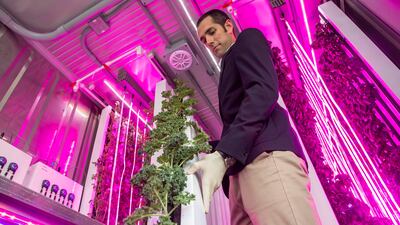
Kyle Wagner, head of operations at Masdar Farms, shows the inside of the smart farming retrofitted shipping container in Abu Dhabi that grows four tonnes of leafy greens per year. Antonie Robertson / The National -
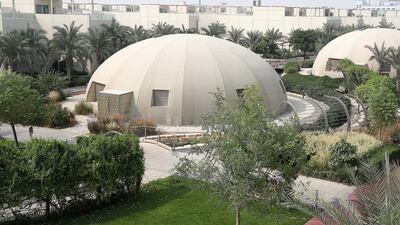
A view of the domes used for urban farming in the Sustainable City in Dubai. Pawan Singh / The National -
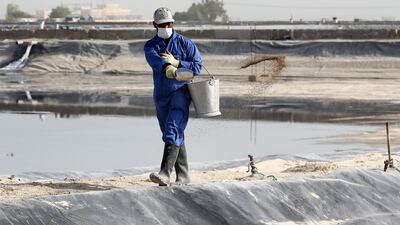
A member of staff tosses feed in the shrimp pond at an aquaculture farm in Abu Dhabi. Pawan Singh / The National -

Jubail Mangrove Park in Abu Dhabi. Mangroves are abundant along the coastline of the emirate and can sequester and store carbon for thousands of years. Victor Besa / The National -
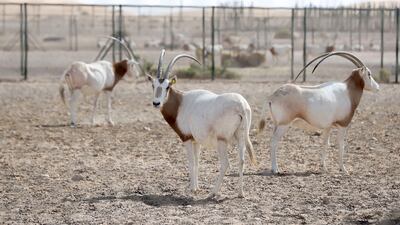
Scimitar-horned oryx, part of the antelope family, at the Deleika Wildlife Management Centre in Abu Dhabi. Khushnum Bhandari / The National -
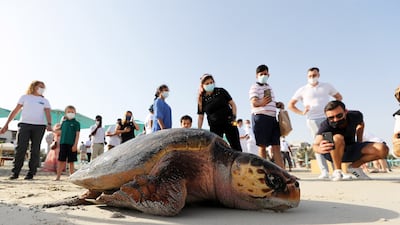
About 30 turtles are released into the sea on World Sea Turtle Day at Jumeirah Al Naseem beach in Dubai. Pawan Singh / The National -
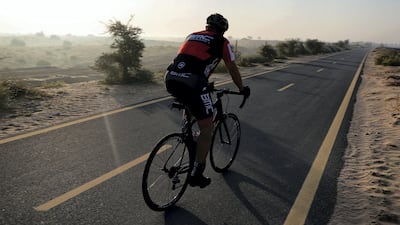
Cyclists get up early to exercise at Al Qudra Bike Track, Dubai. Chris Whiteoak / The National -
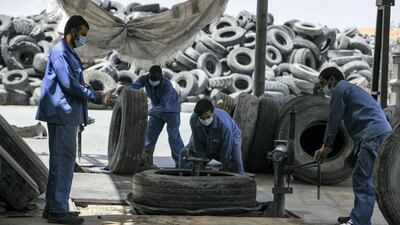
Workers prepare tyres before the recycling process at the Gulf Rubber factory in Al Ain. Khushnum Bhandari / The National -
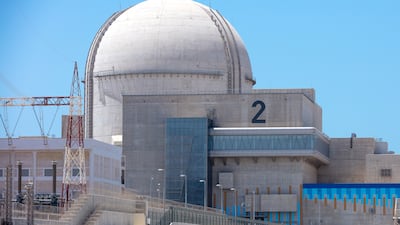
A view of Barakah's Unit 2. Photo: Wam -
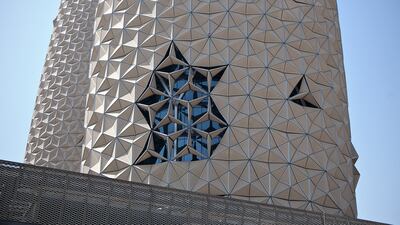
Al Bahar Towers in Abu Dhabi use a solar shading system that features a computer-controlled facade made up of thousands of translucent units. Silvia Razgova / The National -
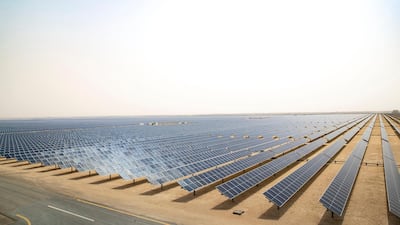
Sheikh Mohammed bin Rashid Al Maktoum Solar Park is the largest single-site solar park in the world and central to Dubai's plans to obtain 75 per cent of its energy from renewable sources by 2050. Photo: Wam -
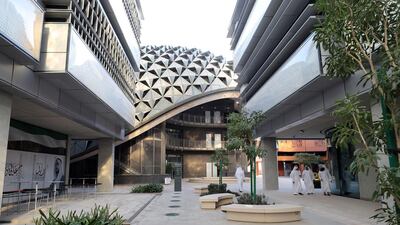
Masdar City in Abu Dhabi is the first attempt in the Middle East to build a sustainable city. Chris Whiteoak / The National


Last year, the US government launched the Energy Transition Accelerator (ETA) alongside private partners the Rockefeller Foundation and the Bezos Earth Fund, with the intention of funding renewable energy projects in developing countries through the creation of a new voluntary carbon credit marketplace.
Mr Kerry said “no” to the question of if there was today proper scrutiny of carbon markets for the initiative to be successful.
“But we are absolutely determined in this effort. And we have all of those stakeholders at the table, in order to be able to make sure that there is transparency, that there is accountability, that this is not a phoney process.
“But we have a challenge, which is being able to get companies and countries to be able to transition more rapidly to reduce emissions. We want it to be a gold standard measurement of emissions reduction and enticement for companies and countries to be able to engage in that reduction.”
Commenting on the nuclear fusion breakthrough announced by the US Department of Energy in December, Mr Kerry called it a “welcome breakthrough … [that] is not going to solve our immediate problem”, adding that it would be at least 20 years before a nuclear fusion energy might be commercially viable.
On the question of his legacy as the first climate envoy for the US, Mr Kerry, who turns 80 this year, indicated his work is unfinished.
“I want to get the job done,” he said. “I want to make sure we are on the road with clarity to do real things, not rhetorical, but real things that are going to make life better. And guarantee we can leave our kids and our grandkids, the world that they deserve.
"It's exciting. There are huge, positive economic and health and security possibilities here. I mean, this is a winner. In terms of life itself on the planet. If we do what we know we have to do.”

