


As climate change wreaks havoc, plastic pollution blights oceans and biodiversity losses pile up, it is all too easy to fear for the future.
But amid the gloomy forecasts there is hope on the horizon as society bands together to successfully tackle issues that once plagued the planet.
From acid rain to precipitous declines in whale populations, progress has been made in helping the environment to recover.
The biggest eco-threat of all – climate change – is proving hard to resolve because everything from transport to energy generation is tied up with burning fossil fuels.
The likes of acid rain and smog were easier to solve, according to Prof Niklas Hoehne, founder of the NewClimate Institute for Climate Policy and Global Sustainability, a think tank in Germany.
"For climate change, we need to transform every corner of our society," he said. "I think we have 90 per cent of the solutions already. That’s not a problem – it’s political will and change in society."
While many challenges clearly lie ahead, previous environmental success stories demonstrate where there is a will there is a way.
A solution to acid rain

Turn the clock back several decades and acid rain was often in the news. Almost in the way that climate change is now.
Mirroring the present-day antics of climate change groups such as Extinction Rebellion, back in the 1980s acid rain campaigners climbed smoke stacks and unfurled banners to raise awareness.
Evidence of the problem was clear for all to see. Sections of attractive historical buildings in Europe were left looking like melting ice sculptures because elaborately carved stonework was dissolving away.
Forests were destroyed because the acid rain left soil bereft of nutrients, with high levels of dissolved aluminium, which harmed plant life. Aquatic creatures suffered too.
The issue resulted from the burning of coal, oil and natural gas by power stations, releasing nitrogen oxides and sulphur dioxide, turning rain acidic.
At least in Europe and North America, the problem has largely been eliminated and soils are recovering.
"Acid rain was about [emissions from] a small number of large industrial installations. There are clear technologies to get rid of the sulphur in the exhaust stream," said Prof Hoehne.
He added that two approaches were taken.
The Acid Rain Programme from the US Environmental Protection Agency set an aim of cutting sulphur dioxide emissions from power plants in central and midwest parts of the country by half between 1980 and 2010.
In Europe regulations were introduced mandating the use of cleaner ways to burn fossil fuels. These helped to significantly reduce the scale of the problem, although some plant and animal communities will take longer to recover.
Mirroring the situation with air pollution as a whole, acid rain is today a key environmental issue in parts of Asia, with areas in China and India among those affected.
Saving the whales
"Save the Whales" campaign resonated powerfully in the 1970s as activists tried to prevent the large-scale slaughter of the world’s biggest mammals.
While whaling still goes on, it happens on a much smaller scale now. Some whale populations are recovering.
Commercial whaling began in the 1860s with the use of steamships and explosive-grenade harpoons and "almost totally wiped out" many of the largest whale species, according to WWF.
In 1966 a ban on hunting blue and humpback whales came into force. And in 1986, a global moratorium on commercial hunting was brought in by the International Whaling Commission.
Norway, Iceland and Japan in particular have continued to hunt whales and campaigners still unfurl banners from speedboats to highlight their calls for the practice to end.
The numbers worldwide are a fraction of the 1960s peak, a decade when more than 700,000 whales were killed.
Many whale populations have increased in numbers.
For example, some humpback whale populations are now at "pre-exploitation levels", according to Dr Kirsten Thompson, a lecturer at the University of Exeter in the UK.
"The moratorium, it shows that species-focused conservation does work, and for certain species, it works really well," she said.
"It doesn’t mean these animals and populations aren’t facing a whole myriad threats – ocean noise, pollution, ship strikes and other threats are continuing."
According to the IWC, Southern Atlantic populations of the humpback whale have shown "strong recovery", increasing by about 10 per cent a year. Southern right whales have increased almost as fast.
Blue whale populations are also growing slowly, although the species remains listed as "endangered" by the International Union for Conservation of Nature.
"It’s very patchy, but it’s a very good message to send to policymakers that if you do implement conservation policies, those policies will work, but you obviously have to … monitor these populations in detail and find how it’s working," Dr Thompson said.
Rebuilding the ozone layer

The global effort to stop the release of substances that destroy the ozone layer in the atmosphere is seen as one of the biggest environmental success stories of all time..
By the early 1980s it was apparent that a major "hole" had developed in the ozone layer in the stratosphere (which sits above the troposphere, the atmosphere’s lowest layer).
Chemicals such as chlorofluorocarbons (CFCs), used as refrigerants and aerosol propellants, were responsible for the destruction of the layer, which protects against the sun’s most harmful ultraviolet rays.
At the beginning of 1989, however, things changed with the coming into force of the Montreal Protocol, a universally ratified treaty that covered the production and use of nearly 100 substances that harm the ozone layer.
Applying to all UN member states, the protocol mandated a phase out in the use of CFCs, but in the end a faster reduction was achieved.
The release of CFCs and other chemicals that deplete the ozone layer has been cut by about 98 per cent compared to before the protocol.
The late Kofi Annan, a former United Nations secretary general, described the protocol “the most successful environmental treaty in history”. Indeed he even suggested that it could be the most successful international agreement of any kind to date.
Solving the ozone problem was easier than dealing with climate change for several reasons, including that the problem and its causes were clearly identified.
Only a limited number of industries were affected and alternatives to the harmful chemicals were available which were often manufactured by the companies that made the banned chemicals. So, vested commercial interests were less of an issue.
There continues to be close monitoring of the quantities of ozone-depleting chemicals in the atmosphere, and this has identified breaches of the treaty, such as the unauthorised release of ozone-destroying substances in the Far East, which has been dealt with.
Cutting through the smog
-
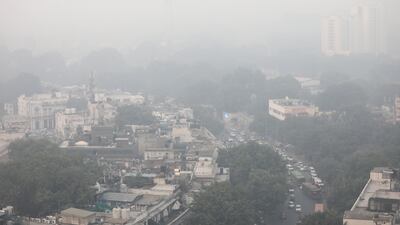
An aerial view of New Delhi, India, engulfed in heavy smog. EPA -
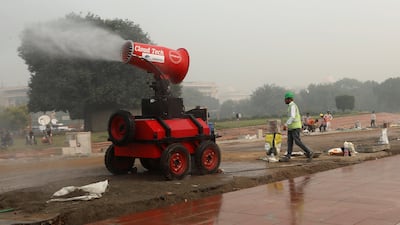
A worker is seen next to an anti-smog gun near the ongoing redevelopment project on Rajpath, on a smoggy day in New Delhi. Reuters -
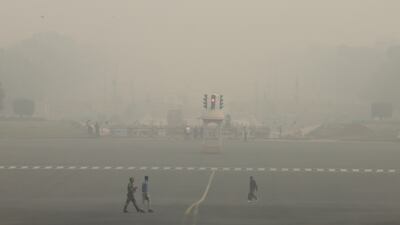
Rajpath on a smoggy day. Reuters -

A woman crosses railway tracks as a goods train passes by, on a smoggy day in New Delhi. Reuters -

Commuters make their way along a busy road in New Delhi. AFP -

A woman carrying a child walks across a footbridge in heavy smog in New Delhi. AFP -

Labourers work at the construction site of the Delhi–Meerut Regional Rapid Transit System in smoggy conditions in Ghaziabad. AFP -
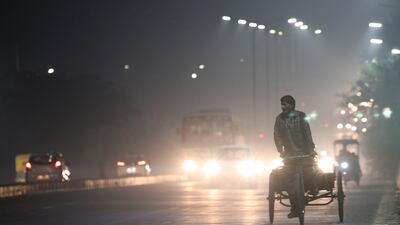
An Indian man on the rickshaw passes over a flyover as the city is engulfed in heavy smog near New Delhi. EPA -

A cyclist rides past a worker holding a sign, requesting motorists to turn off their engines while waiting at a traffic signal, in New Delhi. Bloomberg


In the mid-20th century, terrible smogs afflicted parts of the US and Europe because of industrial emissions.
Today, while air quality remains a major concern, particularly in larger cities, such acute air pollution is largely absent from Europe and North America.
A notorious example in the US is the Donora Smog of 1948, which hit the Donora and Webster areas in Pennsylvania.
These communities were affected by pollution from two industrial facilities (an American Steel and Wire plant and the Donora Zinc Works), as well as coal-burning furnaces in people’s homes, and boats on the nearby river.
At least 20 people died at the time and, in the following decade, rates of cancer and heart disease increased.
Parts of Europe experienced similar smog, the events nicknamed pea-soupers because the choking air had a sinister green tinge.
Among the worst happened in London in December 1952, when the city was engulfed in smog so thick that people could not find their way even in areas they knew well.
Blamed for at least 4,000 deaths, the 1952 event was largely caused by domestic coal burning, which releases particulate matter that allow fog to form. Paris too suffered extreme smogs.
Clean Air Acts passed on both sides of the Atlantic from the 1950s onwards played a significant part in reducing the threat, forcing factories and homes to burn cleaner fuel.
"The question was to find what was emitting the smog and stop them from doing it … It was done a lot by regulation," said Prof Hoehne.
While air pollution still causes many deaths in western nations, acute events of the kind seen in the middle of the 20th century are less of an issue.
But demonstrating that environmental problems are rarely solved once-and-for-all, industrial plants, road traffic and domestic fuel burning are leading to pollution in developing countries comparable to that once seen in the US and Europe.
"Reports regarding air pollution have indicated that levels of pollutants similar to those estimated to have occurred in Donora are currently present in some rapidly industrialising regions of China and India," Professor Elizabeth Jacobs, of the University of Arizona, and two other researchers wrote in the American Journal of Public Health in 2018.
Driving out leaded petrol
It may seem hard to believe now, but many of today’s adults used to walk to school beside roads where vehicles gave off fumes that contained lead, a metal that impairs the brain development of youngsters.
Today, the use of leaded fuel is banned everywhere, with Algeria the last country to phase out its sale, albeit only as recently as 2021.
There is little doubt that the ban was needed. Introduced in 1922 as a petrol additive to improve engine performance, tetraethyllead caused "a century of deaths and illnesses that affected hundreds of millions and degraded the environment worldwide", Inger Andersen, the UN Environment Programme’s executive director, said when Algeria’s ban came in.
Ms Anderson’s uncompromising verdict is backed up by plenty of evidence. Having lead in petrol has been found to result in heart disease, strokes and cancer, to reduce IQs, and to contaminate water, air, soil and even dust.
The phase out of leaded petrol began in the 1970s, when the US, for example, started to restrict its use, but Japan became the first country to eliminate it entirely, in 1986.
Further bans followed in the 1980s and 1990s, and by 2002 most of North and South America and Europe had outlawed its sale, as had India, China, Australia and a number of other countries.
In the coming few years, amid continuing campaigning, much of Africa followed suit, with just a few nations holding out, with Algeria the final player to fall into line in 2021.
According to the UNEP, more than 1.2 million lives a year have been saved by eliminating leaded petrol.
While lead in petrol is now a thing of the past, vehicle exhausts continue to release large quantities of pollutants that harm health, among them nitrogen oxides and particulate matter.
Road transport is also a key contributor to climate change, accounting for around a quarter of energy-related greenhouse gas emissions, the UNEP states.
Transitioning to electric vehicles, ideally powered by electricity generated using renewable sources, is regarded by campaigners as essential if the world is to limit climate change.
When it comes to lead, the UNEP says restrictions are still needed on its use in batteries, paints and household items.

