Pink-coloured turbines installed by Octopus Energy at Expo City Dubai. EPA

Energy bosses jostle for a piece of the grid at Cop28


Tim Stickings
  • English
  • Arabic

Live updates: Follow the latest news on Cop28

The Cop28 summit enters a day of energy-themed talks on Tuesday as each sector makes its case for a prime spot in the world’s future power grids.

An early pledge by 118 countries to treble the world’s renewable capacity by 2030 gives industries such as wind and solar a chance to capitalise.

Nuclear power also wants to be embraced as part of the clean energy line-up, building on new momentum behind fission as countries search for reliable power sources.

And discussions on a phase-out or phase-down of “unabated fossil fuels” means the oil and gas sectors look set to remain in the fray.

Many industry bosses want the same things, such as improved electricity grids that nuclear plants, wind turbines and solar panels could all benefit from.

But the talks on fossil fuels – and how to pay for a massive electricity expansion – are expected to go on well beyond Tuesday’s energy-themed day.

The National has been hearing from bosses in different sectors before and after the summit as they set out their agenda.

Wind and solar

The basics The sun and wind are free – and their energy can be captured by turbines and photovoltaic cells, although only at the right times of day.

Wind and solar have expanded worldwide as they become more cost-competitive. Solar capacity has risen by more than 900 per cent worldwide over the past decade, helped by a boom in China.

The political battleground The wind sector aims to contribute as much as 40 to 50 per cent of the world’s power, Irfan Mirza, the president of the World Wind Energy Association, said in Dubai.

Chris Hewett, head of the Solar Trade Association, said: “Solar and wind are the two power technologies which are absolutely essential to deliver transition as fast as we need it, and we’re seeing that happen already globally.”

What supporters of both would like is to make it as easy as possible to connect up turbines and solar panels, even at a micro-level such as on a balcony, and start selling electricity to the grid.

Getting a permit for new wind power typically takes 29 months and it “this the kind of impediment which needs to be removed”, Mr Mirza said. In many developed countries there are “very weak grids”, he said.

A report underpinning Cop28’s key negotiating text says stronger power grids are “critical to unlocking the potential” of clean energy, but it is not yet clear whether this will be reflected in the final decision.

Nuclear

The basics Splitting the atom produces a tremendous amount of energy and accounts for about 10 per cent of global electricity production. This produces minimal carbon dioxide, although it does generate other waste.

There are 32 countries that use nuclear power, including the UAE, the US, Britain, France and Russia, under the supervision of a UN body in Vienna that checks whether their intentions are peaceful.

The political battleground: For supporters of nuclear, a level playing field with other renewables is “all we ask”, Tom Greatrex, the head of Britain’s Nuclear Industry Association, told The National before the summit began.

Leaders including French President Emmanuel Macron have sought to secure nuclear’s place in the fold at Cop28 with a declaration, backed by the UAE, that pledges to treble the “clean, dispatchable baseload power” source.

“The UAE is a very good case study to show how nuclear can contribute to reducing carbon emissions,” said Mr Greatrex, who touts nuclear’s advantages including its on-all-the-time reliability compared to wind and solar.

France's President Emmanuel Macron was among leaders making the case for nuclear power at Cop28. AFP

Opponents raise fears about hazardous waste, reliance on uranium imports from countries such as Russia and the danger of catastrophic events such as Chernobyl and Fukushima. Germany has banned it on safety grounds.

But supporters are pushing for a “technology-neutral” approach that keeps nuclear as an option – look for language such as “low-emission energy systems”, which is in a first draft of the stocktake.

Another key part of the tug-of-war is whether investors will find nuclear on official menus of options that count as climate-friendly (“green taxonomies” in policy jargon), although that debate takes place outside Cop28.

Fossil fuels

The basics Burning hydrocarbons – mainly coal, oil and gas – has powered the industrialised world for centuries but the realisation that this fuels climate change has turned the tide against them.

Still, coal remained the world’s largest electricity source last year, followed by natural gas, while transport and domestic heating remain heavily reliant on fossil fuels.

The political battleground The future of fossil fuels is the primary talking point for the rest of Cop28.

The summit’s President Dr Sultan Al Jaber, UAE Minister of Industry and Advanced Technology, has described a phase-down of fossil fuels as inevitable.

Fifty leading oil and gas companies including Adnoc, Aramco and Shell signalled their intentions on day three of Cop28 by signing a charter committing to net-zero operations by 2050 and clamp down on gas flaring.

But the exact language that emerges from the global stocktake – on which countries are expected to base their national climate plans – will be closely fought over.

_____________________________________

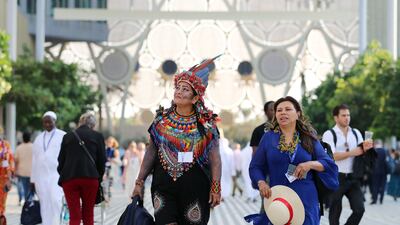
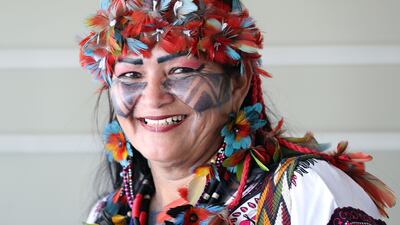
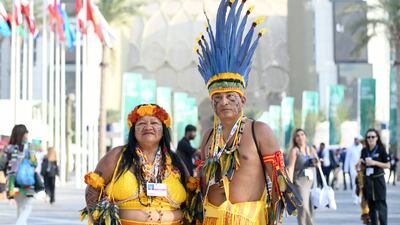
Indigenous peoples campaigners at Cop28 – in pictures

  • Indigenous people have asked world leaders at Cop28 to protect ancestral land under threat from global warming, mining, oil and gas extraction. Chris Whiteoak / The National
    Indigenous people have asked world leaders at Cop28 to protect ancestral land under threat from global warming, mining, oil and gas extraction. Chris Whiteoak / The National
  • Valdelice Veron is from the Guarani-Kaiowa community that has long fought for rights to its mineral-rich land in Brazil. Chris Whiteoak / The National
    Valdelice Veron is from the Guarani-Kaiowa community that has long fought for rights to its mineral-rich land in Brazil. Chris Whiteoak / The National
  • Micah Lee Carpenter-Lott is among those asking that the voices of native people are heard by world leaders at Cop28. Chris Whiteoak / The National
    Micah Lee Carpenter-Lott is among those asking that the voices of native people are heard by world leaders at Cop28. Chris Whiteoak / The National
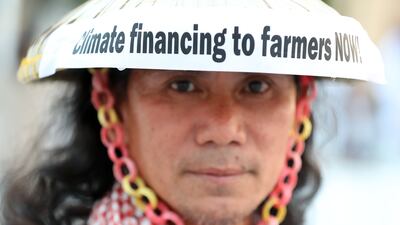
  • Jon Sarmiento is campaigning for more financing to protect indigenous farmers from natural disasters. Chris Whiteoak / The National
    Jon Sarmiento is campaigning for more financing to protect indigenous farmers from natural disasters. Chris Whiteoak / The National
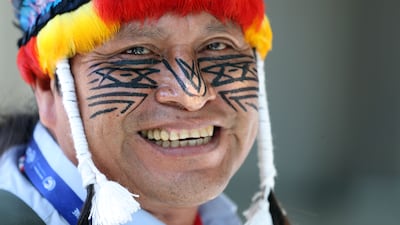
  • The indigenous community from Ecuador has called for safeguards for people whose lands bear the brunt of climate change and exploitation of natural resources. Chris Whiteoak / The National
    The indigenous community from Ecuador has called for safeguards for people whose lands bear the brunt of climate change and exploitation of natural resources. Chris Whiteoak / The National
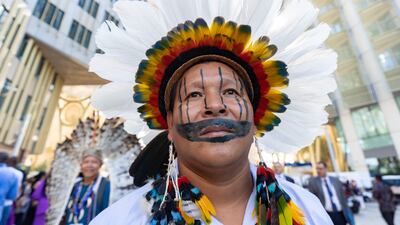
  • Jaime Zehamy Rikbakta, from Brazil, is among several indigenous groups who want the world to listen to the challenges they face. Chris Whiteoak / The National
    Jaime Zehamy Rikbakta, from Brazil, is among several indigenous groups who want the world to listen to the challenges they face. Chris Whiteoak / The National
  • Ingrid Silva de Assis Leitemberg, from Brazil, is at Cop28 to highlight the consequences of damage to ancestral land. Chris Whiteoak / The National
    Ingrid Silva de Assis Leitemberg, from Brazil, is at Cop28 to highlight the consequences of damage to ancestral land. Chris Whiteoak / The National
  • Knowledge is passed down through listening and watching elders gather medicine and food in the forest. Chris Whiteoak / The National
    Knowledge is passed down through listening and watching elders gather medicine and food in the forest. Chris Whiteoak / The National
  • Several indigenous groups are at Cop28 to address biodiversity challenges their regions face. Khushnum Bhandari / The National
    Several indigenous groups are at Cop28 to address biodiversity challenges their regions face. Khushnum Bhandari / The National
  • The UN estimates there are more than 370 million indigenous people in 70 nations and recognises the need to respect and promote their unique cultures. Khushnum Bhandari / The National
    The UN estimates there are more than 370 million indigenous people in 70 nations and recognises the need to respect and promote their unique cultures. Khushnum Bhandari / The National

Adding the qualifier “unabated fossil fuels” would mean they could still be used if emissions are reduced, for example by carbon capture, a compromise that the US and EU – but not everyone – is on board with. Then there is the question of a “phase-out” versus a “phase-down”.

“We imagine that this issue of how we’re going to address fossil fuels will be at the top of the list” of negotiations in the second half of the summit, said top EU negotiator Jacob Werksman.

Hydrogen

The basics Not really a power source in itself, hydrogen is more like electricity – whether it is climate-friendly or not depends on how it is produced.

At the moment it is only made in small quantities, much of which is “grey” hydrogen produced with natural gas rather than the “green” kind.

The political battleground Many are still mulling how to approach hydrogen, which the technical stocktake report calls a possible solution in certain sectors.

Dr Al Jaber said on Monday that a declaration on hydrogen would be issued at Cop28 in the coming days.

Tipped as a fuel source in sectors such as aviation, shipping and heavy industry when it is impractical to turn to electricity, the UAE’s Masdar has said a “green wave is coming” in which hydrogen will be produced in sustainable ways.

However, Finland’s Climate and Environment Minister Kai Mykkanen said hydrogen should not “become a buzzword or a goal itself” and is best reserved for industrial use.


F1 The Movie

Starring: Brad Pitt, Damson Idris, Kerry Condon, Javier Bardem

Director: Joseph Kosinski

Rating: 4/5

Countries recognising Palestine

France, UK, Canada, Australia, Portugal, Belgium, Malta, Luxembourg, San Marino and Andorra


Honeymoonish
%3Cp%3E%3Cstrong%3EDirector%3A%3C%2Fstrong%3E%20Elie%20El%20Samaan%3C%2Fp%3E%0A%3Cp%3E%3Cstrong%3EStarring%3A%20%3C%2Fstrong%3ENour%20Al%20Ghandour%2C%20Mahmoud%20Boushahri%3C%2Fp%3E%0A%3Cp%3E%3Cstrong%3ERating%3A%3C%2Fstrong%3E%203%2F5%3C%2Fp%3E%0A
Test

Director: S Sashikanth

Cast: Nayanthara, Siddharth, Meera Jasmine, R Madhavan

Star rating: 2/5

SUCCESSION%20SEASON%204%20EPISODE%201
%3Cp%3E%3Cstrong%3ECreated%20by%3A%20%3C%2Fstrong%3EJesse%20Armstrong%3C%2Fp%3E%0A%3Cp%3E%3Cstrong%3EStars%3A%3C%2Fstrong%3E%20Brian%20Cox%2C%20Jeremy%20Strong%2C%20Kieran%20Culkin%2C%20Sarah%20Snook%2C%20Nicholas%20Braun%3C%2Fp%3E%0A%3Cp%3E%3Cstrong%3ERating%3A%3C%2Fstrong%3E%204%2F5%3C%2Fp%3E%0A
%20Ramez%20Gab%20Min%20El%20Akher
%3Cp%3E%3Cstrong%3ECreator%3A%3C%2Fstrong%3E%20Ramez%20Galal%3C%2Fp%3E%0A%3Cp%3E%3Cstrong%3EStarring%3A%3C%2Fstrong%3E%20Ramez%20Galal%3C%2Fp%3E%0A%3Cp%3E%3Cstrong%3EStreaming%20on%3A%20%3C%2Fstrong%3EMBC%20Shahid%3C%2Fp%3E%0A%3Cp%3E%3Cstrong%3ERating%3A%20%3C%2Fstrong%3E2.5%2F5%3C%2Fp%3E%0A
THE DETAILS

Director: Milan Jhaveri
Producer: Emmay Entertainment and T-Series
Cast: John Abraham, Manoj Bajpayee
Rating: 2/5

Mercer, the investment consulting arm of US services company Marsh & McLennan, expects its wealth division to at least double its assets under management (AUM) in the Middle East as wealth in the region continues to grow despite economic headwinds, a company official said.

Mercer Wealth, which globally has $160 billion in AUM, plans to boost its AUM in the region to $2-$3bn in the next 2-3 years from the present $1bn, said Yasir AbuShaban, a Dubai-based principal with Mercer Wealth.

Within the next two to three years, we are looking at reaching $2 to $3 billion as a conservative estimate and we do see an opportunity to do so,” said Mr AbuShaban.

Mercer does not directly make investments, but allocates clients’ money they have discretion to, to professional asset managers. They also provide advice to clients.

“We have buying power. We can negotiate on their (client’s) behalf with asset managers to provide them lower fees than they otherwise would have to get on their own,” he added.

Mercer Wealth’s clients include sovereign wealth funds, family offices, and insurance companies among others.

From its office in Dubai, Mercer also looks after Africa, India and Turkey, where they also see opportunity for growth.

Wealth creation in Middle East and Africa (MEA) grew 8.5 per cent to $8.1 trillion last year from $7.5tn in 2015, higher than last year’s global average of 6 per cent and the second-highest growth in a region after Asia-Pacific which grew 9.9 per cent, according to consultancy Boston Consulting Group (BCG). In the region, where wealth grew just 1.9 per cent in 2015 compared with 2014, a pickup in oil prices has helped in wealth generation.

BCG is forecasting MEA wealth will rise to $12tn by 2021, growing at an annual average of 8 per cent.

Drivers of wealth generation in the region will be split evenly between new wealth creation and growth of performance of existing assets, according to BCG.

Another general trend in the region is clients’ looking for a comprehensive approach to investing, according to Mr AbuShaban.

“Institutional investors or some of the families are seeing a slowdown in the available capital they have to invest and in that sense they are looking at optimizing the way they manage their portfolios and making sure they are not investing haphazardly and different parts of their investment are working together,” said Mr AbuShaban.

Some clients also have a higher appetite for risk, given the low interest-rate environment that does not provide enough yield for some institutional investors. These clients are keen to invest in illiquid assets, such as private equity and infrastructure.

“What we have seen is a desire for higher returns in what has been a low-return environment specifically in various fixed income or bonds,” he said.

“In this environment, we have seen a de facto increase in the risk that clients are taking in things like illiquid investments, private equity investments, infrastructure and private debt, those kind of investments were higher illiquidity results in incrementally higher returns.”

The Abu Dhabi Investment Authority, one of the largest sovereign wealth funds, said in its 2016 report that has gradually increased its exposure in direct private equity and private credit transactions, mainly in Asian markets and especially in China and India. The authority’s private equity department focused on structured equities owing to “their defensive characteristics.”

Pupils in Abu Dhabi are learning the importance of being active, eating well and leading a healthy lifestyle now and throughout adulthood, thanks to a newly launched programme 'Healthy Lifestyle'.

As part of the Healthy Lifestyle programme, specially trained coaches from City Football Schools, along with Healthpoint physicians have visited schools throughout Abu Dhabi to give fun and interactive lessons on working out regularly, making the right food choices, getting enough sleep and staying hydrated, just like their favourite footballers.

Organised by Manchester City FC and Healthpoint, Manchester City FC’s regional healthcare partner and part of Mubadala’s healthcare network, the ‘Healthy Lifestyle’ programme will visit 15 schools, meeting around 1,000 youngsters over the next five months.

Designed to give pupils all the information they need to improve their diet and fitness habits at home, at school and as they grow up, coaches from City Football Schools will work alongside teachers to lead the youngsters through a series of fun, creative and educational classes as well as activities, including playing football and other games.

Dr Mai Ahmed Al Jaber, head of public health at Healthpoint, said: “The programme has different aspects - diet, exercise, sleep and mental well-being. By having a focus on each of those and delivering information in a way that children can absorb easily it can help to address childhood obesity."

Updated: December 06, 2023, 8:22 AM