


In 1969, Prince Charles wrote a letter to Prime Minister Harold Wilson, highlighting the decline of salmon stocks in Scottish rivers.
“People are notoriously short-sighted when it comes to questions of wildlife,” he wrote.
It was the newly-invested Prince of Wales's first foray into the world of environmentalism and sustainability, subjects that more than five decades later, now as king, are still his passion.
An invitation from President Sheikh Mohamed for King Charles to deliver the opening speech at Cop28 in Dubai gives him a platform to deliver his message, honed over 50 years, that determined action is needed to combat global warming.
The speech will be a "pivotal moment" as the world looks to the future, according to royal watcher and author Richard Fitzwilliams.
His longevity of environmentalism is extraordinary, he told The National. "There is no doubt on this issue, he is very significant.”
As king, Charles is bound by convention to stay silent on political matters. It was thought that convention would curtail his environmental campaigning.
But on his most recent foreign tour, to Kenya last month, he showed he is still committed to getting his message across. In doing so, he also gave clues to what could be the focus of his Cop28 appearance.
The king chose to plant a sapling with 10-year-old Karen Kimani, who told him “we need a clean environment, free from pollution”.
Speaking to UN staff in Nairobi during the trip, the king said: “As I am sure the many experts in this room know only too well, left unchecked, global warming, biodiversity loss and climate change are challenges which threaten us all and can only be met by the whole of society working together in the spirit of action, partnership and commitment.”
As he looked ahead to Cop28, he added: "We go far when we go together," diplomatically quoting Kenya's President William Ruto who had used those words at the Africa Climate Summit.
Buckingham Palace said the Commonwealth countries will be a focus of the king's participation at the climate summit. He is due to meet with students and graduates from across the group of countries during the event to hear about green tech, sustainable innovations and their role in delivering climate solutions.
He will also talk to female climate leaders about the risks posed to women by climate change, in addition to holding meetings with indigenous leaders to discuss the role of traditional knowledge in fighting climate crises.
King Charles understood the significance of environmental issues long before many policymakers did, according to Bob Ward, policy and communications director at the Grantham Research Institute on Climate Change and the Environment.
He told The National: “He used his influence over the years to try and draw attention to the importance of these issues. The reception was not always favourable in the early days, but he persevered anyway and he has been proven right.
“The world has begun to understand how important all these environmental issues are.”
To be given a prominent opening slot "is a recognition of his longstanding interest and credibility on this issue”, Mr Ward said.
It is not yet known what he will say, but he may well address the first stocktake, which is intended to evaluate progress on climate goals at the global level.
“I am sure he will draw attention to the fact that we are in serious trouble, and we need a much greater sense of urgency and scale of action,” Mr Ward said.
“But, again, I think he will emphasise the sense that we have to be collective in our action and we should avoid arguments between different parties about who should do what, but instead be determined to work together collectively.
“The fact that he’s non-political means that he’s not there to sell particular policies. He’s there to urge people to recognise [the problem] and urge leaders to work together.
“I hope people will listen to his message.”
A lifelong passion
The environment has been a lifelong interest for the monarch, whose father, Prince Philip, was an environmentalist who highlighted issues including poaching, deforestation and pollution.
And he has now passed on the baton to Prince William, the heir to the throne, who launched the annual Earthshot Prize in 2020, which seeks solutions to the world's environmental challenges.
A year after his letter to Mr Wilson, at the age of 21, Prince Charles spoke publicly for the first time about the environment to the Countryside Steering Committee for Wales, raising concerns about the “growing menace of oil pollution at sea”, the chemicals being discharged into rivers, and gases being pumped out by cars and aeroplanes.
He later acknowledged he was perceived as “rather dotty” with his suggestions on sustainability, such as the time he set up a reed-bed sewage treatment system at Highgrove all those years ago, which “was considered completely mad".
The mocking continued into the 1980s, when he revealed in an interview that he talks to plants.

But environmentalism is not just something the monarch preaches. He practises it, too.
He is famously a stickler for turning the lights off when he leaves a room and apparently he turned down the heat in the pool at Buckingham Palace.
His vintage Aston Martin has been converted to run on surplus wine and excess cheese whey, while his properties also have numerous eco-friendly features, having installed solar panels at several of his properties and hydroelectric turbines and biomass boilers at Balmoral.
In the 1980s, he started moving Duchy Home Farm at his Highgrove Estate in Gloucestershire towards organic farming, a practice for which it is now famous.
Around the same time he started speaking more about sustainable urban design.
His plans for Poundbury, a sustainable development now home to about 4,600 people on Duchy of Cornwall land, were unveiled in the late 1980s, according to the principles of architecture and urban planning as advocated by the prince, and shared in his book A Vision of Britain.
The development, an extension of Dorchester, features several sustainable initiatives, including materials and built-in bird boxes.
By 1990 he required British businesses seeking Royal Warrants to demonstrate a commitment to responsible societal and environmental practices.
King Charles's Poundbury village - in pictures
-
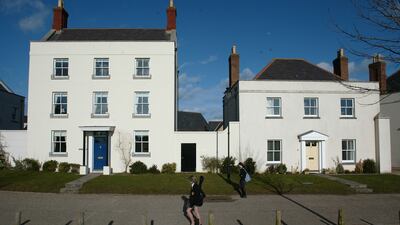
When land owned by the then-Prince of Wales was earmarked in 1987 for a new community near Dorchester, he took the opportunity to challenge modern planning and create a model of excellence. All photos: Getty Images -

Well-known architect Leon Krier, left, was appointed in 1989 to work on the concept for what would become Poundbury -

The four key principles are: Architecture of place that reflects local character and identity -
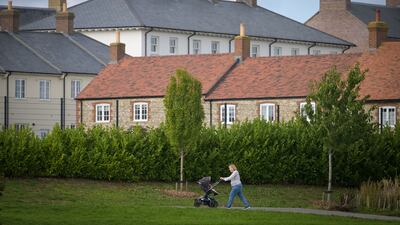
Affordable housing that is integrated with and indistinguishable from private housing -
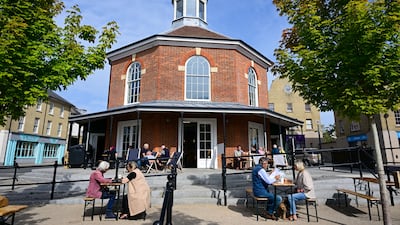
A walkable community designed to be welcoming for all non-car road users -
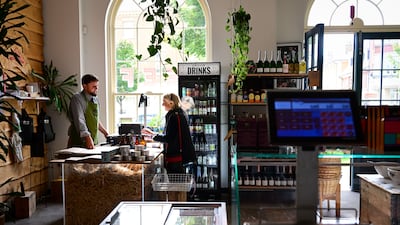
A mix of uses including homes, retail, other employment and public areas -
Dorset estimates that Poundbury will have established 1,760 full-time equivalent jobs by 2025 and employment for 2,640 people -

Poundbury is home to more than 4,600 people -
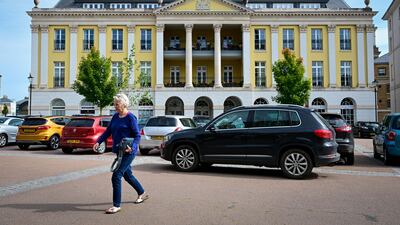
Even the parking is generally provided in landscaped courtyards


But his environmental message has regularly reached a global audience.
A conference he held on the Royal Yacht Britannia on the Amazon river paved the way for the 1992 Rio Earth Summit, where the climate Cops were initially launched.
He also spoke at the Rio+20 Cop in 2012, telling the conference: “Like a sleepwalker, we seem unable to wake up to the fact that so many of the catastrophic consequences of carrying on with business as usual are bearing down on us faster than we think, already dragging many millions more people into poverty and dangerously weakening global food, water and energy security for the future.”
It is said he played a significant part in brokering a ground-breaking agreement struck in 2009, when Norway pledged to give Guyana $250 million to preserve its rainforest.
In 2020 he established the Sustainable Markets Initiative at the World Economic Forum’s annual meeting in Davos. The chief executive-led forum sought ways for industries to grow that protect the environment.
"Global warming, climate change and the devastating loss of biodiversity are the greatest threats humanity has ever faced," he said.
“What good is all the extra wealth in the world gained from 'business as usual' if you can do nothing with it except watch it burn in catastrophic conditions.
“The only limit is our willingness to act, and the time to act is now.”
King Charles III drives environmental efforts - in pictures
-
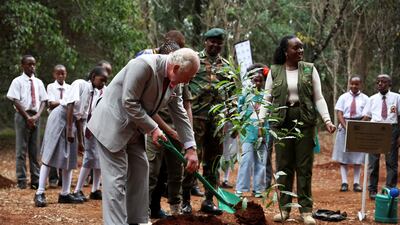
King Charles III helps to plant a tree during a visit to Karura urban forest in Kenya to highlight the crucial role of green spaces and forests in sustainable cities. Getty Images -
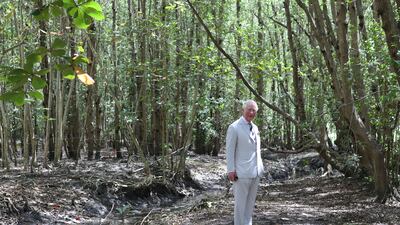
King Charles visited the threatened mangrove swamps in St Vincent and Grenadines in the Caribbean in 2019, when he was still the Prince of Wales. Getty Images -

Prince Charles visited India in 2017 where he has been supporting the plight of the endangered elephant. Getty Images -

The king has worked with indigenous people in Canada in his fight to protect the environment. Alamy -
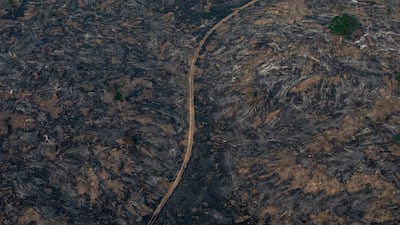
An aerial view of a section of the Amazon rain forest in Brazil devastated by wild fires. A year before the 1992 UN Earth Summit in Brazil, Prince Charles held an informal reception for delegates on the royal yacht Britannia. Getty Images -
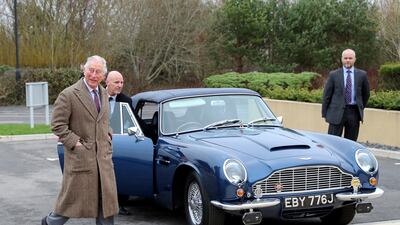
King Charles runs his Aston Martin DB6 Volante on English white wine and whey. Getty Images -
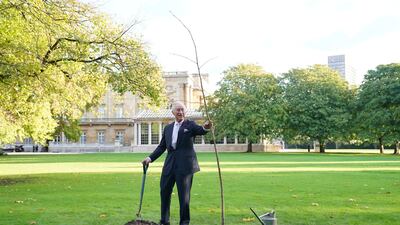
King Charles plants a lime tree in the Buckingham Palace gardens where large pieces of wood are used to provide habitats for creatures. Getty Images -
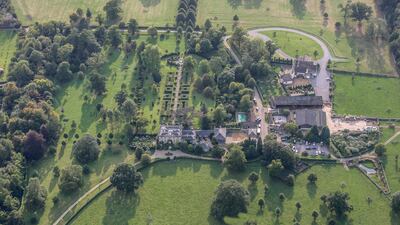
The king's Highgrove residence has solar panels and an organic garden. Getty Images -

King Charles founded organic food and drink brand Duchy Originals in 1990. Getty Images -
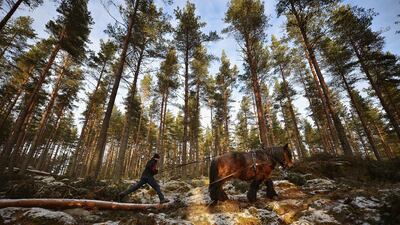
He has installed a hydroelectric turbine on a river and biomass boilers fuelled by trees felled at Birkhall, a 21,000-hectare Balmoral estate in Scotland. Getty Images -
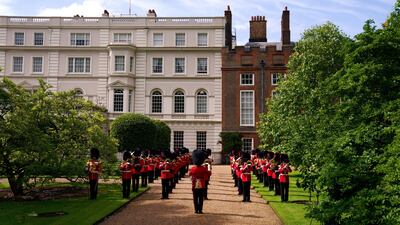
Solar panels have been installed on the roof of Clarence House, King Charles's London mansion. Getty Images -
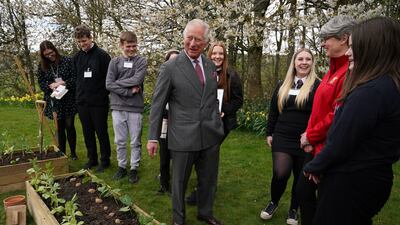
Dumfries House in Scotland champions a sustainable approach life and communities. Getty Images -
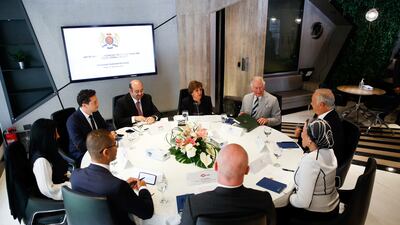
King Charles set up the Sustainable Markets Initiative in 2019. Getty Images -

Poundbury, on the outskirts of Dorchester, Dorset, reflects King Charles's traditional approach to architecture and urban planning, and designed to be a sustainable community. Getty Images


The king last spoke at a Cop in 2021, when he addressed Cop26.
The king had also planned to speak at Cop27 in Egypt last year, but Liz Truss, as British prime minister at the time, advised him to stay away.
Current Prime Minister Rishi Sunak appears to have no such qualms, despite scaling back Britain's net-zero ambitions in recent months.
But in many senses the issue is considered above party politics, Mr Fitzwilliams said.
"It’s one of the issues that the royal family, as Britain’s use of soft power, can contribute to."
After meeting King Charles, the Kenyan schoolgirl Karen said she had written to him to let him know that children who care so much about the future of the planet "need their voices to be heard".
With his platform at Cop28, and a lifetime devoted to green causes, King Charles has that opportunity.

