


Only four days remain at Cop27. It is endgame.
Countries are racing to agree to clinch a deal on curbing emissions and stepping up finance to deal with the devastating effects of climate change.
But in the opaque world of technical committees, panel discussions and wrangling over words, what is happening behind closed doors at the crucial climate talks and what are the chances of success?
Talks need speedy progress
Cop27 president Sameh Shoukry has already had to tell parties to “shift gears” and accelerate the pace.
Technical discussions about a final draft text have now been extended to late on Tuesday, before ministers take over on Wednesday to try to thrash out a final agreement by Friday, the event’s scheduled last day.
These discussions typically end by Saturday so it does not leave much time.
“There has been a good amount of work done,” Jan Dusik told The National. He is head of the delegation of the Czech presidency of the European Union, and speaks on behalf of the bloc.
“But there is also a lot of unfinished business. So it is important for experts to be given more time as ministers would not be able to clean up so much text.”
Negotiators are now effectively working through the night to boost the likelihood of a successful conclusion.
Main talking points
Loss and damage — what some describe as compensation for developing countries that suffer climate change harm — has become vital. Getting it on to the agenda on the first day was a win but establishing such a fund is a different matter.
“Loss and damage for us is critical,” said Nabil Mounir, Pakistan’s chief negotiator, who also chairs the important Group of 77 developing countries.
“We want a concrete decision from Cop. We are pushing for the establishment of a fund. We remain hopeful we will be able to do that.”
Gideon Behar, the Israeli climate envoy, said he understood the position of developing countries on loss and damage. “Our wish is to see a balanced Cop and give consideration to loss and damage.”
The EU said it was important to recognise the importance of this new item on the agenda.
“Talks are now moving to the political level so we will see how far we can go in terms of agreeing,” said Mr Dusik.
“There is an understanding that not everything will be agreed during this meeting. So it is also about setting the road map.”
EU Climate Policy chief Frans Timmermans also told reporters on Tuesday that he wasn't certain countries would find consensus on the loss and damage mechanism.
-
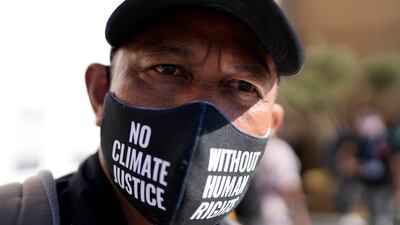
A man wears a face mask that reads "no climate justice without human rights" during a protest at the COP27 UN Climate Summit in Sharm El Sheikh, Egypt. AP -
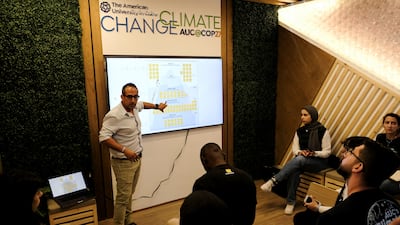
A presentation at the American University in Cairo Pavilion. Reuters -
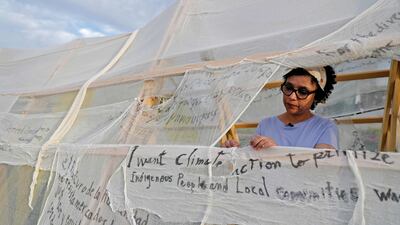
Egyptian artist Bahia Sheha stands inside her installation "Heaven & Hell in the Anthropocene." AFP -
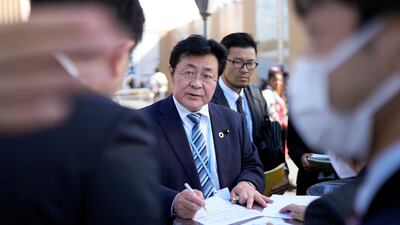
Akihiro Nishimura, minister of the environment of Japan, reviews notes with others at the COP27. AP -
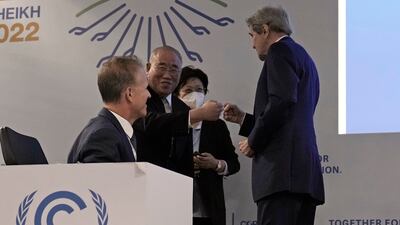
US Special Presidential Envoy for Climate John Kerry, right, and Xie Zhenhua, China's special envoy for climate greet each other at the COP27 UN Climate Summit in Sharm el-Sheikh, Egypt. AP -

Brazilian president-elect Luiz Inacio Lula da Silva poses for a group photograph with representatives of his country's indigenous people. AFP -
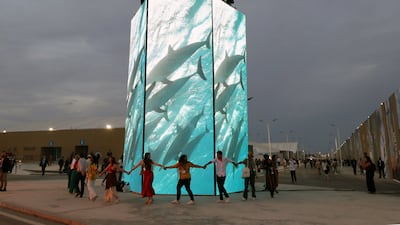
People attend the COP27 UN Climate Summit in Sharm El-Sheikh. EPA -

Activists dancing during a discussion on leaflets at the Cop27 climate conference, taking place in Sharm El Sheikh, Egypt. AFP -

An activist wears a polar bear outfit as part of campaigning. AFP -
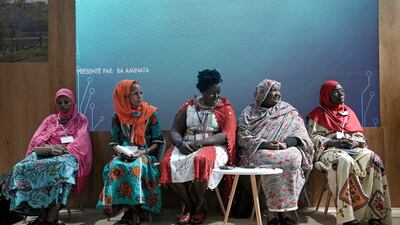
From left, Rakia Amandou of Niger, Ba Aminata of Burkina Faso, Kenyan Rosemary Nenini, Fatima Mustafa Ahmed from Sudan and Djeneb Dicko from Burkina Faso at the Indigenous Peoples Pavilion. AP -
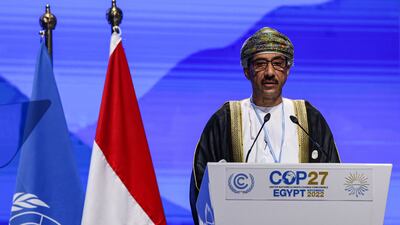
Abdulla Nasser Musallam Al Rahbi, Oman's Ambassador to Egypt and Permanent Representative to the Arab League, speaks at the COP27 climate conference in Egypt's Red Sea resort city of Sharm el-Sheikh. AFP -
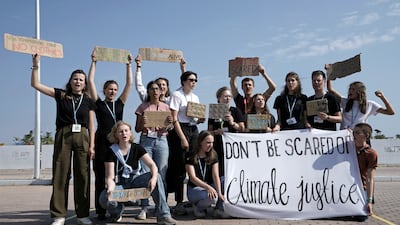
Climate activists demonstrate in the designated protest zone. AP -
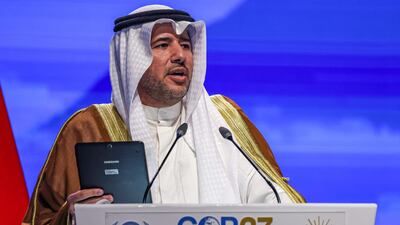
Sheikh Abdullah, Director General of Environment at the Public Authority of Kuwait, speaks at Cop27. AFP -
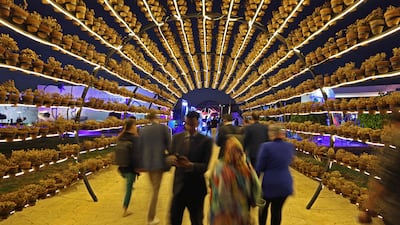
Visitors at the Sharm El Sheikh International Convention Centre. AFP -
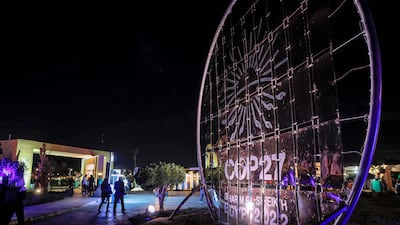
A display outside the convention centre. AFP -

A fountain in the green zone at the International Convention Centre at sunset. AFP -
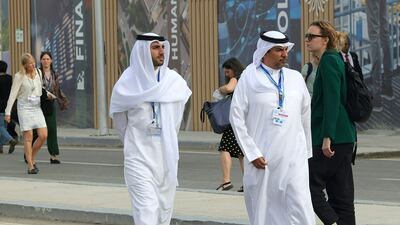
Mohamed bin Daina, right, Bahrain's Special Envoy for Climate Affairs and Chief Executive at the Supreme Council for Environment, at the conference. AFP -
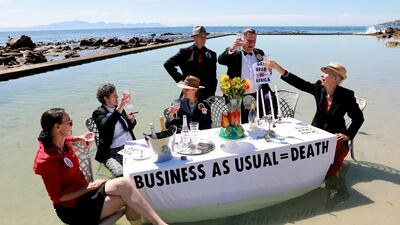
Members of Extinction Rebellion stage a protest at the Glencairn tidal pool outside Cape Town, South Africa to mark Cop27's 'Water Day'. AP -
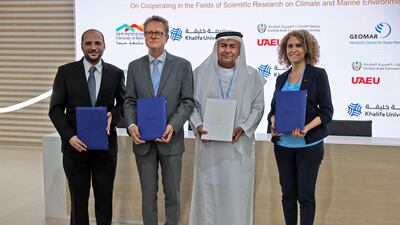
From left, Fahad Al Maskari of the Khalifa University, Frank Hartmann, Ghaleb Al Breiki of the UAE University, and Mouna Maroun of the University of Haifa, sign an agreement at Cop27. AFP -
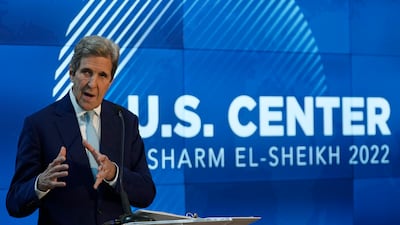
John Kerry, US special presidential envoy for climate, at Cop27 in Sharm El Sheikh, Egypt. AP Photo -

Australian climate activists offer bananas to climate summit participants. AFP -

Climate activist Sabrina Elba. AP Photo -

Egyptian security forces stand guard during the protest. AFP -
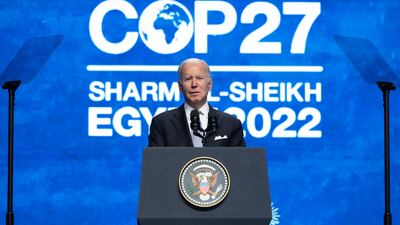
US President Joe Biden. AFP -

Mr Biden with Egyptian President Abdel Fattah El Sisi. AP -
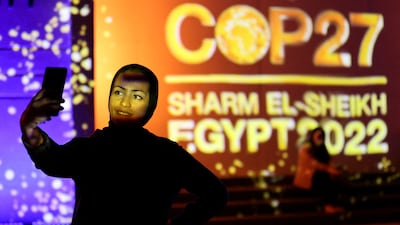
A Cop27 sign in Sharm El Sheikh, Egypt, provides the backdrop for this woman's selfie. Reuters -
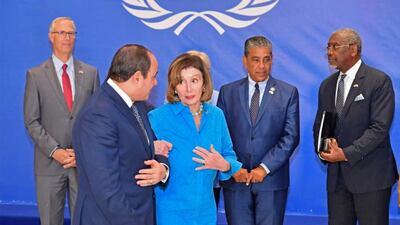
Egypt's President Abdel Fattah El Sisi speaks to US House Speaker Nancy Pelosi at the climate summit. AFP -

A water wonderland greets this child at an acquarium in the Cop27 Green Zone. Reuters -
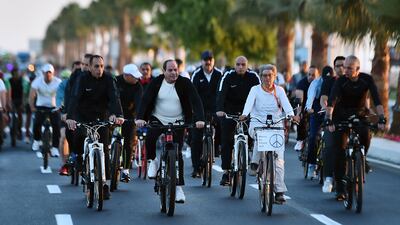
Mr El Sisi, second left, takes part in a cycling marathon on the sidelines of Cop27. EPA -
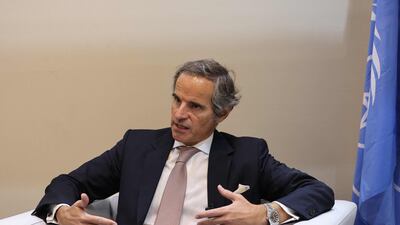
Rafael Grossi, director of the International Atomic Energy Agency, speaks in Sharm El Sheikh about 'complicated' talks to set up a protection zone around Ukraine's Zaporizhzhia nuclear plant. AFP -
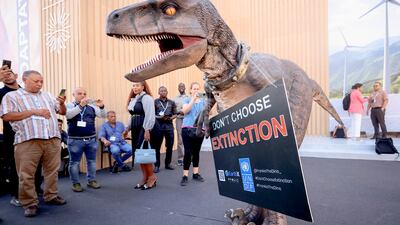
Frankie the dinosaur. Reuters -

US House Speaker Nancy Pelosi. Reuters -
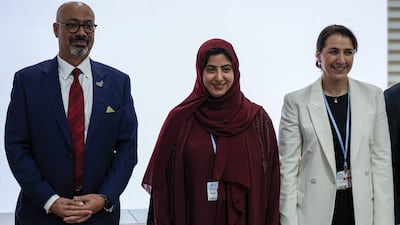
Sheikha Shamma bint Sultan, CEO of the Alliances for Global Sustainability; Mariam Al Mheiri, Minister of Climate Change and Environment and Minister of State for Food Security; and Hatem Dowidar, group CEO at e&. AFP -

Sameh Shoukry, Cop27 president, centre left, poses for photos in the youth pavilion. AP -

A visitor looks at the 'Zero Point' series of collage portraits by Turkish artist Deniz Sagdic, each of which is made from a particular kind of upcycled waste material. Getty -

Participants visit the Ukrainian pavillon. AFP -

Mr Kerry speaks during a session on accelerating the clean energy transition in developing countries. AP -
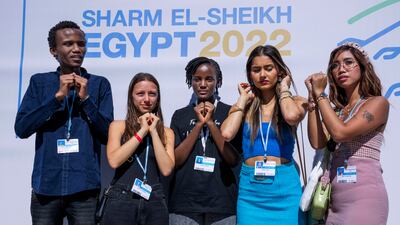
Youth climate activists. Pictured, from the left, Eric Njuguna of Kenya, Nicole Becker of Argentina, Vanessa Nakate of Uganda, Sophia Kianni from Iran, and Mitzi Jonelle Tan of the Philippines. AP -
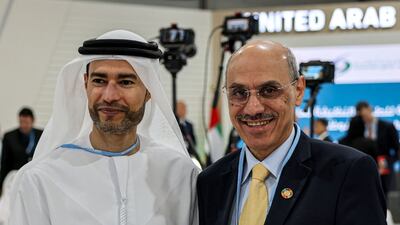
Muhammad Sulaiman Al Jasser, right, chairman of the Islamic Development Bank Group, poses for a photo with Mohamed Hadi Al Hussaini, the UAE's Minister of State for Financial Affairs. AFP -
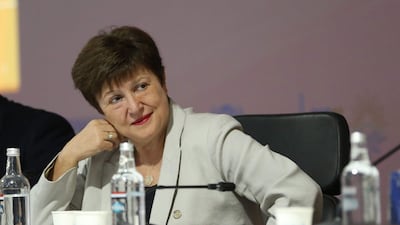
Kristalina Georgieva, managing director of the International Monetary Fund. Bloomberg -

A police officer stands at the entrance of the Sharm El Sheikh International Convention Centre during Cop27. Reuters -

United Nations Secretary General Antonio Guterres. AP Photo -

Former US vice president Al Gore speaks during a session at Cop27. AP Photo -
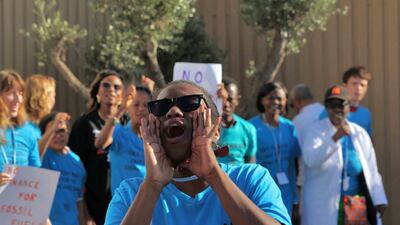
Demonstrators shout slogans during a protest. AFP


Set as part of the Paris Agreement, the international treaty on climate change adopted in 2015, the 1.5°C goal — an attempt to limit global warming to this threshold on pre-industrial levels — is also in the spotlight.
Commentators have speculated that some countries were trying to water this down but Mr Dusik said the objective remained.
“I just came out of round-table on mitigation to 2030 and everyone was saying we cannot afford abandoning the 1.5°C ambition," he said. "That gives me hope.”
Kevin Conrad, executive director of the Coalition for Rainforest Nations, said he was concerned there was too much noise and “parallel silos” at Cop27 that distracted attention from Paris and the 1.5°C goal. He urged a refocusing on Paris by getting countries to execute it and reward them when they do.
“If you executive Paris, there is a pot of gold for you,” he said.
How are the talks going?
About 200 countries are jockeying for position. They will try to advance national interests, as well as seek consensus on saving the planet. But trying to read the tea leaves of what is happening in the darkened, air-conditioned conference rooms at the Sharm El Sheikh venue remains elusive.
Mr Mounir said “talks are always difficult” at this stage but was “pretty hopeful” of a deal. He said the atmosphere in the negotiating rooms away from the glare of the media was positive. “They know the whole world is watching,” he said. “They want this to be successful.”
The role of the Egyptian presidency comes into play during the second week where they instruct where more work needs to be done. Mr Dusik said there was a still “a great many things still open” and much work to be done before the ministers looked at crunch issues. “We need the Egypt presidency to distil this,” he said.
Mr Behar said it was “really hard to say” how the talks were progressing. But Israel was keen to focus on solutions. “The issue of solutions has been neglected at Cops, generally speaking,” he said.
What will happen on Friday?
A declaration, or what is known as a cover decision, is expected. This will set out what has been achieved at Cop27 and the path ahead. Cops tend to overrun but is there enough time to clinch a deal?
Mr Conrad said he did not expect major exciting decisions but wanted mention of saving the rainforests in the final declaration. “Showing momentum is always really important,” he said.
Mr Mounir said he expected something “concrete” on Friday. “I think there is a sense of that.” Mr Dusik cautioned that there was a lot more work to do but despite that, he said: “Yes, I am optimistic.”

