Belem, Brazil, will host Cop30 in November 2025. AP

'Our last chance': Pressure on Cop30 to deliver after divisive Cop29


Rachel Kelly
  • English
  • Arabic

Read more: Cop29 secured a done deal but it needs to be built on

All eyes are on Brazil, the host of Cop30, after developing nations deemed the finance plan agreed at Cop29 to pay for the ravages of climate change to be too little, too late. The climate summit, which will bring together tens of thousands of delegates, will be held from November 10 to 21 next year in the northern city of Belem.

Marina Silva, Brazil's Minister of Environment, said that Cop29 was the finance Cop but Cop30 would be the Cop of Nationally Determined Contributions (NDCs) – plans set out by governments to tackle climate change. Climate activists hope more can be achieved in Brazil than in Baku, Azerbaijan, over the past two weeks.

"To be held in Brazil, a major developing country with huge forest reserves, it’s even more apt to push the frontier even harder for global funding and carbon markets advancement," Prof Lawrence Loh, director of the Centre for Governance and Sustainability at NUS Business School, told The National.

Clare Shakya, global managing director for climate of The Nature Conservancy, a US global conservation organisation, said the Paris Agreement process is still alive, albeit barely, post-Cop29. "Hopefully the ambition evident in fresh NDCs from Brazil and others, coupled with President Lula's recent G20 summit comments, will inject fresh vigour into UN climate at Cop30," she said.

Brazil's Environment Minister says Cop30 will be the Cop of action plans. AP Photo

Brazil's President, Luiz Inacio Lula da Silva, went further, inviting participants to make next year the "turnaround Cop". "Cop30 will be our last chance to avoid an irreversible rupture in the climate system," he said.

Civil rights groups are looking to Cop30 to mend the chasm opened by events in Baku. Sergio Chaparro Hernandez, international co-ordinator of Dejusticia (Colombia), said the $300 billion deal at Cop29 falls far short of the ambition the world needs to show to confront the climate crisis.

"We needed those most responsible for the climate crisis to go beyond speeches and commit to resources at the level of trillions," he said. "But this did not happen, which shows the crisis of these multilateral spaces, and the need to give new impetus to climate co-operation at Cop30 and seek to align financial flows."

Claudio Angelo, head of international policy at Observatorio do Clima, said: “Brazil now is given one more daunting task for Cop30: to scale up finance and rebuild the trust among countries.”

Cop29's finance deal was agreed in the early hours of Sunday. AP

From Baku to Brazil

A hard-fought agreement was reached in Baku after developed nations increased their offer from $250 billion to $300 billion, bringing the negotiations at the Cop29 summit to a delayed conclusion.

The compromise agreement urges "all actors" to contribute to the $1.3 trillion annual funding target sought by developing countries. However, the $300 billion core commitment from wealthier nations is smaller and more vague than the specific amount that poorer and more vulnerable countries had pushed for during the two weeks of negotiations in Azerbaijan.

"Cop29’s conclusion may seem to be a mixed bag with the difficulty in aligning the expectations of financing level between developed and developing countries. Even with the apparent discord, Cop29’s outcomes are commendable," said Prof Loh.

Laura Sabogal, a senior policy adviser at E3G, said that the adoption of the New Collective Quantified Goal marks a "critical yet imperfect step forward". "At the same time, its glaring shortcomings cannot be ignored, it reflects a troubling lack of urgency and ambition in addressing the deep inequities at the heart of global climate finance."

Beyond the finance plan, on day one of the Cop29 conference, the presidency had signalled an early win on pushing forward progress on carbon markets after almost a decade of standstill. "This resolution is probably most significant as the world is now ready to implement net zero through proper country-level carbon trading procedures and crediting mechanisms," Prof Loh said.

Known as Article 6 of the 2015 Paris Agreement, carbon markets allow nations to transfer carbon credits earned through emission reductions to help meet their climate targets. For instance, initiatives such as preserving rainforests or other carbon sinks could receive funding from credits from those looking to offset emissions.

Cop29 – in pictures

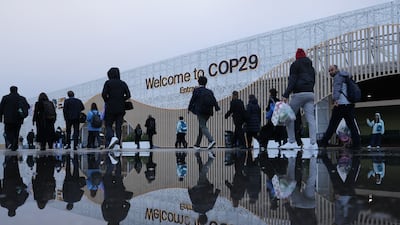
  • Participants at the Cop29 venue in Baku, Azerbaijan. Reuters
    Participants at the Cop29 venue in Baku, Azerbaijan. Reuters
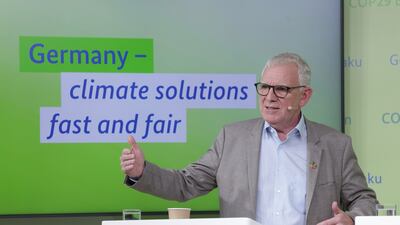
  • Jochen Flasbarth, State Secretary in the German Ministry for Economic Co-operation and Development, speaks in the Germany pavilion. Getty Images
    Jochen Flasbarth, State Secretary in the German Ministry for Economic Co-operation and Development, speaks in the Germany pavilion. Getty Images
  • Nuclear power activists demonstrate. AP
    Nuclear power activists demonstrate. AP
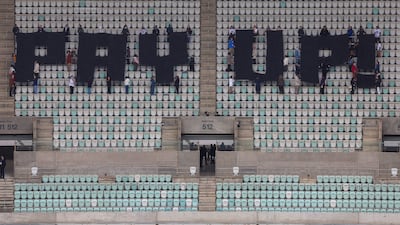
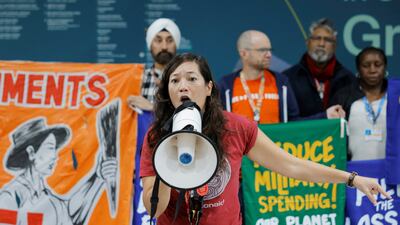
  • Activists hold a protest calling on developed nations to provide financing. Reuters
    Activists hold a protest calling on developed nations to provide financing. Reuters
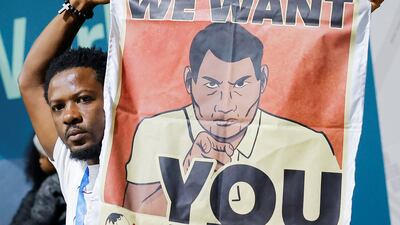
  • An activist holds up a sign. Reuters
    An activist holds up a sign. Reuters
  • Conference participants arrive on day four. Getty Images
    Conference participants arrive on day four. Getty Images
  • Another protest. Reuters
    Another protest. Reuters
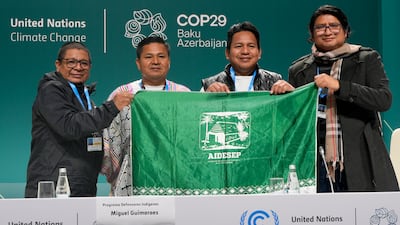
  • From left, Jorge Perez, Rolando Escobar, Miguel Vasquez and Esteban Cama at a session on Indigenous communities in the Peruvian Amazon. AP
    From left, Jorge Perez, Rolando Escobar, Miguel Vasquez and Esteban Cama at a session on Indigenous communities in the Peruvian Amazon. AP
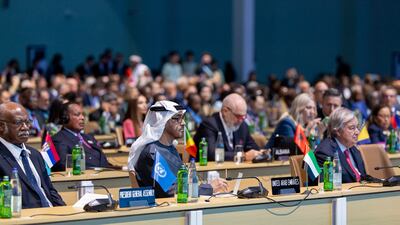
  • President Sheikh Mohamed attends the World Leaders Climate Action Summit at Cop29, in Azerbaijan's capital Baku. UAE Presidential Court
    President Sheikh Mohamed attends the World Leaders Climate Action Summit at Cop29, in Azerbaijan's capital Baku. UAE Presidential Court
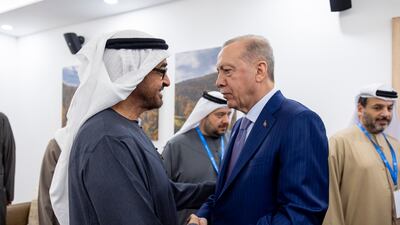
  • Sheikh Mohamed greets Recep Tayyip Erdogan, President of Turkey. WAM
    Sheikh Mohamed greets Recep Tayyip Erdogan, President of Turkey. WAM
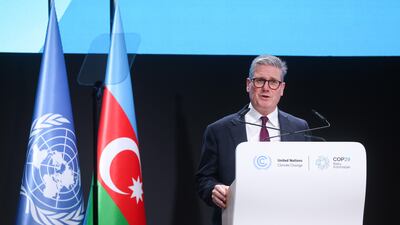
  • British Prime Minister Keir Starmer at Cop29. Bloomberg
    British Prime Minister Keir Starmer at Cop29. Bloomberg
  • Ding Xuexiang, China's first Vice Premier, at Cop29. Bloomberg
    Ding Xuexiang, China's first Vice Premier, at Cop29. Bloomberg
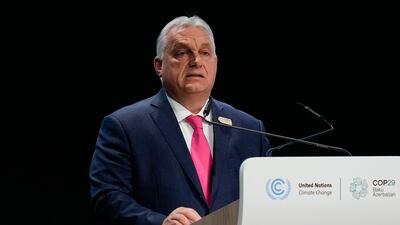
  • Hungary's Prime Minister Viktor Orban at a plenary session at Cop29. AP
    Hungary's Prime Minister Viktor Orban at a plenary session at Cop29. AP
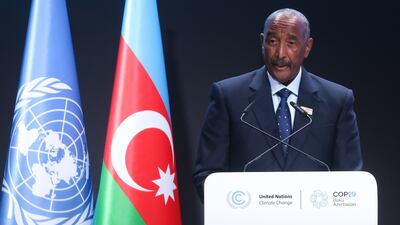
  • Sudan's military leader Abdel Fattah Al Burhan, at Cop29. Bloomberg
    Sudan's military leader Abdel Fattah Al Burhan, at Cop29. Bloomberg
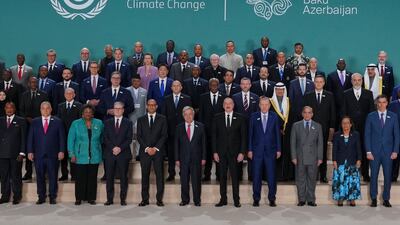
  • World leaders pose for a group photo at the Cop29 United Nations Climate Change Conference, in Baku, Azerbaijan. AP
    World leaders pose for a group photo at the Cop29 United Nations Climate Change Conference, in Baku, Azerbaijan. AP
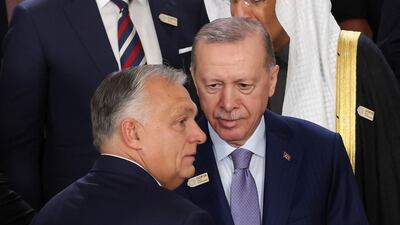
  • Hungarian Prime Minister Viktor Orban, left, stands next to Turkish President Recep Tayyip Erdogan. Reuters
    Hungarian Prime Minister Viktor Orban, left, stands next to Turkish President Recep Tayyip Erdogan. Reuters
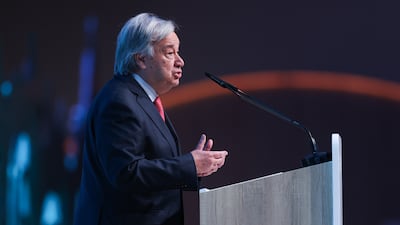
  • Antonio Guterres, UN secretary-general, addresses Cop29. Bloomberg
    Antonio Guterres, UN secretary-general, addresses Cop29. Bloomberg
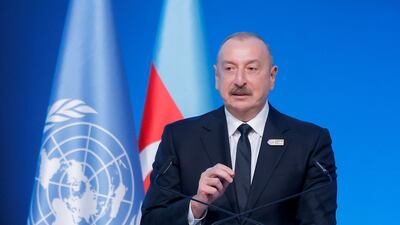
  • Azerbaijan's President Ilham Aliyev speaks during the Cop29 opening ceremony. Reuters
    Azerbaijan's President Ilham Aliyev speaks during the Cop29 opening ceremony. Reuters
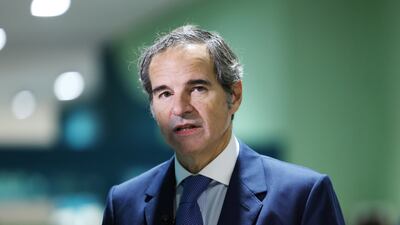
  • Rafael Grossi, director general of International Atomic Energy Agency (IAEA), at Cop29. Bloomberg
    Rafael Grossi, director general of International Atomic Energy Agency (IAEA), at Cop29. Bloomberg
  • Activists demonstrate for climate justice and a ceasefire in the Israel-Hamas war in Gaza, on day one of Cop29. AP
    Activists demonstrate for climate justice and a ceasefire in the Israel-Hamas war in Gaza, on day one of Cop29. AP
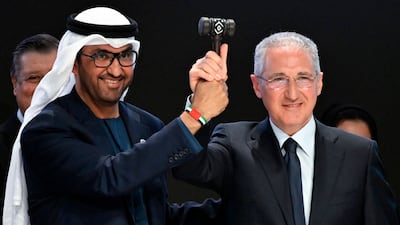
  • Cop28 President Dr Sultan Al Jaber and Cop29 President Mukhtar Babayev at the official handover. AFP
    Cop28 President Dr Sultan Al Jaber and Cop29 President Mukhtar Babayev at the official handover. AFP
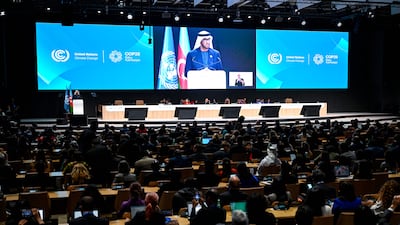
  • Dr Al Jaber, Minister of Industry and Advanced Technology, delivers a speech during the opening of Cop29 in Baku. AFP
    Dr Al Jaber, Minister of Industry and Advanced Technology, delivers a speech during the opening of Cop29 in Baku. AFP
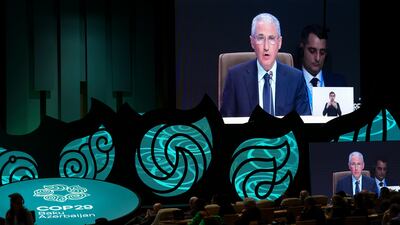
  • Mr Babayev speaks during the opening plenary session. AP
    Mr Babayev speaks during the opening plenary session. AP
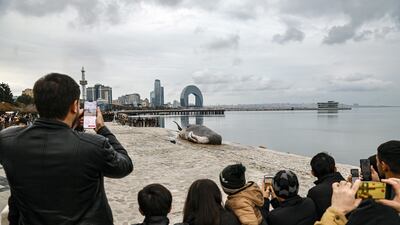
  • An installation depicting a beached whale by the Belgian art collective Captain Boomer on an embankment in Baku. EPA
    An installation depicting a beached whale by the Belgian art collective Captain Boomer on an embankment in Baku. EPA
  • The Turkey Solidarity Centre pavilion. Bloomberg
    The Turkey Solidarity Centre pavilion. Bloomberg
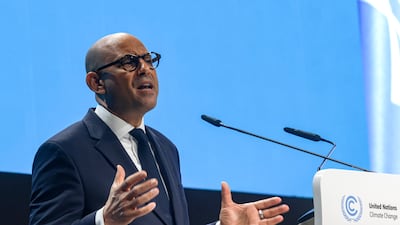
  • Simon Stiell, executive secretary of the UN Framework Convention on Climate Change, speaks during the opening ceremony. EPA
    Simon Stiell, executive secretary of the UN Framework Convention on Climate Change, speaks during the opening ceremony. EPA
  • People begin arriving for the start of Cop29 in Baku. Bloomberg
    People begin arriving for the start of Cop29 in Baku. Bloomberg
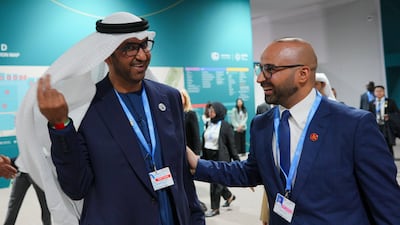
  • Dr Al Jaber at Cop29 with Moroccan climate researcher Cherif El Khalil. AP
    Dr Al Jaber at Cop29 with Moroccan climate researcher Cherif El Khalil. AP
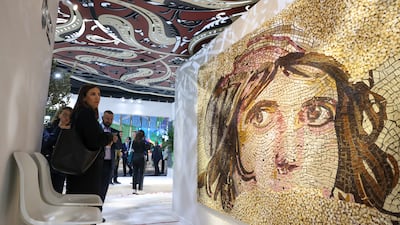
  • A mosaic adorns a wall at the Cop29 venue, Baku Stadium, in the capital of Azerbaijan. Bloomberg
    A mosaic adorns a wall at the Cop29 venue, Baku Stadium, in the capital of Azerbaijan. Bloomberg
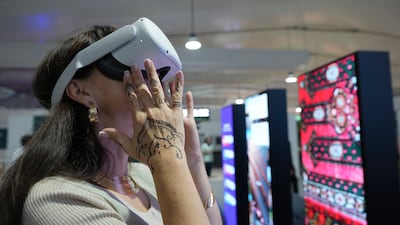
  • A woman tries out a VR headset at the tourism booth as the Cop29 UN climate summit gets under way in Baku, Azerbaijan. AP
    A woman tries out a VR headset at the tourism booth as the Cop29 UN climate summit gets under way in Baku, Azerbaijan. AP
Who's who in Yemen conflict

Houthis: Iran-backed rebels who occupy Sanaa and run unrecognised government

Yemeni government: Exiled government in Aden led by eight-member Presidential Leadership Council

Southern Transitional Council: Faction in Yemeni government that seeks autonomy for the south

Habrish 'rebels': Tribal-backed forces feuding with STC over control of oil in government territory

DIVINE%20INTERVENTOIN
%3Cp%3EStarring%3A%20Elia%20Suleiman%2C%20Manal%20Khader%2C%20Amer%20Daher%3C%2Fp%3E%0A%3Cp%3EDirector%3A%20Elia%20Suleiman%3C%2Fp%3E%0A%3Cp%3ERating%3A%204.5%2F5%3C%2Fp%3E%0A

Mercer, the investment consulting arm of US services company Marsh & McLennan, expects its wealth division to at least double its assets under management (AUM) in the Middle East as wealth in the region continues to grow despite economic headwinds, a company official said.

Mercer Wealth, which globally has $160 billion in AUM, plans to boost its AUM in the region to $2-$3bn in the next 2-3 years from the present $1bn, said Yasir AbuShaban, a Dubai-based principal with Mercer Wealth.

Within the next two to three years, we are looking at reaching $2 to $3 billion as a conservative estimate and we do see an opportunity to do so,” said Mr AbuShaban.

Mercer does not directly make investments, but allocates clients’ money they have discretion to, to professional asset managers. They also provide advice to clients.

“We have buying power. We can negotiate on their (client’s) behalf with asset managers to provide them lower fees than they otherwise would have to get on their own,” he added.

Mercer Wealth’s clients include sovereign wealth funds, family offices, and insurance companies among others.

From its office in Dubai, Mercer also looks after Africa, India and Turkey, where they also see opportunity for growth.

Wealth creation in Middle East and Africa (MEA) grew 8.5 per cent to $8.1 trillion last year from $7.5tn in 2015, higher than last year’s global average of 6 per cent and the second-highest growth in a region after Asia-Pacific which grew 9.9 per cent, according to consultancy Boston Consulting Group (BCG). In the region, where wealth grew just 1.9 per cent in 2015 compared with 2014, a pickup in oil prices has helped in wealth generation.

BCG is forecasting MEA wealth will rise to $12tn by 2021, growing at an annual average of 8 per cent.

Drivers of wealth generation in the region will be split evenly between new wealth creation and growth of performance of existing assets, according to BCG.

Another general trend in the region is clients’ looking for a comprehensive approach to investing, according to Mr AbuShaban.

“Institutional investors or some of the families are seeing a slowdown in the available capital they have to invest and in that sense they are looking at optimizing the way they manage their portfolios and making sure they are not investing haphazardly and different parts of their investment are working together,” said Mr AbuShaban.

Some clients also have a higher appetite for risk, given the low interest-rate environment that does not provide enough yield for some institutional investors. These clients are keen to invest in illiquid assets, such as private equity and infrastructure.

“What we have seen is a desire for higher returns in what has been a low-return environment specifically in various fixed income or bonds,” he said.

“In this environment, we have seen a de facto increase in the risk that clients are taking in things like illiquid investments, private equity investments, infrastructure and private debt, those kind of investments were higher illiquidity results in incrementally higher returns.”

The Abu Dhabi Investment Authority, one of the largest sovereign wealth funds, said in its 2016 report that has gradually increased its exposure in direct private equity and private credit transactions, mainly in Asian markets and especially in China and India. The authority’s private equity department focused on structured equities owing to “their defensive characteristics.”

Updated: November 25, 2024, 5:22 PM