

UN climate talks went into extra time on Saturday after key players rejected a $1.3 trillion deal put on the table by Azerbaijan, as negotiators made a last-ditch bid to bridge "chasms" between rich and poor countries at the Cop29 summit.
The proposal would set a $250 billion per year floor for funding for the fight against climate change to be arranged by the rich world – well below what developing countries have been asking for. Donors and investors would be asked to "work together" towards hitting $1.3 trillion by 2035.
Emerging economies such as China and Brazil would be invited to contribute, after the US and Europe demanded the costs be split beyond the traditional rich world. The $250 billion core would come from a "variety of sources", including public and private funds, despite a push from poorer nations for direct grants.
Talks stretched past their Friday deadline at Baku Stadium, as countries sought last-minute changes to the pact. Brazil wants to push the "inner" target up to $390 billion, while African states objected to a goal for which "all countries are responsible" with the developed world merely "taking the lead".
Brazil, the host of next year's Cop, expressed concern at the late hour in which concrete figures were finally put forward. Speaking to the media, Marina Silva, Brazil's Minister of Environment and Climate Change, said "we know the figure is not sufficient". In place of the $250 billion core proposed in the latest text, Ms Silva said $300 billion is needed until 2030, and $390 billion until 2035.
Ana Toni, Brazil's Secretary for Climate Change, said that what negotiators seek now is clarity as the language in the current draft leaves a lot of margin for interpretation.
A key group of small islands threatened by rising sea levels said it was "deeply disappointed" by what it called an unacceptable proposal that asked: “How low can you go?”. It said it "cannot be expected to agree to a text which shows such contempt for our vulnerable people".
In an appeal to the "moral conscience" of other nations, the Alliance of Small Island States said its members had borne the burden of climate change for three decades and all they asked was for the protection offered under the Paris climate agreement. "This ask is not a threat," it said. "It is just a matter of justice."
The chair of an African negotiating group, Ali Mohamed, called the $250 billion figure "totally unacceptable and inadequate", as the talks headed into extra time. A lack of funds would "lead to unacceptable loss of life in Africa and around the world", he said.

The US did not rule out supporting the deal but many activists in Baku were unhappy. "The amount is a joke. It's totally a joke and it's unacceptable," said Obed Koringo, a charity adviser from Kenya. "We're better not having a deal than having a bad deal, and this is a very bad deal. We want our leaders to do better."
The text, tabled just hours before the scheduled end of negotiations, is the first attempt by Azerbaijan to broker a compromise in the difficult talks. The $1.3 trillion figure was a demand of developing nations, but many had asked for $900 billion of it to come directly from governments in the rich world. Azerbaijan said there were "few options remaining" as it told countries to agree on "final adjustments".
Agreeing language on fossil fuels was a further sticking point, amid fears raised by the EU and Germany of backsliding on the "transition away" agreed at last year's Cop28 summit in Dubai. Saudi Arabia said it opposed text that "targets specific sectors, including fossil fuel".
"How can a mitigation text not mention fossil fuels? The basis for the climate crisis," said Hailey Campbell, director of campaign group Care about Climate. "Mitigation, just transition, and finance must be in lock step, we can’t accept anything else for our future and that of the planet.”
Delayed finish
The two-week talks were due to end at 6pm on Friday - and did not - but Cop summits rarely finish on time. An extra 23 hours were needed to agree last year's UAE Consensus, and a second day of overtime is not unheard of. German Foreign Minister Annalena Baerbock said everyone was prepared for the talks to roll on with the "clock ticking mercilessly".
"We are seeing at this Cop the chasms between positions of different states come to the fore," said Nikki Reisch, watching the talks for the Centre for International Environmental Law. Complaints have been heard about Azerbaijan's failure to "identify bridges between positions" instead of "merely reflecting back the great divide", she said.
That divide was spelt out in earlier negotiating texts put on the table by Azerbaijan, which asked countries to help with "bridging proposals" between two opposing options to replace a previous $100 billion a year target. Sindra Sharma, a Fijian delegate representing the Pacific Islands Climate Action Network, said she awoke on Friday with a "complete sense of frustration".
She said it was "really disappointing" that the texts on the table do not include specific sub-goals for emissions cuts, adaptation and disaster recovery. "We’re hoping that can be reflected back into the text but at this stage it feels really frustrating that we probably won’t be able to get there," she told The National.

A senior US official said the previous $100 billion goal had been a "significant lift" and reaching $250 billion would "require even more ambition and extraordinary reach", including funds from private investors and development banks.
The new $250 billion sub-goal "is clearly a lot less than developing countries need and are hoping for,” said Rob Moore, a former UK finance negotiator and director at climate think tank E3G. “If developed countries can go further they need to say so fast to make sure we get a deal at Cop29”.
The European Union and China have held side talks with the Alliance of Small Island States as delegates wait for white smoke at the Baku Stadium. Splits also emerged within a powerful group of small and medium-sized economies over whether to accept the US and European demands to widen the pool of donors. China, Russia and India are among the major polluters who are not asked to pay towards climate efforts under current UN rules that class them as developing.
Cop29 in Azerbaijan – in pictures
-

Participants at the Cop29 venue in Baku, Azerbaijan. Reuters -
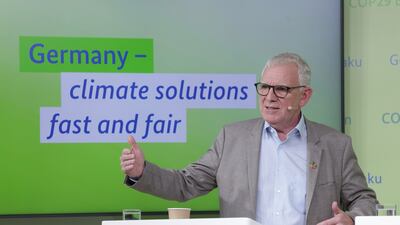
Jochen Flasbarth, State Secretary in the German Ministry for Economic Co-operation and Development, speaks in the Germany pavilion. Getty Images -
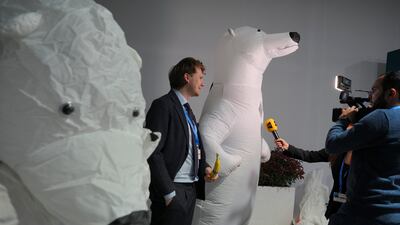
Nuclear power activists demonstrate. AP -
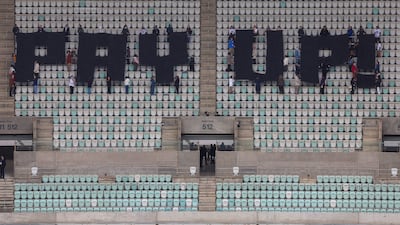
Activists hold a protest calling on developed nations to provide financing. Reuters -
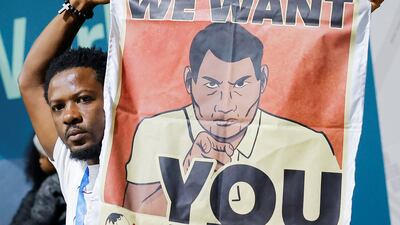
An activist holds up a sign. Reuters -
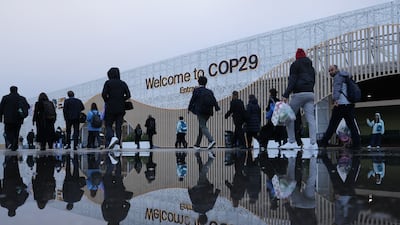
Conference participants arrive on day four. Getty Images -
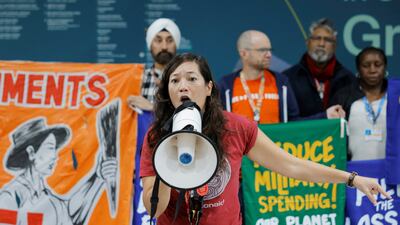
Another protest. Reuters -
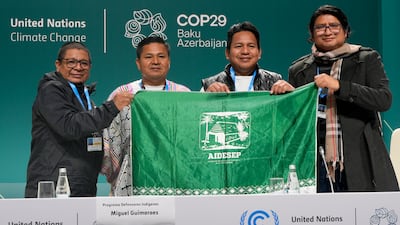
From left, Jorge Perez, Rolando Escobar, Miguel Vasquez and Esteban Cama at a session on Indigenous communities in the Peruvian Amazon. AP -
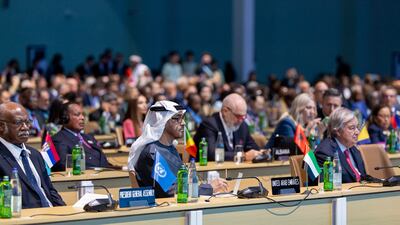
President Sheikh Mohamed attends the World Leaders Climate Action Summit at Cop29, in Azerbaijan's capital Baku. UAE Presidential Court -
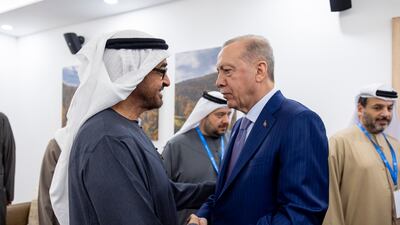
Sheikh Mohamed greets Recep Tayyip Erdogan, President of Turkey. WAM -
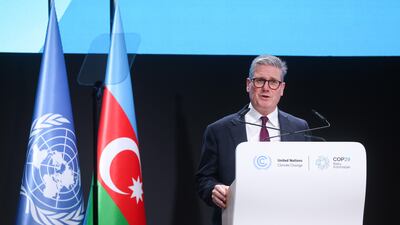
British Prime Minister Keir Starmer at Cop29. Bloomberg -

Ding Xuexiang, China's first Vice Premier, at Cop29. Bloomberg -
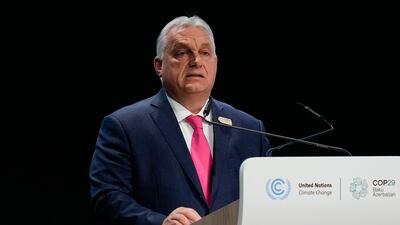
Hungary's Prime Minister Viktor Orban at a plenary session at Cop29. AP -
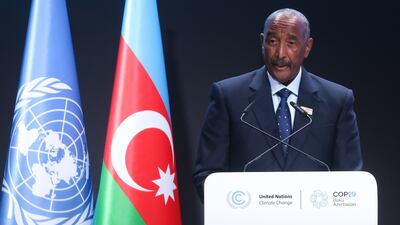
Sudan's military leader Abdel Fattah Al Burhan, at Cop29. Bloomberg -
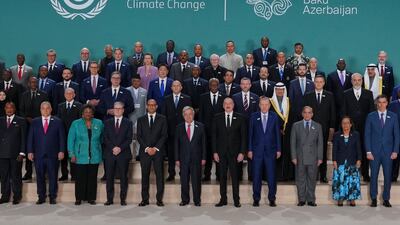
World leaders pose for a group photo at the Cop29 United Nations Climate Change Conference, in Baku, Azerbaijan. AP -
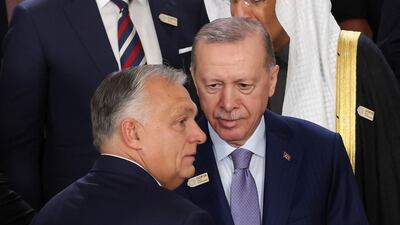
Hungarian Prime Minister Viktor Orban, left, stands next to Turkish President Recep Tayyip Erdogan. Reuters -
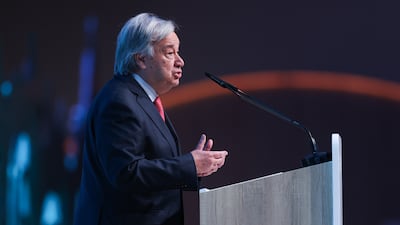
Antonio Guterres, UN secretary-general, addresses Cop29. Bloomberg -
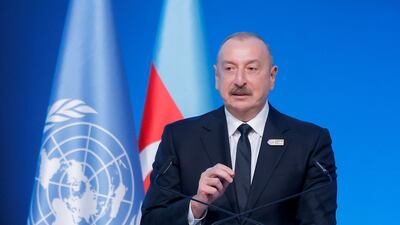
Azerbaijan's President Ilham Aliyev speaks during the Cop29 opening ceremony. Reuters -
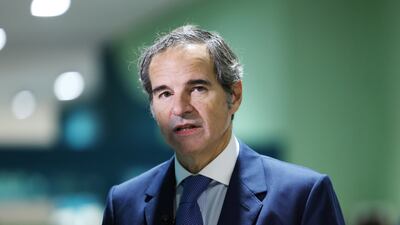
Rafael Grossi, director general of International Atomic Energy Agency (IAEA), at Cop29. Bloomberg -

Activists demonstrate for climate justice and a ceasefire in the Israel-Hamas war in Gaza, on day one of Cop29. AP -
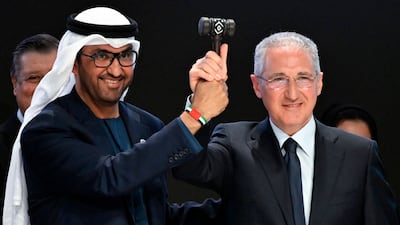
Cop28 President Dr Sultan Al Jaber and Cop29 President Mukhtar Babayev at the official handover. AFP -
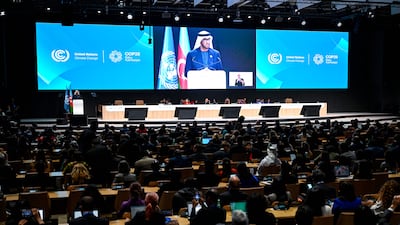
Dr Al Jaber, Minister of Industry and Advanced Technology, delivers a speech during the opening of Cop29 in Baku. AFP -
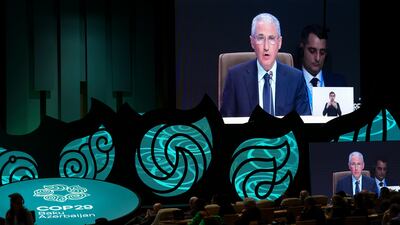
Mr Babayev speaks during the opening plenary session. AP -
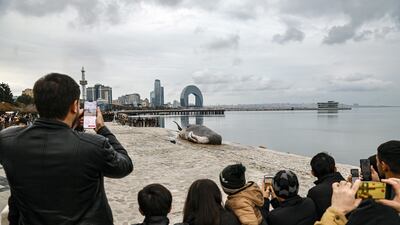
An installation depicting a beached whale by the Belgian art collective Captain Boomer on an embankment in Baku. EPA -

The Turkey Solidarity Centre pavilion. Bloomberg -
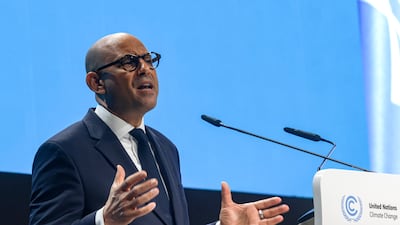
Simon Stiell, executive secretary of the UN Framework Convention on Climate Change, speaks during the opening ceremony. EPA -
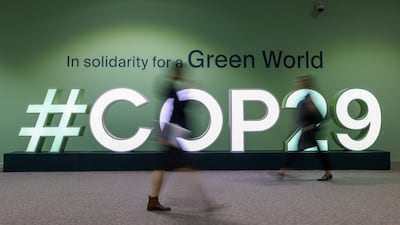
People begin arriving for the start of Cop29 in Baku. Bloomberg -
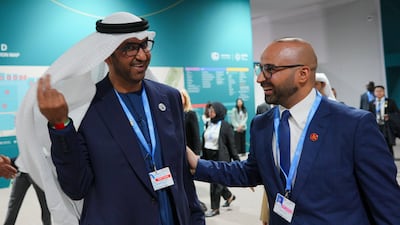
Dr Al Jaber at Cop29 with Moroccan climate researcher Cherif El Khalil. AP -

A mosaic adorns a wall at the Cop29 venue, Baku Stadium, in the capital of Azerbaijan. Bloomberg -

A woman tries out a VR headset at the tourism booth as the Cop29 UN climate summit gets under way in Baku, Azerbaijan. AP


Ministers were convened on Thursday for what the hosts called a qurultay, a word for a traditional meeting in Azerbaijan, but it appeared to make little progress as delegates panned an earlier draft text that made clear the gap between the rich and developing world's proposals.
The WWF's Shirley Matheson said leaving Baku without a finance deal could make the job at Cop30 in Brazil next year harder. Ms Matheson said a “flood” of national climate action plans – known as Nationally Determined Contributions – are to come next year and any agreement in Baku would help shape them.
“A lot of the parties here are looking for the right signals and the confidence that they can submit real action which will close the ambition gap … and that will be backed by finance,” Ms Matheson, a global NDC enhancement co-ordinator at the fund, told reporters on Friday.
“I think the risk is if we are deciding to have this discussion again in Brazil, the dynamics will change,” Ms Matheson said, highlighting "trust" issues. “It's really, really important that they do come out with a decision this time.”

