

Deaths caused by heat could triple in Europe by 2100 under current climate policies, according to a study published in The Lancet Public Health journal.
Researchers say their findings highlight the need to strengthen policies to limit global warming to protect vulnerable regions and members of society from the effects of higher temperatures.
In recent years, Europe has experienced some of its hottest summers, which have coincided with high mortality rates.
London heatwaves – in pictures
-

The sun rises above the London skyline. Reuters -

London has experienced 116 days over 30°C in the past three decades – more than half of which, 59, occurred in the last 10 years. AP -

Extreme temperatures have become more frequent too, with seven days above 35°C in the past three decades, five of which occurred in the last five years. AP -

Since 2017, every year except 2021 has seen the temperature rise above 30C in London for three or more consecutive days each summer. AP -

It will take a range of strategies to adapt Britain’s capital to the growing heat. Bloomberg -

The Tube can be exceptionally uncomfortable during heatwaves in London. PA -

Experts have said technological interventions, such as better building insulation are required. Bloomberg -

A person holds a thermometer at Oxford Road station of the London underground in 2022. PA -

Many Londoners take to city fountains to cool off in the summer. Reuters -

A member of the Queen's Guard receives water to drink during a heatwave in July 2022. Reuters -

A study looked at how climate change is affecting the world’s most populous capital cities – using airport data for consistency across cities, including City Airport in London. Reuters -

Summers have been getting warmed in London. City office workers stretch out over the grass during a hot summer lunchtime in Trinity Square in the City of London, July 1993, in London. Getty Images -

Researchers called for urgent action to prepare the capital for more days of extreme heat. Getty Images -

Temperatures exceeding 30°C are increasingly being recorded in London, analysis shows. Getty Images -

There have been calls for London to adapt to its new reality. Getty Images -

Smoke from fires in a residential area in Wennington, England. Getty Images -
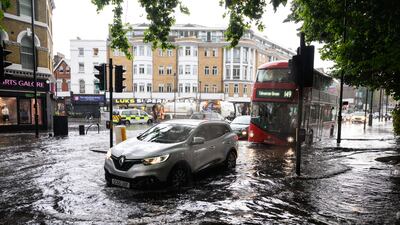
London has also suffered from flooding and other extreme weather. Getty Images -

Experts have called for more tree cover and extending green space to combat the urban heat island effect, where cities are hotter because of their built-up nature. EPA -

People take shelter in the entrance to an underground station, as torrential rain and thunderstorms hit London in 2022 Getty Images


Elderly people are at heightened risk of death from extreme temperatures, and the number of people reaching old age is projected to increase over time.
Overall, with 3°C global warming – an upper estimate based on current climate policies – the number of heat-related deaths in Europe could increase from 43,729 to 128,809 by the end of the century.
In the same scenario, deaths attributed to cold – currently much higher than from heat – would remain high with a slight decrease from 363,809 to 333,703 by 2100.
“Our analysis reveals that the ratio of cold-heat deaths will shift dramatically over the course of this century, with those attributed to heat increasing in all parts of Europe and surging in some areas,” said Dr Juan-Carlos Ciscar, of the Joint Research Centre at the European Commission.
“At the same time, cold-related deaths will decline slightly overall.
“Our study looks at more than 1,000 regions across 30 countries, enabling the identification of hotspots where people will be worst affected in the future.”
The authors of the new study used data on 1,368 regions in 30 European countries to model present disparities in deaths from hot and cold temperatures and estimate how risks could change by 2100.
Findings from the study estimate that hot and cold temperatures currently lead to 407,538 deaths across Europe each year, with 363,809 related to cold and 43,729 to heat.
Deaths from cold are currently highest in eastern Europe and the Baltic states and lowest in central and parts of southern Europe.
The lowest rates of heat-related deaths are in the UK and Scandinavian countries and highest in Croatia and the southernmost parts of the continent.
With 3°C warming, temperature-related deaths are projected to rise by 13.5 per cent, leading to 55,000 more deaths each year, driven by an increase in deaths from heat.
Most deaths will be among people aged over 85 years.
By 2100, cold-related deaths under a scenario of 3°C warming, are projected to have negligible decreases on average across Europe.
There is predicted to be moderate reductions in cold-related deaths in Eastern Europe and slight falls in parts of Germany, France, Italy and Portugal.
Cold-related deaths are estimated to increase in Ireland (where they will almost double), Norway and Sweden, all of which are predicted to see large increases in citizens aged 85 years and older.
Heat-related deaths are estimated to increase across all regions of Europe under 3°C warming, with mortality rates rising.
Hotspots that will be particularly affected by greater warming and increasingly elderly populations include Spain, Italy, Greece and parts of France.
“We find that deaths in Europe from hot and cold temperatures will rise substantially as many more heat-related deaths are expected to occur as the climate warms and populations age, while deaths from cold decline only slightly in comparison,” said Dr David García-León, also of the Joint Research Centre at the European Commission.
“Our study also identifies hotspots where the risk of death from high temperatures is set to drastically increase over the next decade.
“There is a critical need for the development of more targeted policies to protect these areas and members of society most at risk from temperature extremes.”

