



Sea temperatures reached record levels this week in the latest indication of the large-scale impact of climate change.
The Copernicus Climate Change Service, EU's Earth observation programme, said that average global sea surface temperatures reached 20.96°C – well above normal for this time of year.
It comes shortly after Copernicus and others said that July was set to be the hottest month on record in terms of air temperature.
Here we look at the effects of ocean warming on everything from sea-level rises to coral reef bleaching.
What is happening with ocean temperatures?
Although only 0.01 °C above the previous record set in March 2016, the increase is particularly concerning because it has been set in the month of August.
Ocean temperatures typically peak around March, as was the case in 2016, which makes this week’s high especially anomalous.
There have been marine heatwaves across the globe recently, including off Florida, where sea surface temperatures reportedly climbed as high as 38.4°C in July. The Mediterranean has also seen temperature records broken.
NYU Abu Dhabi
“We are seeing that there are marine heatwaves going on around the world,” said Bob Ward, of the Grantham Research Institute on Climate Change and the Environment, part of the London School of Economics.
“There are areas where the temperatures are several degrees higher than normal.”
One factor pushing up sea temperatures is that the world’s climate has entered an El Nino phase, when temperatures tend to be higher than in the opposite La Nina system, which involves cold waters being brought up from the depths of the Pacific.
However, this is not considered sufficient to account for the record temperatures. Heat from deep in the oceans could be coming up to the surface, leading to temperatures that are much higher than normal, scientists have suggested.
What effects does ocean warming have?
Water covers more than 70 per cent of the Earth’s surface and, according to figures published by Nasa, oceans have absorbed 90 per cent of the warming that has resulted from human-induced climate change.
As well as absorbing heat, the oceans also take in carbon dioxide, the main greenhouse gas, and so act as a brake on climate change.
UN figures indicate that oceans have absorbed about a quarter of all CO2 emissions, but warmer water cannot hold as much, which could cause temperature increases to accelerate.
“The functioning of the oceans is critically important to how the planet warms, as is the absorption of carbon into the oceans,” said Asher Minns, executive director of the Tyndall Centre for Climate Change Research at the University of East Anglia in the UK.
Heatwaves around the world – in pictures
-
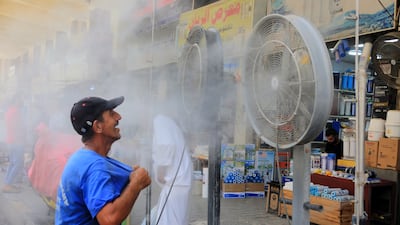
An Iraqi man cool himself off in a spray of water during a sweltering hot day at the Al-Khilani square in central Baghdad, Iraq. EPA -

Children play on water jets at a public square on a very hot afternoon in Madrid, Spain. Getty Images -

A costumed spiderman drinks during a heat wave in New York. Bloomberg -

A pedestrian carries an umbrella during a heat wave in Miami, Florida, US. Bloomberg -

A Palestinian, Mustafa Abdou, repairs fan in his shop amid a heatwave at Shati refugee camp in Gaza City. Reuters -

A man dives into a canal during a hot day in Larkana district of Sind province. AFP -

A man cools himself with a fan while browsing his phone on a sweltering day in Beijing. AP -

People drink coconut water at a market in Dubai to cope with the hot weather. AFP -
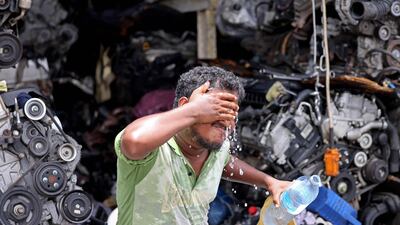
A worker washes his face to cope with the hot weather in Dubai. AFP -

An Egyptian girl cools off in the water amid a heatwave, at a Red Sea resort in Hurghada Egypt. Reuters -

Pedestrians hold umbrellas for protection from the sun during a heat wave in New York, US. Bloomberg -

A homeless person holds an umbrella to block out the sun on a hot day in New York City. AFP -

Bottles of water being delivered on a hot summer day in Istanbul. AP -

Diving into the Treska river near Skopje, as temperatures in North Macedonia soared. AFP -

A woman takes a photograph of the Acropolis in Athens in high temperatures. AFP -

A woman shelters from the sun during a heatwave in Rome. Reuters -

Shelia Nunez, 40, cools her dog with ice while sitting under a shaded bus stop in Phoenix, Arizona. AFP -

A lion eats an icy treat containing meat and ostrich eggs to cool down during a regional heatwave at the Safari Zoological Centre in Ramat Gan, Israel. Reuters -

Children play in a water fountain near the walls of Jerusalem's Old City. Reuters -
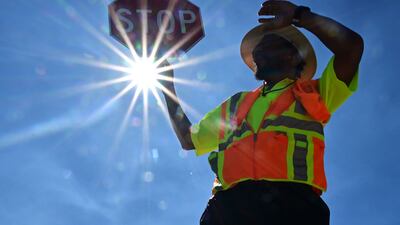
Traffic warden Rai Rogers works on his street corner under the hot sun in Las Vegas. AFP -

A woman uses a fan amid an alert for a heatwave in Shanghai. Reuters -

Andrea Washington pours water on herself in the Hungry Hill neighbourhood of Austin, Texas. Getty -

A busy beach in Rabat, Morocco. EPA -

A person receives medical attention after collapsing in a shop in Phoenix, Arizona, in high heat. AFP -

An Iraqi dives into the Tigris to beat the heat in Baghdad. AP -

Youths play in a fountain at a park in the Syrian capital Damascus, as temperatures exceed 35°C. AFP


Rising temperatures also cause oceans to expand, leading to sea-level increases, threatening coastal and island communities. The expansion of water has caused about one third of the sea level rises since 2004, according to Nasa data.
There are other factors linked to the warming of oceans that are causing sea levels to rise.
“It helps to erode and starts to melt the ice shelves around the big land ice sheets in Greenland and Antarctica. The ice sheets, they’re what flow into oceans, leading to more sea level rises,” Mr Ward said.
Warmer waters in the polar regions help to melt sea ice. Mr Ward said the water off of Antarctica is currently abnormally warm, causing sea-ice levels in the region to decline.
Sea ice reflects between 50 per cent and 70 per cent of the sun’s energy, according to the National Snow and Ice Data Centre at the University of Colorado Boulder in the US, while the darker ocean reflects only 6 per cent. As a result, the loss of sea ice contributes to the warming of the climate.
Another effect of warming seas is that higher sea surface temperatures in hotter parts of the world can result in more tropical cyclones.
How are organisms affected by rising sea temperatures?
The current change in marine temperatures “is unlike anything we have seen in the past”, according to John Burt, an associate professor of biology at New York University Abu Dhabi. He added that this has created “unprecedented times” for marine organisms.
“Marine heatwaves are expected to increase in both frequency and severity, with resultant impacts to more vulnerable ecosystems and organisms in the coming two decades,” he said.

Some marine life is moving towards the poles, said Mr Ward, but not all organisms are moving together.
“That causes disruption to the ecosystem,” he said. “For instance, some fish are finding their foodstuff is less common because it’s moved away.”
Dr Burt studies coral reefs and he said that these “are considered the ecosystem most susceptible to current climate change”.
Coral lives in symbiosis with single-celled algae, called zooxanthellae, which Dr Burt said provides more than 90 per cent of its energy. During heatwaves, the coral expels the zooxanthellae and turns white, a process called bleaching.
“If the bleaching event lasts more than a few days to a week, colonies will typically start to die off,” Dr Burt said.
“Sadly, the UAE experienced several extreme bleaching events in recent years – 2017 and 2021 – and we have lost over 75 per cent of corals from many reefs across the UAE.
“My team also noted bleaching beginning last week, and it is now in full effect in Abu Dhabi waters, raising the spectre of another possible mass die off.”
Bleaching, even if not fatal, may increase disease among coral and lower reproductive output, making it harder for it to recover when a portion has died off.
“Obviously, a key mechanism driving all of these temperature changes is CO2, and therefore this adds even more urgency to efforts such as those being discussed at the upcoming Cop28 towards reductions in fossil fuel use,” Dr Burt said, referring to the UN climate change conference to be held in the UAE later this year.
“It's in the hands of our world's leaders to commit to meaningful CO2 reduction targets and to get our planet back in a state we'd be happy to hand over to our children.”

