


Shares in Burberry, one of the UK's leading luxury brands, are set to drop out of the FTSE 100, the index of leading companies by market capitalisation on the London Stock Exchange.
Burberry’s market capitalisation of £2.5 billion ($3.3 billion) at the close on Tuesday simply wasn't enough for the company to remain in the index. Its shares lost nearly a third of their value in just three months and 70 per cent over the past year.
Burberry, which was founded in 1856 by Thomas Burberry, is not alone in facing troubles. The global luxury market has taken a beating in recent years as the cost of living crisis tightened consumer belts in the UK, the US, Europe, and especially, in China.
In Burberry's last quarterly figures in June, sales in China dropped 21 per cent compared to a year earlier, while global revenue as a whole for the 13 weeks to the end of June was down 22 per cent at £458 million.
At the same time, Burberry warned on its profits going forward and, once again, replaced its chief executive, for the fourth time in 10 years. Joshua Schulman, the former boss at the US fashion brands Michael Kors and Coach, took over from Jonathan Akeroyd, after his turnaround plan fell short of the mark.
Burberry had attempted to move further up the luxury ladder, by making products with higher price points aimed at drawing in more affluent buyers, something luxury industry watchers call 'brand elevation'.
In the process, however, the company was accused of shedding its core customers who, while aspirational, were being hit by higher inflation and rising borrowing rates and, as such, were reining in their spending.
“It is unsurprising that aspirational shoppers are showing caution in an uncertain economic climate,” said Susannah Streeter at Hargreaves Lansdown. “The costs of refreshing the store estate have also been onerous and it will take time for Burberry’s brand elevation to reap rewards.”

Under Mr Akeroyd's tenure, the British fashion designer Daniel Lee was brought on board as part of an effort to take the brand more upmarket.
Burberry chairman Gerry Murphy said recently that while the strategy had its merits, perhaps the company “went a bit too far, too fast, with the creative transition”.
For many analysts, that was an understatement.
“The decision to take Burberry more upmarket – and price its goods accordingly – has not gone to plan and left the firm with unsold stock which it has then had to discount,” Russ Mould, investment director at AJ Bell told The National.
“That has hit profit margins, but also taken the gloss off Burberry’s credentials as a luxury brand – part of whose appeal is how such goods are beyond the reach of most people’s wallets and purses.”
Absent consumers
Success and survival in the luxury good sector has very much depended on market position over the past few years.
Aspirational buyers who had been prepared to splash their cash on lower-priced luxury items suddenly became more concerned about their spending in the face of the cost of living crisis. However, at the top end of the luxury scale, the ultra-wealthy paid little heed to such economic turmoil and could continue to afford big ticket items.
This is the reason why when Burberry was warning on its profits, Hermes, the maker of the Birkin bag, announced a 13 per cent rise in quarterly sales.
It also proves that brand elevation, the act of moving a brand and its associated products into higher and higher price brackets, is becoming increasingly difficult in a world where consumers have gripped their spending increasingly tightly.

The industry's colossus, LVMH, is a past master at this and has spent decades lifting some of its brands to iconic status. The trouble is, such heavy lifting takes time and money, as LVMH discovered with its massive investment in Tiffany and Co, which it bought four years ago for $16 billion.
Even so, as sales growth becomes a rare beast in the luxury sector, analysts like Richard Hunter, head of markets at Interactive Investor, feel investors now favour the likes of LVMH and Hermes over Burberry, given the British company's recent profit warnings “have done little to lift the mood”.
“A general slowdown in demand for luxury goods has weighed on the sector, especially from Chinese consumers, who have been conspicuous by their absence,” he told The National.
Better times ahead?
Nonetheless, the luxury goods sector is expected to be worth in the region of €1.8 trillion ($1.98 trillion) next year, with a growth rate of 6 to 8 per cent, according to the Luxonomy website.
As such, after a few years of stormy times, many luxury goods makers should see plainer sailing from next year onwards – barring any global economic shocks.

Indeed, on Tuesday the UK's biggest seller of Rolex and Omega watches, Watches of Switzerland, said it remains on track for sales to grow by up to 12 per cent to around £1.73 billion over 2024-25.
“Over the period, we have seen continued stabilisation of the UK market in both luxury watches and jewellery following a period of challenging macroeconomic conditions in the prior financial year,” the company said.
That prior financial year saw Watches of Switzerland's profit plunge by 40 per cent in the 12 months to the end of April this year.
Even so, there are a few areas of concern that will restrain the strength of any recovery in the UK's luxury goods sector, not least the ongoing issue of the so-called “tourist tax” – the continuing inability of visitors to the UK being able to reclaim VAT on their purchases. This inducement to buy was stopped in 2021.
There's some hope in the sector that the new Chancellor Rachel Reeves will reinstate tax-free shopping for international tourists in her budget at the end of October.
Research by the specialist tax refund company Global Blue showed that British businesses missed out on up to £4.3 billion in spending over the summer, because of the tourist tax.
The loss of revenue to UK luxury good retailers brought about by the tourist tax was also compounded over the summer by the relative strength of the British pound, which made products more expensive for foreign buyers.
For its part, Burberry is still worried about the immediate future, predicting wholesale revenue to decline by around 30 per cent for the full year.
But the company intends to “reconnect” with its core customer base, “capitalise on the enduring appeal of Burberry’s iconic products”, and launch a dedicated outerwear campaign in October.
With its shares at 14-year lows, Burberry is vulnerable to a takeover, not least because its distinctive camel, red and black check pattern is instantly recognisable as an enduring luxury brand, which could certainly entice any suitor looking to play the long game.
But while having its shares drop out of the FTSE 100 may be a blow to Burberry's prestige in some small way, in itself it is not a financial issue and is just “noise”, according to Mr Mould. He describes it as a reflection on what has happened, “not what may happen in the future, and it is the future that matters more now”.
-

A model posing on a rooftop and wearing a ruched-waist suit from Burberry, London, in 1921. All photos: Getty Images -

Skiing clothes modelled at Burberry, London, in 1927 -

A model with a double-breasted tweed cape and a riding hat, at Burberrys in 1966 -
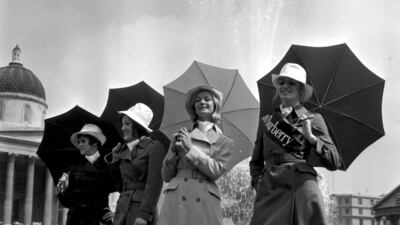
Brenda Capwell, the year's 'Miss Burberry' poses in London's Trafalgar Square with three other models in Burberry fashions, in 1970 -
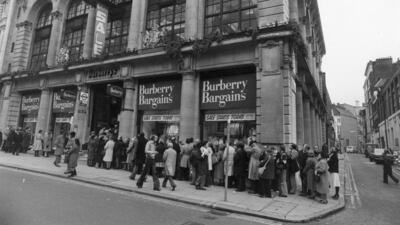
A queue waits outside London's Burberry store for the start of the January sale, in 1977 -
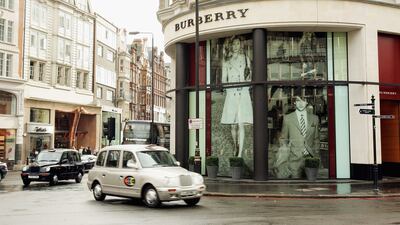
An advertisement for Burberry, featuring supermodel Kate Moss in Knightsbridge, London, in 2005 -
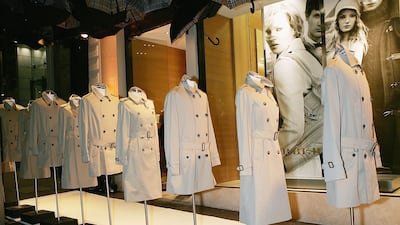
Coats on display at Sydney's first Burberry Store, in 2006 -

A Burberry store in Beijing, in 2007 -
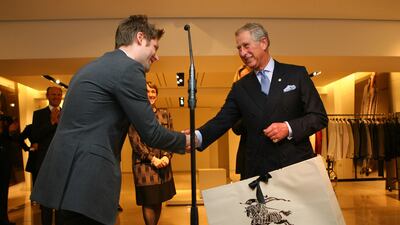
King Charles III, at the time Prince Charles, Prince of Wales, is presented with a gabardine walking jacket by Burberry's creative director Christopher Bailey at the opening of the company's global headquarters in London, in 2009 -
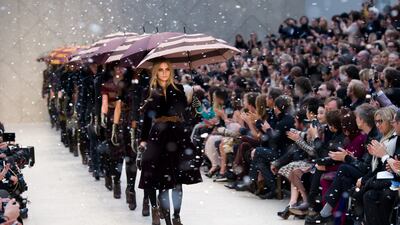
Model and actress Cara Delevingne heads Burberry's runway show at London Fashion Week, in 2012 -
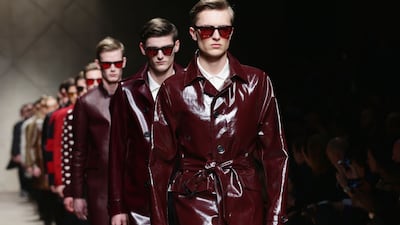
Models walk the runway during the Burberry show as part of Milan Fashion Week in, 2013 -

Models Suki Waterhouse, left, and Cara Delevingne at the Burberry brings London to Shanghai event, in 2014 -

Rock star Liam Gallagher wearing Burberry at London Fashion Week, in 2018 -
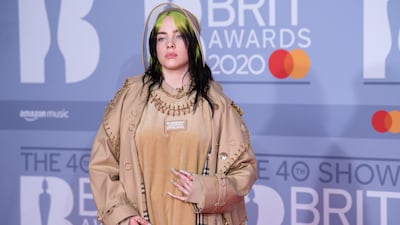
Singer-songwriter Billie Eilish wears Burberry at The BRIT Awards in London, in 2020 -
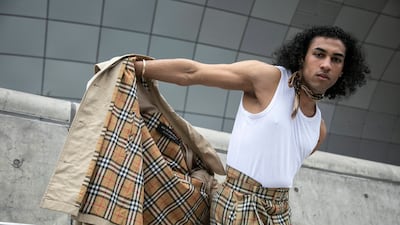
A guest wearing a Burberry trench coat and trousers at Seoul Fashion Week, in 2023 -
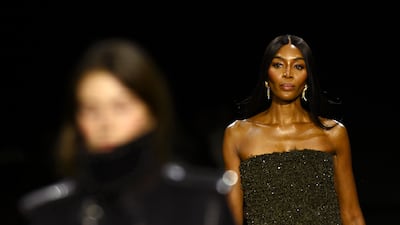
Supermodel Naomi Campbell walks the runway at the Burberry show during London Fashion Week, in 2024



