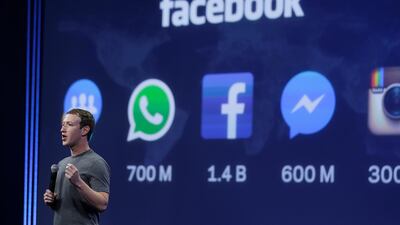
The UK’s Competition and Markets Authority called for sweeping new powers to roll back the dominance of Google and Facebook in the online advertising market, a move designed to push global regulators to be more aggressive against the tech giants.
The regulator said a new regime should have the ability to respond far more quickly to digital monopolies with powers to require structural changes, including potentially forcing Google to split its ad server operations. Its existing powers are insufficient and an entirely new approach is needed, the CMA said.
“What we have found is concerning – if the market power of these firms goes unchecked, people and businesses will lose out,” the CMA’s chief executive, Andrea Coscelli, said in a statement on Wednesday.
The proposals serve as a potential template for the US and the European Union to tackle the unassailable market power of the largest tech firms in digital-advertising markets. In Britain, Google and Facebook account for 80 per cent of all spending on digital advertising, the CMA said.
The advertising revenues that fuel profits for Google and Facebook are increasingly coming under antitrust scrutiny, often prompted by complaints from media companies as advertising spend shifts to the web. France’s competition authority has flagged the scale of Google’s ad business as a potential concern while Germany is also looking at the market.
“We support regulation that benefits people, businesses and society, and we’ll continue to work constructively with regulatory authorities and government on these important areas so that everyone can make the most of the web,” said Ronan Harris, vice president of Google’s UK arm.
The CMA, which has long been keen to challenge the power of the tech giants in the UK, has recently used its oversight of acquisitions to scrutinise the firms. But the new powers of a Digital Markets Unit would allow the regulator to go as far as demanding structural changes.
Among the more stark options under consideration was a suggestion that Facebook should separate Instagram to allow the two to better compete for users. “While we recognise that a forced separation would bring significant costs and complexity, this should be a tool available,” the CMA said.
“We face significant competition from the likes of Google, Apple, Snap, Twitter and Amazon, as well as new entrants like TikTok, which keeps us on our toes,” a representative for Facebook said in a statement.
Representatives for Amazon, which would potentially also be affected, couldn’t immediately comment.
The EU’s antitrust watchdog is also seeking new powers to police online giants, aware that years of probes into the likes of Google haven’t extracted much meaningful change, despite hefty penalties.
EU commissioner Margrethe Vestager, a regular Silicon Valley tormentor, suggested last week this could even mean breaking up companies as a “last resort” to protect competition.
Under the new UK regime, the CMA said the largest tech firms, designated as having “strategic market status”, could face an enforceable code of conduct that is eventually extended to mergers.
Operational splits that would specifically force Google to separate its advertising business into different units and maintain Chinese walls within its companies are some of the specific powers that the CMA wants.
“Each of these businesses potentially faces a conflict of interest,” the CMA said. “While we recognise that these would be highly intrusive interventions, they might also have the potential to change the nature of competition substantially.”

Play-off fixtures
Two-legged ties to be played November 9-11 and November 12-14
- Northern Ireland v Switzerland
- Croatia v Greece
- Denmark v Ireland
- Sweden v Italy
The smuggler
Eldarir had arrived at JFK in January 2020 with three suitcases, containing goods he valued at $300, when he was directed to a search area.
Officers found 41 gold artefacts among the bags, including amulets from a funerary set which prepared the deceased for the afterlife.
Also found was a cartouche of a Ptolemaic king on a relief that was originally part of a royal building or temple.
The largest single group of items found in Eldarir’s cases were 400 shabtis, or figurines.
Khouli conviction
Khouli smuggled items into the US by making false declarations to customs about the country of origin and value of the items.
According to Immigration and Customs Enforcement, he provided “false provenances which stated that [two] Egyptian antiquities were part of a collection assembled by Khouli's father in Israel in the 1960s” when in fact “Khouli acquired the Egyptian antiquities from other dealers”.
He was sentenced to one year of probation, six months of home confinement and 200 hours of community service in 2012 after admitting buying and smuggling Egyptian antiquities, including coffins, funerary boats and limestone figures.
For sale
A number of other items said to come from the collection of Ezeldeen Taha Eldarir are currently or recently for sale.
Their provenance is described in near identical terms as the British Museum shabti: bought from Salahaddin Sirmali, "authenticated and appraised" by Hossen Rashed, then imported to the US in 1948.
- An Egyptian Mummy mask dating from 700BC-30BC, is on offer for £11,807 ($15,275) online by a seller in Mexico
- A coffin lid dating back to 664BC-332BC was offered for sale by a Colorado-based art dealer, with a starting price of $65,000
- A shabti that was on sale through a Chicago-based coin dealer, dating from 1567BC-1085BC, is up for $1,950
The%20Emperor%20and%20the%20Elephant
%3Cp%3E%3Cstrong%3EAuthor%3A%20%3C%2Fstrong%3ESam%20Ottewill-Soulsby%3C%2Fp%3E%0A%3Cp%3E%3Cstrong%3EPublisher%3A%20%3C%2Fstrong%3EPrinceton%20University%20Press%3C%2Fp%3E%0A%3Cp%3E%3Cstrong%3EPages%3A%20%3C%2Fstrong%3E392%3C%2Fp%3E%0A%3Cp%3E%3Cstrong%3EAvailable%3A%20%3C%2Fstrong%3EJuly%2011%3C%2Fp%3E%0A
Classification of skills
A worker is categorised as skilled by the MOHRE based on nine levels given in the International Standard Classification of Occupations (ISCO) issued by the International Labour Organisation.
A skilled worker would be someone at a professional level (levels 1 – 5) which includes managers, professionals, technicians and associate professionals, clerical support workers, and service and sales workers.
The worker must also have an attested educational certificate higher than secondary or an equivalent certification, and earn a monthly salary of at least Dh4,000.
Milestones on the road to union
1970
October 26: Bahrain withdraws from a proposal to create a federation of nine with the seven Trucial States and Qatar.
December: Ahmed Al Suwaidi visits New York to discuss potential UN membership.
1971
March 1: Alex Douglas Hume, Conservative foreign secretary confirms that Britain will leave the Gulf and “strongly supports” the creation of a Union of Arab Emirates.
July 12: Historic meeting at which Sheikh Zayed and Sheikh Rashid make a binding agreement to create what will become the UAE.
July 18: It is announced that the UAE will be formed from six emirates, with a proposed constitution signed. RAK is not yet part of the agreement.
August 6: The fifth anniversary of Sheikh Zayed becoming Ruler of Abu Dhabi, with official celebrations deferred until later in the year.
August 15: Bahrain becomes independent.
September 3: Qatar becomes independent.
November 23-25: Meeting with Sheikh Zayed and Sheikh Rashid and senior British officials to fix December 2 as date of creation of the UAE.
November 29: At 5.30pm Iranian forces seize the Greater and Lesser Tunbs by force.
November 30: Despite a power sharing agreement, Tehran takes full control of Abu Musa.
November 31: UK officials visit all six participating Emirates to formally end the Trucial States treaties
December 2: 11am, Dubai. New Supreme Council formally elects Sheikh Zayed as President. Treaty of Friendship signed with the UK. 11.30am. Flag raising ceremony at Union House and Al Manhal Palace in Abu Dhabi witnessed by Sheikh Khalifa, then Crown Prince of Abu Dhabi.
December 6: Arab League formally admits the UAE. The first British Ambassador presents his credentials to Sheikh Zayed.
December 9: UAE joins the United Nations.
