


After its deadliest earthquake in more than 60 years, Morocco is calling on investors to inject capital into its tourism sector, with opportunities ranging from developing beach resorts to building theme parks.
The North African country is seeking to double the amount of investment in its tourism industry to $2 billion a year by 2026, Imad Barrakad, chief executive of the Moroccan Agency for Tourism Development, told The National on the sidelines of the Future Hospitality Summit in Abu Dhabi.
It currently attracts $1 billion in tourism investments each year, with 80 per cent from domestic investors and 20 per cent from abroad.
To incentivise new investors, Morocco is offering up to 30 per cent cash-back on capital expenditure (capex) on tourism projects, he said.
The goal is to attract 17.5 million tourists by 2026 and 26 million by 2030, Mr Barrakad said. That is up from 11 million visitors last year and 13 million in 2019, before the Covid-19 pandemic.
Morocco aims to create 200,000 new jobs in the tourism sector by 2026 and generate $12 billion in foreign exchange earnings, up 1.5 times from 2019 levels, he said.
The plans are part of its new 2023-2026 strategic road map to revive the country's travel and tourism industry, raising the sector's contribution to gross domestic product to 10 per cent by 2026 from 7 per cent currently.
"Morocco has a lot of tourism potential, we have a lot of opportunities in desert areas, in coastline areas, in national parks," Mr Barrakad said, adding that existing investors are focused on big cities with Unesco-listed monuments.
chief executive of the Moroccan Agency for Tourism Development
"What we are trying to do is to diversify investments into projects along the coastline. We don't have a lot of beach tourism developed enough, so what we're trying to sell is the opportunity for resorts in these areas."
Morocco is also seeking investments in leisure attractions to draw more visitors from around the world and expand its portfolio of 300,000 hotel beds, he added.
"People who are coming to invest in Morocco will find competitive infrastructure, profitability and opportunity," he said.
"But our main competitive advantage is our hospitality, like all Arab and Islamic countries, to all people coming to our country."

Earthquake impact on tourism
Morocco is in the midst of grappling with the damage and debris after a 6.8-magnitude earthquake struck 70 kilometres south-west of the tourist city of Marrakesh on September 8.
The epicentre was in the Atlas Mountains, an area home to many isolated villages with no road access, which is where the most devastating damage took place.
The Atlas Mountains are also a popular tourist destination.
Asked about the impact on hotels and the number of visitors, Mr Barrakad said: "The earthquake impacted rural areas, about 100 kilometres from Marrakesh ... things are coming back now to normal and we're planning to build what has been destroyed by this earthquake."
-
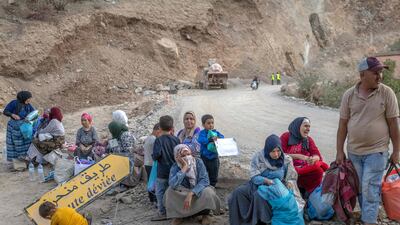
People displaced by the earthquake sit with their belongings by the side of the road between Marrakesh and Taroudant in the Atlas mountains. AFP -
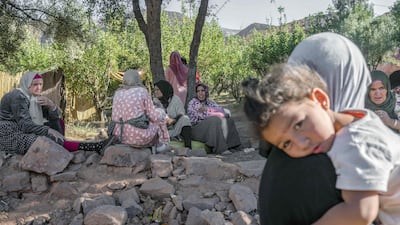
A makeshift camp is set up in the open. AFP -
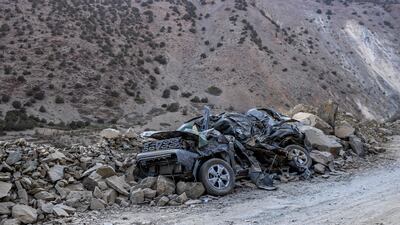
A car is crushed by rubble in the aftermath of the earthquake. AFP -
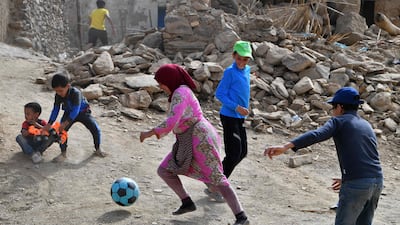
Children play football beside the rubble of collapsed homes in the village of Afella Igir in the Amizmiz region of Morocco. AFP -
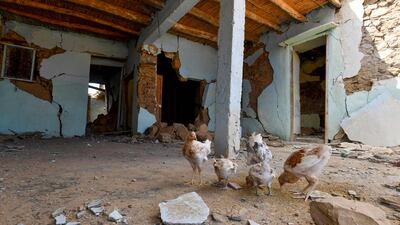
Chickens peck for food at an abandoned home in Afella Igir. AFP -

Not much sign of life in Afella Igir. AFP -

The Moroccan Army on hand in the village of Talat N'Yaaqoub, south of Marrakesh, as the search for victims goes on. EPA -
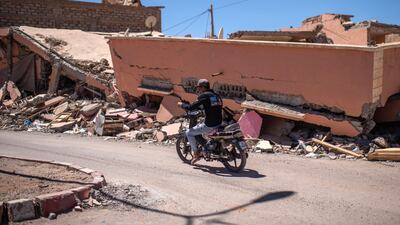
Ruins in the earthquake-hit village of Talat N'Yaaqoub. EPA -
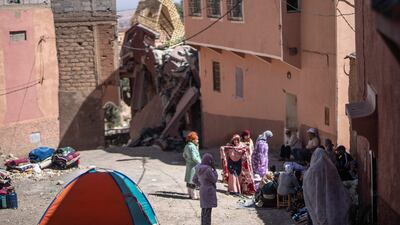
Tents have become homes for people in Moulay Brahim village, whose lives have been turned upside-down by the earthquake. AP -
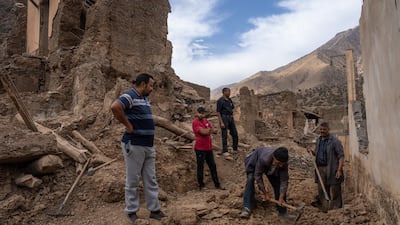
Men clear the rubble of houses that collapsed in Imgdal. Getty Images -
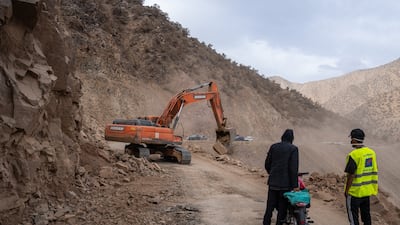
A digger clears a mountain road in Talat N'Yaaqoub. Getty Images -

A badly damaged building leans over in Talat N'Yaaqoub. Getty Images -
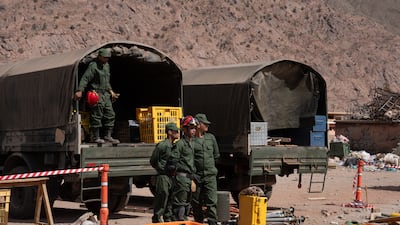
Lorries carrying aid and equipment to be used by rescuers in Talat N'Yaaqoub. Getty Images -
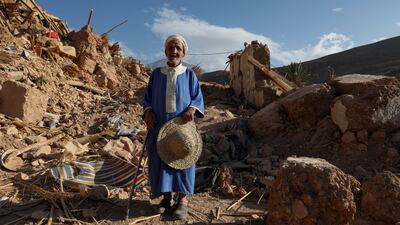
An elderly man is surrounded by rubble in Tikht village, Morocco, days after the quake struck. Reuters -
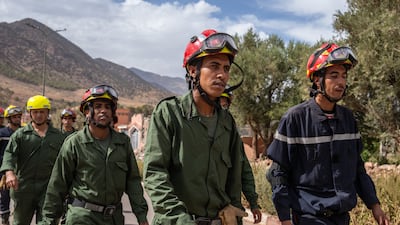
Rescue workers in Talat N'Yaaqoub prepare to search for survivors. Getty Images -
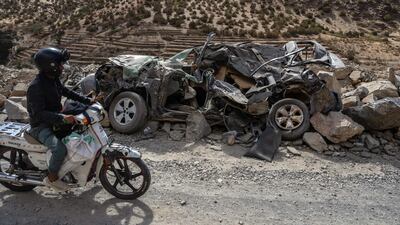
Another crushed car on a mountain road in Talat N'Yaaqoub. Getty Images -
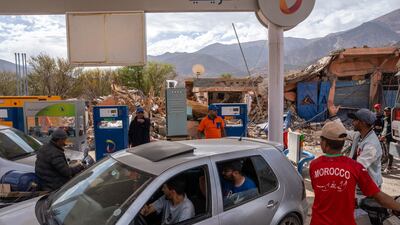
Motorists queue for fuel at one of the few filling stations still open in Talat N'Yaaqoub. Getty Images -
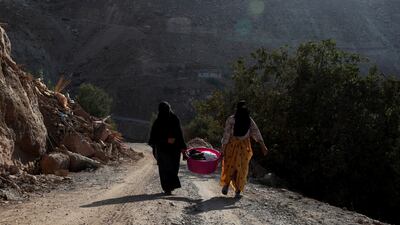
Carrying belongings outside the village of Tikht. Reuters -
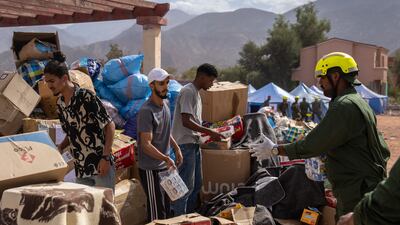
Aid workers distribute relief supplies in Talat N'Yaaqoub. Getty Images -
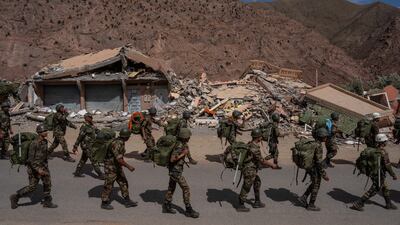
Moroccan troops prepare to embark on relief missions in the mountains near Talat N'Yaaqoub. Getty Images -
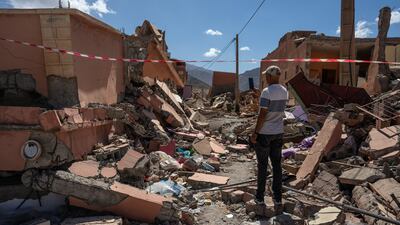
A man films the ruins of collapsed buildings in Talat N'Yaaqoub. Getty Images


Morocco plans to spend $11.7 billion in a post-earthquake reconstruction programme over the next five years, the Royal Palace said on September 20.
While there are postponed reservations to Marrakesh, tourists are still coming to Morocco, Mr Barrakad said.
"We are still working to improve tourism," he said.
"We hope that the tourism investment will be there at the right moment to help people because a lot of people's livelihoods depend on tourism."
Wooing GCC investors
From a GCC perspective, Morocco is wooing all investors, from family offices to sovereign wealth funds, with discussions ongoing, Mr Barrakad said.
"They're all welcome," he said.
"There is high interest but at the end of the day people doing business are looking at the country risk and the risk of this kind of investment."
In June, the UAE said a high-level delegation, led by Abdulla bin Touq, Minister of Economy, will visit Morocco to discuss boosting bilateral co-operation, investment flows and economic partnerships.
The sectors in focus include tourism and infrastructure, energy and renewable energy, industry, trade and mining, information and communications technology, food security, transport and logistics, agricultural technology, entrepreneurship and others that will support the future economy.
Non-oil foreign trade between the two countries amounted to Dh3.6 billion ($980 million) in 2022, up 16 per cent from 2021, according to official data.
While the main focus is on Gulf investors, Morocco is also talking to investors in Asia and Africa to attract capital flows into its tourism sector, Mr Barrakad said.
"The main message is this: If you're investing in Morocco, you're investing in stability, in a country that is in the middle of the world's crossroads," he said.
Marrakesh is set to host the International Monetary Fund and World Bank's annual meetings on October 9.
"It's an amazing moment and Marrakesh will make the Arab world proud," Mr Barrakad said.

