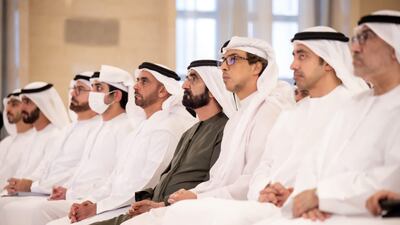
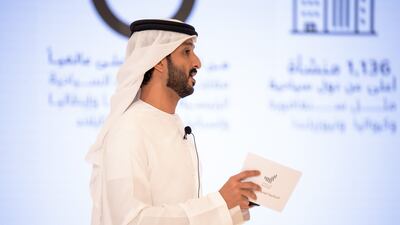
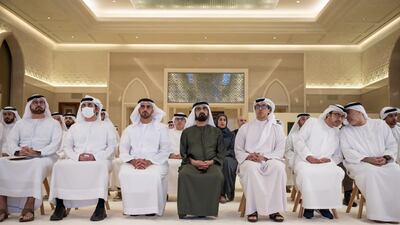
Abdulla bin Touq, the UAE's Minister of Economy, talks to Stephen Sackur, presenter at HARD Talk, at the Future Hospitality Summit in Abu Dhabi. Khushnum Bhandari / The National

Single visa for GCC states would simplify regional travel, UAE Minister of Economy says


Sunil Singh
  • English
  • Arabic

GCC countries are planning a single visa system that would simplify travel within the region and boost tourism across the Gulf states, the UAE’s Minister of Economy said on Tuesday.

“I think that [a single GCC visa] is something which has been on the table. It's been complementing all the GCC strategies on tourism,” Abdulla bin Touq said during the Future Hospitality Summit in Abu Dhabi.

“Hopefully, we are going to see something around a pan-GCC visa, which will allow easier mobility of people within the GCC. A resident of Saudi [Arabia], for instance, can enter the UAE and vice versa. I think that's where we see the future of GCC tourism.

“The UAE has built an infrastructure to really accommodate all these types of tourism over the years.”

The Emirates' tourism infrastructure ensures the development of all stakeholders in the industry, which includes the food and beverage sector, extreme sports and culture tourism, among others, the minister added.

The development and expansion of the tourism sector is a major aim of the Middle Eastern nations, especially the six-member economic bloc of the GCC, that are looking to diversify their economies away from oil.

The Middle East's tourism sector has recorded the strongest post-pandemic rebound in the world, despite persistent global economic headwinds, according to HSBC.

Abdulla bin Touq, Minister of Economy, said a pan-GCC visa could be the future of tourism in the region. Khushnum Bhandari / The National

The region, home to the biggest two Arab economies, Saudi Arabia and the global leisure and commercial hub of the UAE, is unique in recording a “total recovery” in terms of tourist arrivals in the first quarter of 2023, the bank said in its Jet, set, go! research report last month.

Mr bin Touq emphasised that the infrastructure of the tourism and hospitality sector in UAE has been planned for the last four decades, and was not something done overnight.

“It’s always been in organic growth,” he said.

The Covid-19 pandemic posed a challenge for the Emirates’ tourism industry, but it also provided an “opportunity” to review the strategy and plan the way forward, Mr bin Touq said.

Last year's launch of the UAE Tourism Strategy 2031 was a significant step to bolster the tourism strategy. It aims to increase the sector's contribution to Dh450 billion ($122.5 billion) of the UAE’s gross domestic product by 2031, he added.

  • Sheikh Mohammed bin Rashid, Prime Minister and Ruler of Dubai, said that the UAE had adopted a new national tourism strategy. All photos: Twitter / HHShkMohd
    Sheikh Mohammed bin Rashid, Prime Minister and Ruler of Dubai, said that the UAE had adopted a new national tourism strategy. All photos: Twitter / HHShkMohd
  • The national tourism strategy plans to welcome 40 million hotel guests by 2031.
    The national tourism strategy plans to welcome 40 million hotel guests by 2031.
  • The strategy, launched in front of Cabinet ministers and senior officials, plans to attract Dh100 billion in additional tourism investment to the UAE.
    The strategy, launched in front of Cabinet ministers and senior officials, plans to attract Dh100 billion in additional tourism investment to the UAE.
  • The UAE is among the top 10 tourist destinations in the world and a goal of the strategy is to accelerate its competitiveness, Sheikh Mohammed said.
    The UAE is among the top 10 tourist destinations in the world and a goal of the strategy is to accelerate its competitiveness, Sheikh Mohammed said.
  • The new strategy is aimed at increasing the tourism sector's contribution to gross domestic product (GDP) to Dh450 billion by 2031.
    The new strategy is aimed at increasing the tourism sector's contribution to gross domestic product (GDP) to Dh450 billion by 2031.

Mr bin Touq highlighted the rapid growth of tourism projects around the UAE and specifically in Saudi Arabia, which has launched megaprojects, and said they would be beneficial for the whole GCC region.

Growing competition in the tourism sector will play a key role in accelerating the UAE’s GDP growth to 7 per cent by the end of the decade and double the size of its economy, Mr bin Touq said.

“I think competition … actually makes people innovate,” he said. “That's something which is very healthy and important to have in the region.”

Saudi Arabia is pouring in billions of dollars to develop its tourism offering as it targets 100 million visitors a year by 2030.

In July, the kingdom’s sovereign wealth fund, the Public Investment Fund, set up Saudi Tourism Investment Company, or Asfar, to support the growth of the sector.

This year, the PIF-owned AlUla Development Company launched operations with the aim of turning the city into a global tourism destination.

Saudi Entertainment Ventures (Seven), a wholly owned unit of the PIF, said in November that it planned to invest 50 billion Saudi riyals ($13.3 billion) to develop 21 integrated entertainment destinations in 14 cities in the kingdom.

The UAE is also investing heavily to expand its tourism sector.

In May, Sheikh Mohammed bin Rashid, Vice President and Ruler of Dubai, said tourist spending in the country rose 70 per cent to Dh121 billion ($33 billion) last year, the highest in the region.

The travel and tourism sector is projected to contribute Dh180.6 billion to the UAE’s economy this year, representing nearly 10 per cent of the total, the World Travel and Tourism Council said in May.

“The sector is recovering at a rapid pace, proving the UAE continues to grow in popularity among international travellers,” Julia Simpson, WTTC president and chief executive said at the time.

Abu Dhabi is “on track” to meet its target of attracting 24 million visitors this year, up from 18 million last year, Saood Al Hosani, undersecretary of the emirate's Department of Culture and Tourism, told The National in June.

Neighbouring Dubai, which received 4.7 million tourists in the first quarter of this year, aims to exceed the pre-pandemic annual number of international visitors this year, Issam Kazim, chief executive of the Dubai Department of Tourism and Commerce Marketing, told The National in May.


Racecard

6pm: The Pointe - Conditions (TB) Dh82,500 (Turf) 1,400m

6.35pm: Palm West Beach - Maiden (TB) Dh82,500 (T) 1,800m

7.10pm: The View at the Palm - Handicap (TB) Dh85,000 (Dirt) 1,400m

7.45pm: Nakeel Graduate Stakes - Conditions (TB) Dh100,000 (T) 1,600m

8.20pm: Club Vista Mare - Handicap (TB) Dh95,000 (D) 1,900m

8.55pm: The Palm Fountain - Handicap (TB) Dh95,000 (D) 1,200m

9.30pm: The Palm Tower - Handicap (TB) Dh87,500 (T) 1,600m

Squad for first two ODIs

Kohli (c), Rohit, Dhawan, Rayudu, Pandey, Dhoni (wk), Pant, Jadeja, Chahal, Kuldeep, Khaleel, Shami, Thakur, Rahul.

How to watch Ireland v Pakistan in UAE

When: The one-off Test starts on Friday, May 11
What time: Each day’s play is scheduled to start at 2pm UAE time.
TV: The match will be broadcast on OSN Sports Cricket HD. Subscribers to the channel can also stream the action live on OSN Play.

The End of Loneliness
Benedict Wells
Translated from the German by Charlotte Collins
Sceptre

Ten tax points to be aware of in 2026

1. Domestic VAT refund amendments: request your refund within five years

If a business does not apply for the refund on time, they lose their credit.

2. E-invoicing in the UAE

Businesses should continue preparing for the implementation of e-invoicing in the UAE, with 2026 a preparation and transition period ahead of phased mandatory adoption. 

3. More tax audits

Tax authorities are increasingly using data already available across multiple filings to identify audit risks. 

4. More beneficial VAT and excise tax penalty regime

Tax disputes are expected to become more frequent and more structured, with clearer administrative objection and appeal processes. The UAE has adopted a new penalty regime for VAT and excise disputes, which now mirrors the penalty regime for corporate tax.

5. Greater emphasis on statutory audit

There is a greater need for the accuracy of financial statements. The International Financial Reporting Standards standards need to be strictly adhered to and, as a result, the quality of the audits will need to increase.

6. Further transfer pricing enforcement

Transfer pricing enforcement, which refers to the practice of establishing prices for internal transactions between related entities, is expected to broaden in scope. The UAE will shortly open the possibility to negotiate advance pricing agreements, or essentially rulings for transfer pricing purposes. 

7. Limited time periods for audits

Recent amendments also introduce a default five-year limitation period for tax audits and assessments, subject to specific statutory exceptions. While the standard audit and assessment period is five years, this may be extended to up to 15 years in cases involving fraud or tax evasion. 

8. Pillar 2 implementation 

Many multinational groups will begin to feel the practical effect of the Domestic Minimum Top-Up Tax (DMTT), the UAE's implementation of the OECD’s global minimum tax under Pillar 2. While the rules apply for financial years starting on or after January 1, 2025, it is 2026 that marks the transition to an operational phase.

9. Reduced compliance obligations for imported goods and services

Businesses that apply the reverse-charge mechanism for VAT purposes in the UAE may benefit from reduced compliance obligations. 

10. Substance and CbC reporting focus

Tax authorities are expected to continue strengthening the enforcement of economic substance and Country-by-Country (CbC) reporting frameworks. In the UAE, these regimes are increasingly being used as risk-assessment tools, providing tax authorities with a comprehensive view of multinational groups’ global footprints and enabling them to assess whether profits are aligned with real economic activity. 

Contributed by Thomas Vanhee and Hend Rashwan, Aurifer

Updated: September 26, 2023, 12:54 PM