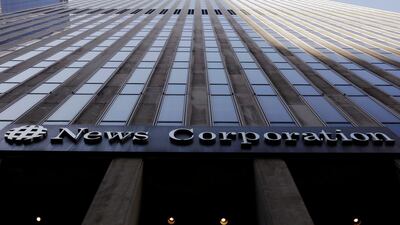
News Corporation's headquarters in midtown Manhattan in New York. The company's content sharing deal with Google comes after years of public disputes between News Corp founder Rupert Murdoch and the Californian tech giant. Reuters
News Corporation's headquarters in midtown Manhattan in New York. The company's content sharing deal with Google comes after years of public disputes between News Corp founder Rupert Murdoch and the C

Rupert Murdoch's News Corp signs media deal with Google


  • English
  • Arabic

News Corporation struck a global news deal with Alphabet's Google, the Rupert Murdoch-controlled media company said on Wednesday, in one of the most extensive deals of its kind with big tech.

The companies will develop a subscription platform, share advertising revenue through Google's ad technology services, build out audio journalism and develop video journalism by YouTube.

The deal comes after years of public feuding between Murdoch and Google, most recently in Australia, where Google has threatened to shut down its search engine to avoid "unworkable" content laws.

It is a capstone for the 89-year-old media mogul, his son Lachlan and News Corp chief executive Robert Thomson to seek compensation for premium content from platforms. Mr Murdoch previously secured payments from Apple and Facebook for their Apple News and Facebook News products.

The company declined to comment on financial details of the deal, which it said involved "significant payments" by Google.

In Australia, the country's two largest free-to-air television broadcasters have struck deals with Google collectively worth A$60 million ($47m) a year, according to media reports.

The Australian deals come days before the government plans to pass laws that would allow it to appoint an arbitrator to set Google's content fees if it cannot strike a deal privately, a factor that government and media figures held up as a turning point for negotiations which stalled a year earlier.

News Corp owns two-thirds of Australia's major city newspapers.

Microsoft, a big beneficiary of Google leaving the Australian market, has publicly endorsed the proposed Australian law and recently urged the US government to copy it.

The company's deal with Google also comes after the tech giant agreed to pay $76m over three years to a group of 121 French news publishers to end a more than year-long copyright spat, documents seen by Reuters show.

Google has also moved to secure deals with major publishers in the UK, Germany, Brazil and Argentina.

“The fact that Google was only brought to the table kicking and screaming due to significant antitrust reports and leading policymakers in Europe and Australia defending the importance of a strong, independent press for society only underscores the importance of Parliament’s new law and markets like the US waking up to their harms to democracy,” said Jason Kint, chief executive of media industry trade association Digital Content Next.

The impact of News Corp's deal with Google on the news publishing environment remains a big question.

In the United States, where smaller publishers in particular have lost ad revenue to the platforms, the news media trade group News Media Alliance is planning to reintroduce to Congress a bill that would allow publishers to collectively negotiate with Facebook and Google without violating antitrust laws.

“The big national publishers already have some leverage,” said David Chavern, president and chief executive of News Media Alliance, the news industry's largest trade organisation.

“How can a smaller publisher get a deal? Really only if there’s some collective action or system – otherwise you’re left with platforms getting to pick winners and losers,” Mr Chavern said.

In January, the Reuters news agency, a division of Thomson Reuters, struck a deal with Google to be the first global news provider for Google's News Showcase.


Everton%20Fixtures
%3Cp%3EApril%2015%20-%20Chelsea%20(A)%3Cbr%3EApril%2021%20-%20N.%20Forest%20(H)%3Cbr%3EApril%2024%20-%20Liverpool%20(H)%3Cbr%3EApril%2027%20-%20Brentford%20(H)%3Cbr%3EMay%203%20-%20Luton%20Town%20(A)%3Cbr%3EMay%2011%20-%20Sheff%20Utd%20(H)%3Cbr%3EMay%2019%20-%20Arsenal%20(A)%3C%2Fp%3E%0A
Profile

Company: Justmop.com

Date started: December 2015

Founders: Kerem Kuyucu and Cagatay Ozcan

Sector: Technology and home services

Based: Jumeirah Lake Towers, Dubai

Size: 55 employees and 100,000 cleaning requests a month

Funding:  The company’s investors include Collective Spark, Faith Capital Holding, Oak Capital, VentureFriends, and 500 Startups. 

UAE currency: the story behind the money in your pockets
Company profile

Company name: Suraasa

Started: 2018

Founders: Rishabh Khanna, Ankit Khanna and Sahil Makker

Based: India, UAE and the UK

Industry: EdTech

Initial investment: More than $200,000 in seed funding

Mercer, the investment consulting arm of US services company Marsh & McLennan, expects its wealth division to at least double its assets under management (AUM) in the Middle East as wealth in the region continues to grow despite economic headwinds, a company official said.

Mercer Wealth, which globally has $160 billion in AUM, plans to boost its AUM in the region to $2-$3bn in the next 2-3 years from the present $1bn, said Yasir AbuShaban, a Dubai-based principal with Mercer Wealth.

Within the next two to three years, we are looking at reaching $2 to $3 billion as a conservative estimate and we do see an opportunity to do so,” said Mr AbuShaban.

Mercer does not directly make investments, but allocates clients’ money they have discretion to, to professional asset managers. They also provide advice to clients.

“We have buying power. We can negotiate on their (client’s) behalf with asset managers to provide them lower fees than they otherwise would have to get on their own,” he added.

Mercer Wealth’s clients include sovereign wealth funds, family offices, and insurance companies among others.

From its office in Dubai, Mercer also looks after Africa, India and Turkey, where they also see opportunity for growth.

Wealth creation in Middle East and Africa (MEA) grew 8.5 per cent to $8.1 trillion last year from $7.5tn in 2015, higher than last year’s global average of 6 per cent and the second-highest growth in a region after Asia-Pacific which grew 9.9 per cent, according to consultancy Boston Consulting Group (BCG). In the region, where wealth grew just 1.9 per cent in 2015 compared with 2014, a pickup in oil prices has helped in wealth generation.

BCG is forecasting MEA wealth will rise to $12tn by 2021, growing at an annual average of 8 per cent.

Drivers of wealth generation in the region will be split evenly between new wealth creation and growth of performance of existing assets, according to BCG.

Another general trend in the region is clients’ looking for a comprehensive approach to investing, according to Mr AbuShaban.

“Institutional investors or some of the families are seeing a slowdown in the available capital they have to invest and in that sense they are looking at optimizing the way they manage their portfolios and making sure they are not investing haphazardly and different parts of their investment are working together,” said Mr AbuShaban.

Some clients also have a higher appetite for risk, given the low interest-rate environment that does not provide enough yield for some institutional investors. These clients are keen to invest in illiquid assets, such as private equity and infrastructure.

“What we have seen is a desire for higher returns in what has been a low-return environment specifically in various fixed income or bonds,” he said.

“In this environment, we have seen a de facto increase in the risk that clients are taking in things like illiquid investments, private equity investments, infrastructure and private debt, those kind of investments were higher illiquidity results in incrementally higher returns.”

The Abu Dhabi Investment Authority, one of the largest sovereign wealth funds, said in its 2016 report that has gradually increased its exposure in direct private equity and private credit transactions, mainly in Asian markets and especially in China and India. The authority’s private equity department focused on structured equities owing to “their defensive characteristics.”

Captain Marvel

Director: Anna Boden, Ryan Fleck

Starring: Brie Larson, Samuel L Jackson, Jude Law,  Ben Mendelsohn

4/5 stars