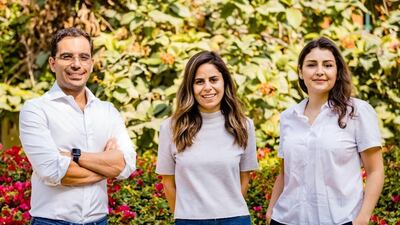
Nuwa Capital's co-founders, from left, Khaled Talhouni, Sarah Abu Risheh and Stephanie Prince. Courtesy Nuwa Capital

Nuwa Capital aims to close $100m fund by end of year as it taps into Mena's tech boom


Alkesh Sharma
  • English
  • Arabic

Nuwa Capital, a venture capital firm based in Dubai and Riyadh, aims to close a $100 million fund by the end of this year as it looks to invest in the rapidly growing number of start-ups in the Middle East.

The firm completed the first close of its Nuwa Ventures Fund I after raising three quarters of its target despite coronavirus-induced challenges.

“The first close [was] much faster than anticipated ... our original plan was to close in up to two years, but it was reduced to half,” said managing partner Khaled Talhouni, who founded Nuwa Capital with Sarah Abu Risheh and Stephanie Prince.

“Things were delayed during the first three months until May ... as markets were closed and we were unable to meet potential start-ups and investors," he said.

"After that things picked up very fast as everybody’s emphasis was on technology and digital during the pandemic.”

Founded in February last year, Nuwa Capital’s launch coincided with the spread of the Covid-19 pandemic around the world.

The venture capital firm is among many looking to invest in start-ups tapping into a technology boom fuelled by the pandemic.

Start-ups in the Mena region attracted a record $1bn in funding last year, according to data platform Magnitt.

“We have been operating in this space for about a decade and continue to see new models emerge and further blur the lines between technology and non-technology,” said Ms Abu Risheh, one of the partners.

“We will be witnessing more pronounced changes across the regional ecosystem and seeing more start-ups reaching escape velocity.”

Nuwa is focused on the rapidly growing Mena region, Sub-Saharan Africa and countries such as Turkey and Pakistan. The company, whose anchor investor is Saudi Arabia-based Al Faisaliah Group, has 10 backers.

It has joined forces with large groups and family offices that are leaders in various industries such as health care, pharmaceutical and property, said Ms Abu Risheh.

The fund also launched the Nuwa Network, which connects founders, investors and operational experts, to help start-ups scale up and expand as they navigate market challenges.

Nuwa supports founders and companies it invests in through a network of operating partners.

It connects the fund’s investors and limited partners, particularly corporate investors, with potential start-ups.

“Although we expected a delay given the challenging economic climate and limited travel, we have been able to build the right partnerships and finalise our first close in under a year,” said partner Ms Prince.

“With a distinguished community of LPs [limited partners] ... we are able to scale up value creation and offer both strategic and operational support.”

Nuwa has already invested in regional companies such as Dubai-based online eyewear retailer Eyewa, FinTech start-up Flexxpay and Cairo-based furniture marketplace Homzmart.

It is set to announce further investments in the coming weeks.

“As a firm, we will be constantly raising funds ... our immediate focus is on raising the remaining 25 per cent. We also co-invest a lot and like to work with other investors,” said Mr Talhouni.


Who's who in Yemen conflict

Houthis: Iran-backed rebels who occupy Sanaa and run unrecognised government

Yemeni government: Exiled government in Aden led by eight-member Presidential Leadership Council

Southern Transitional Council: Faction in Yemeni government that seeks autonomy for the south

Habrish 'rebels': Tribal-backed forces feuding with STC over control of oil in government territory

What is cyberbullying?

Cyberbullying or online bullying could take many forms such as sending unkind or rude messages to someone, socially isolating people from groups, sharing embarrassing pictures of them, or spreading rumors about them.

Cyberbullying can take place on various platforms such as messages, on social media, on group chats, or games.

Parents should watch out for behavioural changes in their children.

When children are being bullied they they may be feel embarrassed and isolated, so parents should watch out for signs of signs of depression and anxiety

How to get exposure to gold

Although you can buy gold easily on the Dubai markets, the problem with buying physical bars, coins or jewellery is that you then have storage, security and insurance issues.

A far easier option is to invest in a low-cost exchange traded fund (ETF) that invests in the precious metal instead, for example, ETFS Physical Gold (PHAU) and iShares Physical Gold (SGLN) both track physical gold. The VanEck Vectors Gold Miners ETF invests directly in mining companies.

Alternatively, BlackRock Gold & General seeks to achieve long-term capital growth primarily through an actively managed portfolio of gold mining, commodity and precious-metal related shares. Its largest portfolio holdings include gold miners Newcrest Mining, Barrick Gold Corp, Agnico Eagle Mines and the NewMont Goldcorp.

Brave investors could take on the added risk of buying individual gold mining stocks, many of which have performed wonderfully well lately.

London-listed Centamin is up more than 70 per cent in just three months, although in a sign of its volatility, it is down 5 per cent on two years ago. Trans-Siberian Gold, listed on London's alternative investment market (AIM) for small stocks, has seen its share price almost quadruple from 34p to 124p over the same period, but do not assume this kind of runaway growth can continue for long

However, buying individual equities like these is highly risky, as their share prices can crash just as quickly, which isn't what what you want from a supposedly safe haven.

The rules on fostering in the UAE

A foster couple or family must:

  • be Muslim, Emirati and be residing in the UAE
  • not be younger than 25 years old
  • not have been convicted of offences or crimes involving moral turpitude
  • be free of infectious diseases or psychological and mental disorders
  • have the ability to support its members and the foster child financially
  • undertake to treat and raise the child in a proper manner and take care of his or her health and well-being
  • A single, divorced or widowed Muslim Emirati female, residing in the UAE may apply to foster a child if she is at least 30 years old and able to support the child financially