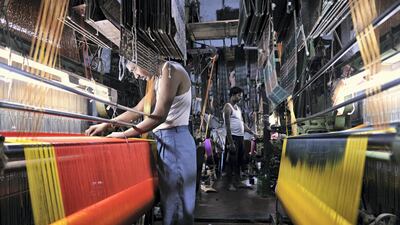

India’s renewable energy giant BLP is leading the way in harnessing technology to get thousands of blue collar workers back to work.
The company is using artificial intelligence sensors and computer vision to track those returning to their jobs at factories. In the process, workers have become subjects of monitoring technology, similar to what's used for industrial assets that maximise the efficiency of wind turbines or predict maintenance needs of major railways.
The rapid shift in using such technology on humans is being hastened by historic economic decline and the lingering threat of the Covid-19 pandemic.
"As a company we do all these things with AI and Internet of Things, and the question became, from the government and major manufacturers, how do you help industry come back with some level of normalcy?" Tejpreet Chopra, the company's chief executive, told The National.
BLP’s subsidiary, Industry.AI, got to work retrofitting its industrial monitoring technology to safely bring back workers, ultimately developing three applications in under a month.
Industry.AI's ‘Trust AI’ product relies on closed circuit video feeds often already placed in public spaces, malls, factories and office complexes to enforce social distancing, PPE, and wearing of masks. An alert is sent to factory security or management when a breach occurs.
The solution is already in use at Havells, an Indian electrical equipment company, as well as at a steel factory and an automotive parts manufacturer. The technology can also be integrated with facial recognition and temperature screening.
Its ‘Us’ mobile application sends an alert to a worker’s cell phone in real time when social distancing is breached. An enterprise version for corporations, which goes by ‘Us Pro’ keeps track of employees’ temperature, provides contactless clocking in for shifts and contact tracing within the factory.
The app also provides analytics on changes in behaviour or biometrics over time.
For workers who do not have smartphones, employers can buy a wearable device called ‘Spot AI’, fitted with a chip ID card that alerts the wearer when they or someone else gets too close.
The chip was previously used to track infrastructure, tools and inventory for the aviation, energy and supply chain sectors.
The economic impact of the ten-week lockdown for the nation’s 1.3 billion people has been devastating. In late May, facing historic contraction, restrictions began to ease even as India continued reporting record-high daily numbers of new coronavirus cases.
Ratings agencies like Moody's have said the economy could contract by 5 per cent or more this year, after expanding about 7 per cent on average over the past decade.
Manufacturing is being hit particularly hard, with millions of labourers leaving cities to return to their rural village homes, delaying the restart of production.
For those who have stayed, wristbands fitted with sensors to monitor their movements, heart rate and temperature are becoming standard at some of the largest facilities, which have already bought into BLP’s solutions.
The “industry is rapidly adopting AI and IoT technologies that help drive productivity, as well as keep our workforce safe," said Anil Rai Gupta, chairman and managing director of Havells India.
"The AI and IoT solutions deliver insights that help this digital transformation, and ensures business continuity.”
Mr Chopra echoed this, saying factory workers will be the subject of monitoring for productivity and safety even “during life after a vaccine”.
Lucas TVS, one of the largest auto component manufacturers in India with around 7,500 employees, is using BLP Industry.AI’s video monitoring technology in eight of its plants, which restarted operations this month.
It is ramping up use of the technology to about 40 per cent capacity. Managers will replay social distancing or PPE violations to employees "to educate them", Arvind Balaji, its managing director, told The National.
“I am not sure how we will use it after Covid, but this kind of monitoring definitely has uses and I will plan to use it in some shape or form going forward,” he added.
Mr Chopra, a former chief executive at GE India, started wind energy company BLP in Bangalore in 2013. Frustrated by how expensive and time-consuming it was to repair massive turbines, he hired a team focused on data science to develop algorithms that can predict hardware failures in wind and solar farms hours before they occur.
Over time, this competency expanded to include predictive monitoring services for aviation, smart buildings, trade and supply chains, with clients like DP World and Bosch.
Covid-19 forced him to adapt once again.
“You’re always going to have that one crazy guy who doesn’t listen, who will take off his helmet or his face mask,” Mr Chopra said. And it is that asset - a company’s workforce - that BLP has its sights on.
As for the issue of privacy, data will only be collected once a worker is clocked in and within company property, he said. The apps and monitoring are built so that “the minute you’re out of the factory, you can go dark”.
This is important, since on a regulatory level, very little exists anywhere in the world to protect workers’ privacy in this new, data-driven workplace.
"We humans are becoming part of the digital nervous system around the world," Olaf Groth, the chief executive of AI think tank Cambrian Futures and author of Soloman's Code: Humanity in a World of Thinking Machines, said.
Technology governance as it relates to the Internet of Things and AI does not yet exist, Mr Groth said.
“Some Internet companies are actually starting to address that with ethical use case designs, but we don’t yet have the societal institutions to work with that," he added.
“There is no evolution without data, but it must have governance.”

