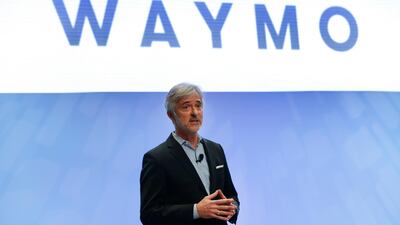
John Krafcik is stepping down after more than five years at the helm of Waymo. Mr Krafcik led the spin-out of the self-driving technology company from Google. AP Photo

Head of Alphabet's self-driving car company Waymo steps down


  • English
  • Arabic

John Krafcik stepped down as chief executive officer of Alphabet’s Waymo self-driving vehicle division, making way for two tech industry veterans to jointly take over the business, the company said in a memo.

Mr Krafcik, 59, will be replaced by Tekedra Mawakana, Waymo’s chief operating officer, and Dmitri Dolgov, chief technical officer, who will serve as co-CEOs. Ms Mawakana was named COO in 2019, and had previously held senior roles at AOL, Yahoo, and EBay. Mr Dolgov had been CTO since late 2016 and previously had engineering positions at Google and was a researcher at the Toyota Research Institute, according to his LinkedIn profile.

Replacing a car industry veteran with executives more steeped in technology points to Waymo’s efforts to move past the industrial phase. After Mr Krafcik cut deals with carmakers to get technology into vehicles, the company’s now moving to deploy vehicles on the road with revenue-generating services.

Under Mr Krafcik, Waymo secured agreements with Stellantis, Jaguar Land Rover, Volvo and Daimler’s truck group to put its technology in passenger cars and freight trucks. While Mr Krafcik got Waymo’s technology in vehicles, he had said that the challenge of autonomy was a difficult one and it could take longer than expected for people to get a truly driverless experience on the road.

“[Mr] Krafcik’s departure comes as the Alphabet-owned company has been slow to capitalise on its lead in autonomous technology over peers such as Tesla and GM Cruise,” Mandeep Singh, senior technology analyst at Bloomberg Intelligence, said. “Tesla’s growing fleet of electric cars with its proprietary Autopilot system could be aiding its competitive positioning versus Waymo One, which still hasn’t been rolled out broadly.”

The company sought its first funding for the business from other investors last year, raising $3.25 billion, an increase from an initial $2.25bn. In autumn, Waymo began offering self-driving services without a test driver in Arizona.

“They went outside for funding, which was a sign that Alphabet was running out of patience to turn this into a real business,” said Sam Abuelsamid, an analyst at Guidehouse Insights. Still, “John accomplished a lot in terms of building relationships at automakers", Mr Abuelsamid said.

"Before he got there, Google talked to a lot of automakers and got turned away.”

Waymo confirmed the move on Twitter, thanking Mr Krafcik for leading the company’s autonomous technology development for more than five years.

“After five-and-a-half exhilarating years leading this team, I’ve decided to depart from my CEO role with Waymo and kick-off new adventures,” Mr Krafcik said in the memo, adding that he will remain as an adviser. “To start, I’m looking forward to a refresh period, reconnecting with old friends and family, and discovering new parts of the world.”

Ms Mawakana brings government affairs experience to the top at Waymo. She was previously chief external officer at the company, heading public policy and communications. She also had similar roles at EBay and Yahoo.

That will be vital as Waymo seeks to run its services on public roads and charge for driverless rides. The federal government is still developing rules for self-driving vehicles and states have their own rules and permits.

Mr Dolgov was one of the original members of Google’s self-driving project that started in more than a decade ago that became Waymo. He also worked on Toyota’s self-driving car programme and was part of Stanford University’s DARPA Urban Challenge team that started the push into autonomous technology. He leads development of Waymo’s autonomous system.


The specs

Engine: 3.5-litre V6

Power: 272hp at 6,400rpm

Torque: 331Nm from 5,000rpm

Transmission: 8-speed auto

Fuel consumption: 9.7L/100km

On sale: now

Price: Dh149,000


COMPANY%20PROFILE
%3Cp%3E%3Cstrong%3ECompany%20name%3A%3C%2Fstrong%3E%20OneOrder%3Cbr%3E%3Cstrong%3EStarted%3A%3C%2Fstrong%3E%20March%202022%3Cbr%3E%3Cstrong%3EFounders%3A%3C%2Fstrong%3E%20Tamer%20Amer%20and%20Karim%20Maurice%3Cbr%3E%3Cstrong%3EBased%3A%3C%2Fstrong%3E%20Cairo%3Cbr%3E%3Cstrong%3ENumber%20of%20staff%3A%20%3C%2Fstrong%3E82%3Cbr%3E%3Cstrong%3EInvestment%20stage%3A%3C%2Fstrong%3E%20Series%20A%3C%2Fp%3E%0A
Tree of Hell

Starring: Raed Zeno, Hadi Awada, Dr Mohammad Abdalla

Director: Raed Zeno

Rating: 4/5

Desert Warrior

Starring: Anthony Mackie, Aiysha Hart, Ben Kingsley

Director: Rupert Wyatt

Rating: 3/5

UPI facts

More than 2.2 million Indian tourists arrived in UAE in 2023
More than 3.5 million Indians reside in UAE
Indian tourists can make purchases in UAE using rupee accounts in India through QR-code-based UPI real-time payment systems
Indian residents in UAE can use their non-resident NRO and NRE accounts held in Indian banks linked to a UAE mobile number for UPI transactions

Yemen's Bahais and the charges they often face

The Baha'i faith was made known in Yemen in the 19th century, first introduced by an Iranian man named Ali Muhammad Al Shirazi, considered the Herald of the Baha'i faith in 1844.

The Baha'i faith has had a growing number of followers in recent years despite persecution in Yemen and Iran. 

Today, some 2,000 Baha'is reside in Yemen, according to Insaf. 

"The 24 defendants represented by the House of Justice, which has intelligence outfits from the uS and the UK working to carry out an espionage scheme in Yemen under the guise of religion.. aimed to impant and found the Bahai sect on Yemeni soil by bringing foreign Bahais from abroad and homing them in Yemen," the charge sheet said. 

Baha'Ullah, the founder of the Bahai faith, was exiled by the Ottoman Empire in 1868 from Iran to what is now Israel. Now, the Bahai faith's highest governing body, known as the Universal House of Justice, is based in the Israeli city of Haifa, which the Bahais turn towards during prayer. 

The Houthis cite this as collective "evidence" of Bahai "links" to Israel - which the Houthis consider their enemy. 


Ten tax points to be aware of in 2026

1. Domestic VAT refund amendments: request your refund within five years

If a business does not apply for the refund on time, they lose their credit.

2. E-invoicing in the UAE

Businesses should continue preparing for the implementation of e-invoicing in the UAE, with 2026 a preparation and transition period ahead of phased mandatory adoption. 

3. More tax audits

Tax authorities are increasingly using data already available across multiple filings to identify audit risks. 

4. More beneficial VAT and excise tax penalty regime

Tax disputes are expected to become more frequent and more structured, with clearer administrative objection and appeal processes. The UAE has adopted a new penalty regime for VAT and excise disputes, which now mirrors the penalty regime for corporate tax.

5. Greater emphasis on statutory audit

There is a greater need for the accuracy of financial statements. The International Financial Reporting Standards standards need to be strictly adhered to and, as a result, the quality of the audits will need to increase.

6. Further transfer pricing enforcement

Transfer pricing enforcement, which refers to the practice of establishing prices for internal transactions between related entities, is expected to broaden in scope. The UAE will shortly open the possibility to negotiate advance pricing agreements, or essentially rulings for transfer pricing purposes. 

7. Limited time periods for audits

Recent amendments also introduce a default five-year limitation period for tax audits and assessments, subject to specific statutory exceptions. While the standard audit and assessment period is five years, this may be extended to up to 15 years in cases involving fraud or tax evasion. 

8. Pillar 2 implementation 

Many multinational groups will begin to feel the practical effect of the Domestic Minimum Top-Up Tax (DMTT), the UAE's implementation of the OECD’s global minimum tax under Pillar 2. While the rules apply for financial years starting on or after January 1, 2025, it is 2026 that marks the transition to an operational phase.

9. Reduced compliance obligations for imported goods and services

Businesses that apply the reverse-charge mechanism for VAT purposes in the UAE may benefit from reduced compliance obligations. 

10. Substance and CbC reporting focus

Tax authorities are expected to continue strengthening the enforcement of economic substance and Country-by-Country (CbC) reporting frameworks. In the UAE, these regimes are increasingly being used as risk-assessment tools, providing tax authorities with a comprehensive view of multinational groups’ global footprints and enabling them to assess whether profits are aligned with real economic activity. 

Contributed by Thomas Vanhee and Hend Rashwan, Aurifer