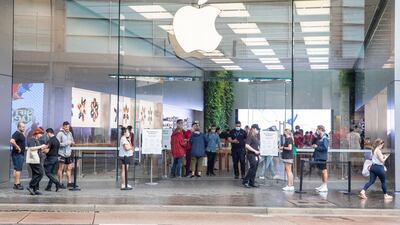
Apple's plans to develop an electric car could take longer to spark into life than the company is anticipating, but the consumer electronics giant could acquire niche technology firms to speed up its arrival, analysts said.
Reports emerged last week that Apple, one of the world's most valuable companies, is planning to produce its first electric vehicle by 2024.
"Apple car specifications have yet to be finalised … it won't be surprising if the vehicle's launch timeframe is pushed out to 2028 or later," Neil Campling, co-head of Mirabaud Securities' Global Thematic Group, told The National.
“There is a lot of uncertainty about the suppliers, specifications and also around Apple's own competitiveness in the EV and self-driving market … even if development starts this year and goes as per the plan, it would take years to get all the requirements in place,” he added.
Apple secretly began its automated and electric vehicles development – known as Project Titan – in 2014. The company has yet to publicly discuss any of its automobile goals, but nearly 5,000 engineers and scientists were reported to be working on the project as of 2018.
"There were rumours that Apple was working on a car a few years ago ... rumours are circulating again, it probably means that they have achieved some breakthrough. That's good news and points in the direction that the car is something that has been actively worked on," Abbas Ali, managing editor of TechRadar Middle East, told The National.
The Covid-19 pandemic has increased the focus on making the car industry greener. With Tesla joining the S&P 500 index this month, some industry analysts say EVs are set to dominate the global auto market. President-elect Joe Biden’s triumph in the US elections and China announcing plans to boost the sector bode well for the industry, as does the European Union's roll out of a new Sustainable and Smart Mobility Strategy that envisages 30 million zero energy cars on its roads by 2030.
The EV share of global car sales is forecast to rise to 2.5 per cent by 2020, from 1 per cent in 2017, according to Bank of America Merrill Lynch, which predicts that EVs will constitute 90 per cent of sales by 2050.
Apple’s modus operandi suggests it will acquire small technology players to help accelerate its EV development but the core of its platform is likely to be “home-grown”, analysts said.
“It won’t be a surprise if they [Apple] have already acquired some companies to speed up the manufacturing process … but it’s anybody’s guess when they will actually have something to show,” said Mr Ali.
Ming-Chi Kuo, an analyst at Hong Kong’s TF International Securities, believes the market is “too bullish” on the Apple car, indicating that its rollout could take until 2028 or later.
“We believe that the current so-called Apple car concept stocks are only speculations by the market and do not involve actual Apple car suppliers,” Mr Kuo, who keenly follows Apple, wrote in a research note to clients.
“We also think that because EV/self-driving car technical specs are still evolving, it is too early to talk about the final specs of the Apple car,” he added. He also said Apple may already be too far behind in artificial intelligence to launch a competitive self-driving car.
“We are very sceptical that Apple will actually produce a car, as auto sector profitability is much lower,” Citi analyst Jim Suva wrote in a note last week.
Apple is facing stiff competition in the electric car market not only from dedicated EV maker Tesla but also from automotive giants like Audi, BMW, Volkswagen and General Motors.
Germany's Volkswagen plans to roll out 22 million EVs within 10 years and almost 70 new electric models by 2028.
BMW this week said it is aiming for 20 per cent of its vehicles to be electric by 2023.
Other tech giants, such as Amazon and Google owner Alphabet, are also backing autonomous-electric initiatives but are more focused on mass transport.
Alphabet's Waymo is operating a commercial self-driving taxi service, whereas Amazon-backed Zoox is working to create an autonomous ride-hailing fleet. Industry analysts said Amazon could also use automated cars to deliver goods to customers.
Tesla, which is aiming to sell 500,000 EVs in 2020 – a 36 per cent increase from last year, may have acted as the “poster child of EV technology but is likely to remain a niche player” in the industry, analysts said.
Often the first mover in a market is not the eventual winner, Mr Campling said.
“We have seen this before in other technologies, such as Kodak cameras, Blackberry smartphones, Excite and Lycos for web search and Netscape web browsers,” he added.
In the past couple of years, Apple has hired key executives from Tesla to propel its autonomous and electric vehicle initiatives.
Doug Field, who worked with Apple between 2011 and 2013 before moving to Tesla, returned in 2018 as vice president of special projects. Steve MacManus, another Tesla veteran, joined Apple as a senior director in July 2019.
Earlier this month, Bloomberg reported that Apple shifted the leadership of its self-driving car project to John Giannandrea, its senior vice president of machine learning and artificial intelligence strategy.
EVs will be a “completely different territory” and “not at a big enough” market for Apple, Naeem Aslam, chief market analyst at brokerage Avatrade, said.
"On average, a person travels 30 miles a day in a car whereas a person uses a phone for over four hours in a day. The phone industry is huge for Apple to continue to innovate and be on the forefront," Mr Aslam told The National.
"To some extent, diversification could be very successful but margins [in the auto industry] are not that great.”
Mr Aslam believes Apple is more likely to partner with an established EV company than develop its own vehicle.
“It’s likely that it will partner with a company such as BMW or Tesla and create market dominance by merging operations. A second option will be outright buying a company leading on the EV front.”

Teaching in coronavirus times
The specs: 2018 Mercedes-AMG C63 S Cabriolet
Price, base: Dh429,090
Engine 4.0-litre twin-turbo V8
Transmission Seven-speed automatic
Power 510hp @ 5,500rpm
Torque 700Nm @ 1,750rpm
Fuel economy, combined 9.2L / 100km
TOUR DE FRANCE INFO
Dates: July 1-23
Distance: 3,540km
Stages: 21
Number of teams: 22
Number of riders: 198
The major Hashd factions linked to Iran:
Badr Organisation: Seen as the most militarily capable faction in the Hashd. Iraqi Shiite exiles opposed to Saddam Hussein set up the group in Tehran in the early 1980s as the Badr Corps under the supervision of the Iran Revolutionary Guards Corps (IRGC). The militia exalts Iran’s Supreme Leader Ali Khamenei but intermittently cooperated with the US military.
Saraya Al Salam (Peace Brigade): Comprised of former members of the officially defunct Mahdi Army, a militia that was commanded by Iraqi cleric Moqtada Al Sadr and fought US and Iraqi government and other forces between 2004 and 2008. As part of a political overhaul aimed as casting Mr Al Sadr as a more nationalist and less sectarian figure, the cleric formed Saraya Al Salam in 2014. The group’s relations with Iran has been volatile.
Kataeb Hezbollah: The group, which is fighting on behalf of the Bashar Al Assad government in Syria, traces its origins to attacks on US forces in Iraq in 2004 and adopts a tough stance against Washington, calling the United States “the enemy of humanity”.
Asaeb Ahl Al Haq: An offshoot of the Mahdi Army active in Syria. Asaeb Ahl Al Haq’s leader Qais al Khazali was a student of Mr Al Moqtada’s late father Mohammed Sadeq Al Sadr, a prominent Shiite cleric who was killed during Saddam Hussein’s rule.
Harakat Hezbollah Al Nujaba: Formed in 2013 to fight alongside Mr Al Assad’s loyalists in Syria before joining the Hashd. The group is seen as among the most ideological and sectarian-driven Hashd militias in Syria and is the major recruiter of foreign fighters to Syria.
Saraya Al Khorasani: The ICRG formed Saraya Al Khorasani in the mid-1990s and the group is seen as the most ideologically attached to Iran among Tehran’s satellites in Iraq.
(Source: The Wilson Centre, the International Centre for the Study of Radicalisation)
The specs
Engine: 4.0-litre V8 twin-turbocharged and three electric motors
Power: Combined output 920hp
Torque: 730Nm at 4,000-7,000rpm
Transmission: 8-speed dual-clutch automatic
Fuel consumption: 11.2L/100km
On sale: Now, deliveries expected later in 2025
Price: expected to start at Dh1,432,000
THE TWIN BIO
Their favourite city: Dubai
Their favourite food: Khaleeji
Their favourite past-time : walking on the beach
Their favorite quote: ‘we rise by lifting others’ by Robert Ingersoll
The%20specs
%3Cp%3E%0D%3Cstrong%3EEngine%3A%20%3C%2Fstrong%3E4.0-litre%20twin-turbo%20V8%0D%3Cbr%3E%3Cstrong%3EPower%3A%20%3C%2Fstrong%3E666hp%20at%206%2C000rpm%0D%3Cbr%3E%3Cstrong%3ETorque%3A%20%3C%2Fstrong%3E850Nm%20at%202%2C300-4%2C500rpm%0D%3Cbr%3E%3Cstrong%3ETransmission%3A%20%3C%2Fstrong%3E8-speed%20auto%0D%3Cbr%3E%3Cstrong%3EOn%20sale%3A%20%3C%2Fstrong%3EQ1%202023%0D%3Cbr%3E%3Cstrong%3EPrice%3A%20%3C%2Fstrong%3Efrom%20Dh1.15%20million%20(estimate)%3C%2Fp%3E%0A
COMPANY PROFILE
Initial investment: Undisclosed
Investment stage: Series A
Investors: Core42
Current number of staff: 47
The story in numbers
18
This is how many recognised sects Lebanon is home to, along with about four million citizens
450,000
More than this many Palestinian refugees are registered with UNRWA in Lebanon, with about 45 per cent of them living in the country’s 12 refugee camps
1.5 million
There are just under 1 million Syrian refugees registered with the UN, although the government puts the figure upwards of 1.5m
73
The percentage of stateless people in Lebanon, who are not of Palestinian origin, born to a Lebanese mother, according to a 2012-2013 study by human rights organisation Frontiers Ruwad Association
18,000
The number of marriages recorded between Lebanese women and foreigners between the years 1995 and 2008, according to a 2009 study backed by the UN Development Programme
77,400
The number of people believed to be affected by the current nationality law, according to the 2009 UN study
4,926
This is how many Lebanese-Palestinian households there were in Lebanon in 2016, according to a census by the Lebanese-Palestinian dialogue committee
Dubai works towards better air quality by 2021
Dubai is on a mission to record good air quality for 90 per cent of the year – up from 86 per cent annually today – by 2021.
The municipality plans to have seven mobile air-monitoring stations by 2020 to capture more accurate data in hourly and daily trends of pollution.
These will be on the Palm Jumeirah, Al Qusais, Muhaisnah, Rashidiyah, Al Wasl, Al Quoz and Dubai Investment Park.
“It will allow real-time responding for emergency cases,” said Khaldoon Al Daraji, first environment safety officer at the municipality.
“We’re in a good position except for the cases that are out of our hands, such as sandstorms.
“Sandstorms are our main concern because the UAE is just a receiver.
“The hotspots are Iran, Saudi Arabia and southern Iraq, but we’re working hard with the region to reduce the cycle of sandstorm generation.”
Mr Al Daraji said monitoring as it stood covered 47 per cent of Dubai.
There are 12 fixed stations in the emirate, but Dubai also receives information from monitors belonging to other entities.
“There are 25 stations in total,” Mr Al Daraji said.
“We added new technology and equipment used for the first time for the detection of heavy metals.
“A hundred parameters can be detected but we want to expand it to make sure that the data captured can allow a baseline study in some areas to ensure they are well positioned.”
TV: World Cup Qualifier 2018 matches will be aired on on OSN Sports HD Cricket channel
Milestones on the road to union
1970
October 26: Bahrain withdraws from a proposal to create a federation of nine with the seven Trucial States and Qatar.
December: Ahmed Al Suwaidi visits New York to discuss potential UN membership.
1971
March 1: Alex Douglas Hume, Conservative foreign secretary confirms that Britain will leave the Gulf and “strongly supports” the creation of a Union of Arab Emirates.
July 12: Historic meeting at which Sheikh Zayed and Sheikh Rashid make a binding agreement to create what will become the UAE.
July 18: It is announced that the UAE will be formed from six emirates, with a proposed constitution signed. RAK is not yet part of the agreement.
August 6: The fifth anniversary of Sheikh Zayed becoming Ruler of Abu Dhabi, with official celebrations deferred until later in the year.
August 15: Bahrain becomes independent.
September 3: Qatar becomes independent.
November 23-25: Meeting with Sheikh Zayed and Sheikh Rashid and senior British officials to fix December 2 as date of creation of the UAE.
November 29: At 5.30pm Iranian forces seize the Greater and Lesser Tunbs by force.
November 30: Despite a power sharing agreement, Tehran takes full control of Abu Musa.
November 31: UK officials visit all six participating Emirates to formally end the Trucial States treaties
December 2: 11am, Dubai. New Supreme Council formally elects Sheikh Zayed as President. Treaty of Friendship signed with the UK. 11.30am. Flag raising ceremony at Union House and Al Manhal Palace in Abu Dhabi witnessed by Sheikh Khalifa, then Crown Prince of Abu Dhabi.
December 6: Arab League formally admits the UAE. The first British Ambassador presents his credentials to Sheikh Zayed.
December 9: UAE joins the United Nations.
GAC GS8 Specs
Engine: 2.0-litre 4cyl turbo
Power: 248hp at 5,200rpm
Torque: 400Nm at 1,750-4,000rpm
Transmission: 8-speed auto
Fuel consumption: 9.1L/100km
On sale: Now
Price: From Dh149,900
