

Apple was set to unveil its new iPhone 15 series on Tuesday and all signs point to another major hardware change – the switch to USB-C.
The company is known for not necessarily being the first in introducing certain technology on its devices. Apple is famous for taking on existing tech and improving it before using it on its own products.
But when it does something, it's a big deal, as it sets the direction for other companies and user adoption. Arguably the most infamous instance was in 2017 when Apple made the decision to kill off the 3.5mm headphone jack port in 2016’s iPhone 7. After initial uproar, its competition soon followed suit and users accepted it, proving Apple was right.
Nothing is official until Apple's announcement. We take a look at what exactly this technology is and how it all came to this point.
What is USB-C?
In simplest terms, USB-C – universal serial bus type C, in full – is a technology and standard used to connect computers and similar devices to peripherals for the purposes of data transfer and charging.
It is part of a wider range of USBs in the market – A, B, C, 3.0, Mini, Micro and Micro B – all with distinct designs, speeds and purposes. In terms of size, USB-C, Mini, Micro and Micro B are the thinnest, giving them more versatility to be included in smaller devices.
Why is USB-C so popular?
Because of the one distinct advantage it has over the rest of the USB types – it has rotational symmetry, meaning it is reversible and can be plugged in any way without worrying about its orientation. It quickly became a popular choice because of this, aside from being slim.
It's difficult to quantify how many devices use USB-C ports, as well as the number of compatible cables, but it should definitely be in the billions.
Which smartphone first used USB-C?
USB-C was introduced in 2014, but it was in 2015 that the first smartphones to use it emerged – and it's probably something you may not have heard of: it was a series of mobiles from China's Le – the Le 1, Le 1 Pro and Le Max – back in 2015.
However, it's important to note that Apple was also one of the earliest adopters of USB-C, but not on the iPhone – the company integrated USB-C into its 2015 MacBook, joining Google's Chromebook Pixel.
How does it compare to Apple's Lightning?
Apple introduced its proprietary Lightning port in 2012 in the iPhone 5, replacing the bulky 30-pin dock connector, and, like USB-C, has rotational symmetry. It was also used in iPads and the now-discontinued iPods.
The most obvious difference between USB-C and Lightning is that the latter is exclusive to Apple products. Lightning also became an additional revenue stream for Apple as it licensed third-party companies to make Lightning accessories iPhones, iPads and iPods.
-

The iPhone through the ages: Former Apple CEO Steve Jobs introduces the iPhone to the world in San Francisco, California, on January 9, 2007. It had a 3.5-inch screen and 2MP camera. Reuters -

The iPhone 3G was launched in 2008 with a faster 3G connection. It also added location services. Reuters -
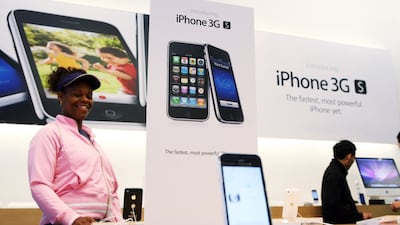
The iPhone 3GS was released on June 19, 2009. It was twice as fast as its previous version. AFP -

The iPhone 4 was released on June 24, 2010. It featured FaceTime for the first occasion as well as a retina screen. Reuters -

A later release, this time on October 14, 2011, the iPhone 4S had a new dual-core processor. Reuters -

Apple CEO Tim Cook takes to the stage following the reveal of the iPhone 5 in San Francisco, California, on September 12, 2012. This was the first 4-inch screen and the phone was faster and slimmer. Reuters -
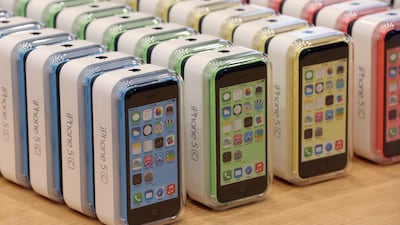
The iPhone 5C arrived on September 20, 2013 and was less expensive and very similar to the iPhone 5 except it came with colourful casing. Getty Images -
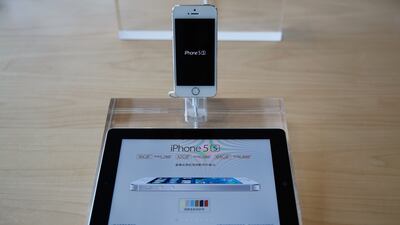
The iPhone 5s came at the same time as the 5C and introduced touch ID and a motion data processor as health and fitness apps started to come to the fore. Getty Images -
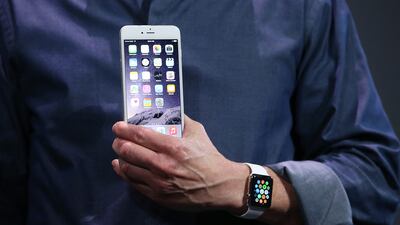
The iPhone 6 marked another double launch when unveiled on September 9, 2014. The 6 had a 4.7-inch screen, faster processor and improved camera. AFP -

The iPhone 6 Plus had a 5.5-inch screen and was $100 more expensive. Reuters -
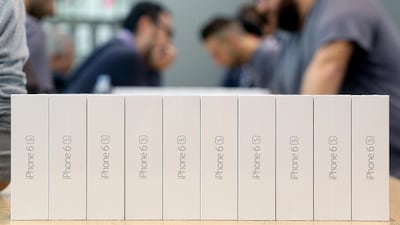
The iPhone 6s came on September 25, 2015 with 3D touch and a camera that could shoot 4K video. EPA -

The iPhone 6s Plus is displayed at Tokyo's flagship store on September 25, 2015. Both new phones came in a new colour - rose gold. AFP -
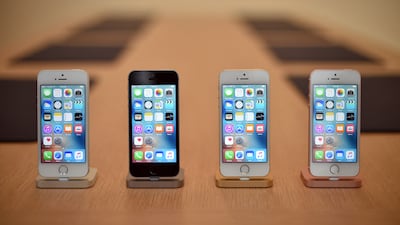
Unveiled on March 21, 2016, the iPhone SE had the same design as the iPhone 5 and saw a return to the 4-inch screen which was preferred by some users. It was more affordable and hence lacked features such as Touch ID. AFP -

The iPhone 7 announced on September 7, 2016, said somewhat controversially goodbye to the audio jack. Reuters -
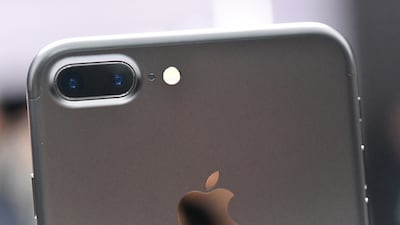
The iPhone 7 Plus had a dual camera added. AFP -

The iPhone 8 was released on September 22, 2017 and had a new glass and aluminium design, retina HD screen. Reuters -
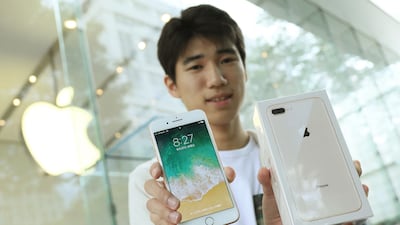
A customer gets his hands on an iPhone 8 Plus on launch day in Tokyo on September 22, 2017. The launches also saw speakers that were 25% louder and the most powerful and smartest chip in a smartphone (according to Apple). AFP -

The iPhone X marked a decade of iPhones on September 12, 2017. It's main changes were an edge-to-edge super retina screen. Touch ID was removed with Face ID introduced. Reuters -

The iPhone XS was released on September 21, 2018 and had a Super Retina OLED screen with improved scratch and water resistance. Face ID was faster. Reuters -

The iPhone XS Max had the largest iPhone screen to date at 6.5 inches. It could handle 3 million pixels. Reuters -
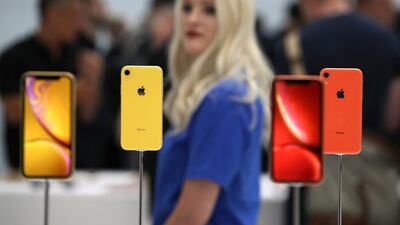
The iPhone XR was slightly cheaper than the XS and came with a 6.1-inch screen. AFP -
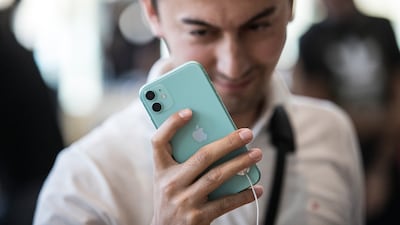
A customer looks at the iPhone 11 at an Apple store in Dubai Mall on September 20, 2019. EPA -
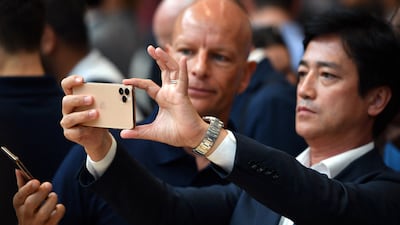
A man tries out the iPhone 11 Pro in Cupertino, California, on September 10, 2019. AFP -

Midnight Green was introduced for the iPhone 11 Pro Max, while there was also a new three-camera system. Reuters -
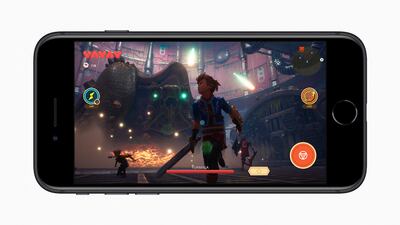
Arriving on April 15, 2020, the iPhone SE was for budget-minded customers and was pretty much a replica of the iPhone 8. Its 4.7-inch screen felt rather on the small side compared to the big screens of its big brothers. Apple Inc. / AFP -
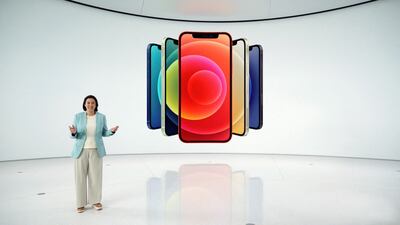
The iPhone 12 on October 13, 2020 introduced a new processor and a screen that offered four times better protection if dropped. Apple / AFP -

The iPhone 12 mini offered a 5.4-inch screen. Getty Images -
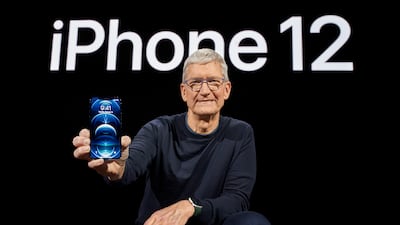
Mr Cook showcases the iPhone 12 Pro during an event at Apple Park in Cupertino, California, on October 13, 2020. This upgrade saw a faster chip, 5G speed, a "camera system that’s killer in low light. A LiDAR Scanner for more realistic AR. And two great sizes to choose from — including our largest display ever". Apple / EPA -

The iPhone 12 Pro Max was categorised as a 'legacy phone'. Reuters -
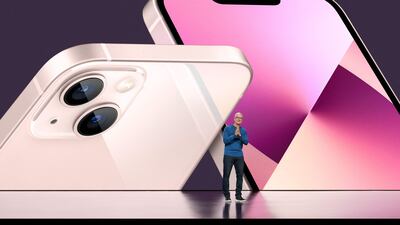
The new iPhone 13 was unveiled on September 14, 2021. It has a smart data mode which helps battery life, more 5G bands and antenna lines that use material made from recycled plastic water bottles. AFP -
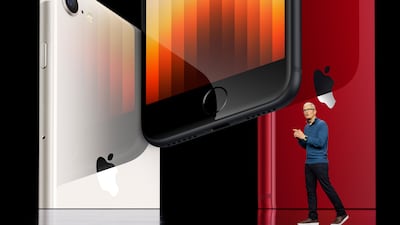
Apple CEO Tim Cook showcasing the third generation iPhone SE featuring 5G and the A15 Bionic chip on March 8, 2022. EPA -
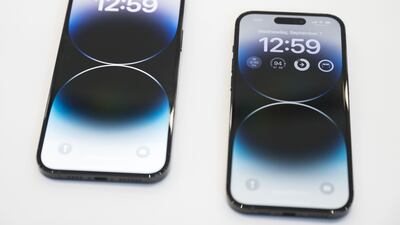
The Apple iPhone 14, 14 Plus, Pro Max and the Apple iPhone 14 Pro were unveiled during an event on September 7, 2022. It didn’t raise its US prices during one of the worst years for inflation in decades. The biggest addition was emergency calling after a car crash. Bloomberg


USB-C, meanwhile, is more versatile. Aside from being the standard for Google's Android smartphones, it is now widely used in other electronics, including headsets, speakers, tablets, laptops, desktops, digital cameras, video game consoles and computer peripherals like mice and keyboards.
However, converters/adaptors can be bought to make these connectors compatible with each other.
The main difference lies in their data transfer and charging speeds.
Lightning cables have a transfer rate of 480Mbps, which meets the USB 2.0 standard, while USB-C clocks in at 640Mbps, which falls under the USB 3.0 standard. In terms of charging, Lightning supports 20W of output, while USB-C can go up at 240W.
What is Thunderbolt?
Thunderbolt is a hardware interface developed by Intel in collaboration with Apple. It looks like USB-C and Apple uses it heavily on its Macs.
True, the latest iterations of Thunderbolt – 3 and 4 – take the form of USB-C. But its initial versions, 1 and 2, utilised the MiniDisplay port.
Thunderbolt is one of the key features of Macs and is used mainly for high-resolution media and high-speed transfers. It isn't exclusive to Apple, but only a very limited number of devices use it.
So, why is Apple switching to USB-C?
As previously stated, Apple began using USB-C ports on its MacBooks since 2015, and has gradually integrated the technology not only within its MacBook line-up, but also to the rest of its portfolio.
Rumblings of another major hardware change at Apple began in 2018 when the company decided to, for the first time, use a USB-C port in that year's iteration of the iPad Pro.
Since then, talk of iPhones switching to USB-C gained steam – and only gathered further momentum when the EU started pushing for a common charger for technology devices in September 2021, which was eventually approved by the EU Parliament in October 2022.
A few weeks after this decision, Apple senior vice president for worldwide marketing Greg Joswiak said Apple would comply but did not give any specific time frame.
He acknowledged that Apple and the EU had been “in an argument” for more than a decade over the issue and said he thought at one point the micro-USB port, whose presence is diminishing, would be used.
Mr Joswiak also argued that by standardising the USB-C port, billions of Lightning cables – Apple's proprietary port – would be rendered useless and would cause “a bunch of e-waste”.
Apple is known to be overly protective of its proprietary technology, but it would not want to risk legal complications, particularly with the EU, as well as disruption in its supply chains and customer base.
The EU's argument is simple: a common charger would reduce the need for owning more than one cable. In the EU alone, consumers bought about 420 million electronic devices in 2020 and, on average, own three chargers to charge them, latest data shows.
It is unclear how this legislation would affect the rest of the world, given there is still a substantial amount of devices that use older USB versions. This would also affect tech giants such as Samsung and, of course, consumers.

