

Al Yah Satellite Communications, better known as Yahsat, is aiming for more than 5 per cent revenue growth in 2023, driven by a strong performance in managed solutions and more diversified revenue streams from new lines of business, its chief financial officer said.
“We have met our revenue target for 2022 at the higher end of the guidance and are confident of meeting our revenue target for the current year, supported by a solid balance sheet that has negative debt, confirmed government contracts and new income sources,” Andrew Cole told The National in an interview on Wednesday.
The company expects a revenue of between $435 million and $455 million and adjusted earnings before interest, taxes, depreciation and amortisation (Ebitda) of between $240 million and $260 million in 2023.
“With confirmed revenue from government contracts and expected strong income from commercial business lines, we are confident of meeting our guidance for the current year,” Mr Cole said.
For the full year 2022, Yahsat reported 6 per cent and 7 per cent growth respectively, in revenue and adjusted Ebitda.
The company's revenue grew to Dh1.6 billion ($433 million) last year, up from Dh1.5 billion in 2021.
The Abu Dhabi-listed subsidiary of Mubadala Investment Company, founded in 2007, offers multi-mission satellite services in more than 150 countries across Europe, the Middle East, Africa, South America, Asia and Australasia.
“While a significant share of our revenue came from managed solutions, this year, we expect our commercial lines to be a significant contributor to the group revenue pool,” said Mr Cole.
Yahsat’s managed solutions business involves providing satellite communication services to the UAE government.
The group last year reported a revenue increase of 41 per cent year-on-year from managed solutions to Dh333 million. About 85 per cent of the company’s revenue comes from the UAE market.
Infrastructure, the group’s largest business segment, continued to deliver stable and predictable returns, reporting Dh872 million in revenue last year, up 1 per cent from the prior year.
The company reported a 6 per cent decline in net profits due to an impairment charge related to an investment in Brazil. Profit attributable to shareholders reached Dh241 million last year, down from Dh256 million in 2021.
“This was due to a non-cash impairment charge against the group’s joint-venture in HPE Brazil. It has been largely driven by financing costs due to the high global interest rate environment,” he said.
Yahsat owns a non-controlling 20 per cent stake in HPE Brazil.

With a strong balance sheet supported by a cash surplus of more than $500 million, the company plans to further increase investments in its commercial lines of business.
In its commercial businesses the company is refocusing on areas of higher growth and profitability. This includes targeting various industry segments, such as oil and gas, health and education, and maritime, and offering both mobile and fixed satellite services to meet their satellite connectivity needs.
New products under development for the Thuraya-4 NGS satellite will also be offered to commercial customers.
“Our strong cash position and long-term visibility of future cash flows continue to support our investment in organic growth as well as opportunistic acquisitions, without impacting our commitment to the dividend policy,” Mr Cole said.
The company has proposed a full-year dividend of Dh16.12 fils per share totalling Dh393 million, 2 per cent higher than the prior year, of which 50 per cent was paid as an interim dividend in October last year. The remaining amount is expected to be paid in May.
Yahsat is also eyeing new acquisitions this year. Last year, it acquired a minority stake in eSat Global, a US-based Internet of Things (IoT) connectivity solutions provider.
The overall IoT market is projected to grow at a compound annual rate of 22 per cent over the next five years to $525 billion, and the satellite IoT business is forecast to generate a cumulative revenue of $6 billion over the same period, according to Yahsat.
In terms of market opportunities, segments such as smart agriculture, environmental monitoring, digital maritime and cold-chain tracking require IoT solutions.
The company is also exploring new business opportunities in satellite data and telecoms business.
“We are looking at growing our commercial business, the data solutions business and some of the key growth areas like maritime, oil and gas,” Mr Cole said.
“With our kind of global satellite coverage, there is big scope for further expansion. Acquisitions will be an option and we are currently evaluating some opportunities.”
The group has a robust balance sheet supported by substantial contracted future revenue of approximately Dh7.3 billion.
Yahsat has a fleet of five satellites that extend its reach to more than 80 per cent of the world’s population, enabling critical communications such as broadband connectivity, broadcasting and mobility solutions.
It is planning to launch the Thuraya 4 Next Generation Satellite (T4-NGS) in 2024 to boost its operations. The satellite is expected to start commercial services in the first half of 2025.
T4-NGS was originally expected to launch in the second half of 2023 and start services in the second half of 2024, but the company now expects a delay of up to six months in the delivery of the satellite by Airbus.
-

Yahsat's broadband satellite services are supporting people across Africa. -

Prince Sebapu, who works for the National Library in Pretoria, has seen at first hand how YahClick has dragged most institutions into the digital age. Courtesy Yahsat -
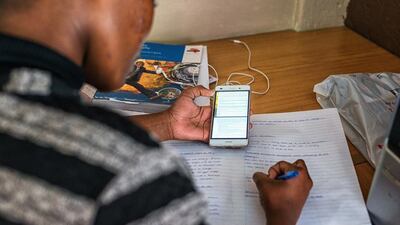
Eastern Cape, the biggest of South Africa’s provinces, now has 207 libraries in remote rural areas, where some do not even have electricity. Courtesy Yahsat -

One beneficiary of the satellite broadband coverage has been Carien De Villiers, a farm owner in the remote South Africa village of Thorndale, where she sells livestock to surrounding businesses and further afield. Courtesy Yahsat -

Above, Sandi du Toit, who is part of the Government Employees Pension Fund in Pretoria. Courtesy Yahsat -

Above, a South African Government Employees Pension Fund field operations team services pensioners in a remote location. Courtesy Yahsat -

The installation of very small aperture systems in remote South African villages could revolutionise education and change the lives of the children who live there. Courtesy Yahsat


“The delay is due to some unavoidable circumstances the manufacturer faced, but we are confident of meeting the new deadline,” Mr Cole said.
Yahsat is also looking to replace two existing satellites, Al Yah 1 and Al Yah 2, with two new satellites, Al Yah 4 and Al Yah 5, in 2026. The new satellites will initially operate alongside the older ones.
The government's focus on putting the UAE at the forefront of space exploration is expected to provide the company further opportunities.
Bayanat, a leading provider of AI-powered geospatial solutions, recently signed an agreement with Yahsat. The partnership is aimed at establishing and operating strategic earth observation within the UAE, including synthetic aperture radar (SAR) and optical imagery satellite capabilities.
The global market potential is estimated at $4 billion for optical and SAR data combined.
Through the procurement of the T4-NGS satellite, “we remain well positioned to meet the UAE government’s increasing need for advanced satellite communication solutions”, Mr Cole said.

