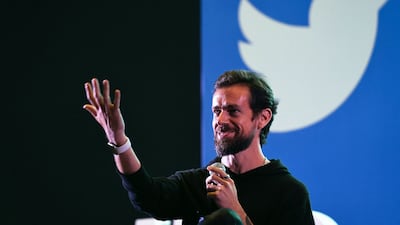
San Francisco-based Twitter fired about half of its staff after Elon Musk bought the company last month in a $44 billion deal. AFP

Twitter backtracks and asks some fired workers to return


  • English
  • Arabic

Twitter, after laying off roughly half the company on Friday following Elon Musk’s $44 billion acquisition, is now reaching out to dozens of employees who lost their jobs and asking them to return.

Some of those who are being asked to return were laid off by mistake, according to two sources.

Others were let go before management realised that their work and experience may be necessary to build the new features Mr Musk envisions, the sources said.

Twitter cut close to 3,700 people this week via email as a way to trim costs after Mr Musk’s acquisition, which closed in late October.

Many employees learnt they had lost their job after their access to company-wide systems, such as email and Slack, was suddenly suspended.

The requests for employees to return demonstrates how rushed and chaotic the process was.

A Twitter representative did not reply to a request for comment. Twitter’s plan to hire back workers was previously reported by Platformer.

“Regarding Twitter’s reduction in force, unfortunately there is no choice when the company is losing over $4M/day,” Musk tweeted on Friday.

Twitter has close to 3,700 employees remaining, according to the sources.

Mr Musk is pushing those who remain at the company to move quickly in shipping new features, and in some cases, employees have even slept at the office to meet new deadlines.

Twitter unveiled a new Twitter Blue subscription plan at the weekend, offering a verification check mark for any user who pays $8 a month.

The company also said it would soon be launching other features, including half the advertisements, the ability to post longer videos and get priority ranking in replies, mentions and searches.


Living in...

This article is part of a guide on where to live in the UAE. Our reporters will profile some of the country’s most desirable districts, provide an estimate of rental prices and introduce you to some of the residents who call each area home. 

What vitamins do we know are beneficial for living in the UAE

Vitamin D: Highly relevant in the UAE due to limited sun exposure; supports bone health, immunity and mood.Vitamin B12: Important for nerve health and energy production, especially for vegetarians, vegans and individuals with absorption issues.Iron: Useful only when deficiency or anaemia is confirmed; helps reduce fatigue and support immunity.Omega-3 (EPA/DHA): Supports heart health and reduces inflammation, especially for those who consume little fish.

Timeline

2012-2015

The company offers payments/bribes to win key contracts in the Middle East

May 2017

The UK SFO officially opens investigation into Petrofac’s use of agents, corruption, and potential bribery to secure contracts

September 2021

Petrofac pleads guilty to seven counts of failing to prevent bribery under the UK Bribery Act

October 2021

Court fines Petrofac £77 million for bribery. Former executive receives a two-year suspended sentence 

December 2024

Petrofac enters into comprehensive restructuring to strengthen the financial position of the group

May 2025

The High Court of England and Wales approves the company’s restructuring plan

July 2025

The Court of Appeal issues a judgment challenging parts of the restructuring plan

August 2025

Petrofac issues a business update to execute the restructuring and confirms it will appeal the Court of Appeal decision

October 2025

Petrofac loses a major TenneT offshore wind contract worth €13 billion. Holding company files for administration in the UK. Petrofac delisted from the London Stock Exchange

November 2025

180 Petrofac employees laid off in the UAE

Mercer, the investment consulting arm of US services company Marsh & McLennan, expects its wealth division to at least double its assets under management (AUM) in the Middle East as wealth in the region continues to grow despite economic headwinds, a company official said.

Mercer Wealth, which globally has $160 billion in AUM, plans to boost its AUM in the region to $2-$3bn in the next 2-3 years from the present $1bn, said Yasir AbuShaban, a Dubai-based principal with Mercer Wealth.

Within the next two to three years, we are looking at reaching $2 to $3 billion as a conservative estimate and we do see an opportunity to do so,” said Mr AbuShaban.

Mercer does not directly make investments, but allocates clients’ money they have discretion to, to professional asset managers. They also provide advice to clients.

“We have buying power. We can negotiate on their (client’s) behalf with asset managers to provide them lower fees than they otherwise would have to get on their own,” he added.

Mercer Wealth’s clients include sovereign wealth funds, family offices, and insurance companies among others.

From its office in Dubai, Mercer also looks after Africa, India and Turkey, where they also see opportunity for growth.

Wealth creation in Middle East and Africa (MEA) grew 8.5 per cent to $8.1 trillion last year from $7.5tn in 2015, higher than last year’s global average of 6 per cent and the second-highest growth in a region after Asia-Pacific which grew 9.9 per cent, according to consultancy Boston Consulting Group (BCG). In the region, where wealth grew just 1.9 per cent in 2015 compared with 2014, a pickup in oil prices has helped in wealth generation.

BCG is forecasting MEA wealth will rise to $12tn by 2021, growing at an annual average of 8 per cent.

Drivers of wealth generation in the region will be split evenly between new wealth creation and growth of performance of existing assets, according to BCG.

Another general trend in the region is clients’ looking for a comprehensive approach to investing, according to Mr AbuShaban.

“Institutional investors or some of the families are seeing a slowdown in the available capital they have to invest and in that sense they are looking at optimizing the way they manage their portfolios and making sure they are not investing haphazardly and different parts of their investment are working together,” said Mr AbuShaban.

Some clients also have a higher appetite for risk, given the low interest-rate environment that does not provide enough yield for some institutional investors. These clients are keen to invest in illiquid assets, such as private equity and infrastructure.

“What we have seen is a desire for higher returns in what has been a low-return environment specifically in various fixed income or bonds,” he said.

“In this environment, we have seen a de facto increase in the risk that clients are taking in things like illiquid investments, private equity investments, infrastructure and private debt, those kind of investments were higher illiquidity results in incrementally higher returns.”

The Abu Dhabi Investment Authority, one of the largest sovereign wealth funds, said in its 2016 report that has gradually increased its exposure in direct private equity and private credit transactions, mainly in Asian markets and especially in China and India. The authority’s private equity department focused on structured equities owing to “their defensive characteristics.”

Top%2010%20most%20competitive%20economies
%3Cp%3E1.%20Singapore%0D%3Cbr%3E2.%20Switzerland%0D%3Cbr%3E3.%20Denmark%0D%3Cbr%3E4.%20Ireland%0D%3Cbr%3E5.%20Hong%20Kong%0D%3Cbr%3E6.%20Sweden%0D%3Cbr%3E7.%20UAE%0D%3Cbr%3E8.%20Taiwan%0D%3Cbr%3E9.%20Netherlands%0D%3Cbr%3E10.%20Norway%0D%3Cbr%3E%3C%2Fp%3E%0A
Stormy seas

Weather warnings show that Storm Eunice is soon to make landfall. The videographer and I are scrambling to return to the other side of the Channel before it does. As we race to the port of Calais, I see miles of wire fencing topped with barbed wire all around it, a silent ‘Keep Out’ sign for those who, unlike us, aren’t lucky enough to have the right to move freely and safely across borders.

We set sail on a giant ferry whose length dwarfs the dinghies migrants use by nearly a 100 times. Despite the windy rain lashing at the portholes, we arrive safely in Dover; grateful but acutely aware of the miserable conditions the people we’ve left behind are in and of the privilege of choice. 

Stats at a glance:

Cost: 1.05 billion pounds (Dh 4.8 billion)

Number in service: 6

Complement 191 (space for up to 285)

Top speed: over 32 knots

Range: Over 7,000 nautical miles

Length 152.4 m

Displacement: 8,700 tonnes

Beam:   21.2 m

Draught: 7.4 m

Key findings of Jenkins report
  • Founder of the Muslim Brotherhood, Hassan al Banna, "accepted the political utility of violence"
  • Views of key Muslim Brotherhood ideologue, Sayyid Qutb, have “consistently been understood” as permitting “the use of extreme violence in the pursuit of the perfect Islamic society” and “never been institutionally disowned” by the movement.
  • Muslim Brotherhood at all levels has repeatedly defended Hamas attacks against Israel, including the use of suicide bombers and the killing of civilians.
  • Laying out the report in the House of Commons, David Cameron told MPs: "The main findings of the review support the conclusion that membership of, association with, or influence by the Muslim Brotherhood should be considered as a possible indicator of extremism."
Updated: November 07, 2022, 6:43 AM